2015: The Year We Finally Started to Care about Working Parents
 THE BUSINESS OF FAMILY LEAVE-Kirsten Calkins was about five months pregnant with her first child, working as an executive coordinator at a small nonprofit in Portsmouth, New Hampshire. Like many working parents in the U.S., she worried about how she’d manage having less money coming in while she cared for a new infant.
Her employer, the International Association of Privacy Professionals, offered four weeks fully paid leave, then five weeks at 60 percent pay and then, if you could swing it, an additional three weeks unpaid.
But Calkins was lucky to become pregnant in 2015: the year companies, particularly in tech, woke up and realized that you can’t strand workers facing huge personal challenges.
In January, IAPP -- which counts many tech companies as members -- started giving all its workers 12 weeks fully paid leave after the arrival of a new child.
“The level of excitement is hard to put into words,” Calkins told The Huffington Post. “Not having to juggle a life altering experience like having a baby with budgeting for a new expense with less income. It was like a weight was lifted.”
The U.S. is one of a handful of countries that offers mothers no paid maternity leave. It is the only developed country without a paid leave policy. The lack of support causes a significant percentage of working parents to fall into poverty. It puts the health of parents and infants at risk.
Finally, in 2015, policymakers and companies started to pay attention -- we may someday look back and see this past year as a tipping point in the movement toward paid leave for all.
A significant number of businesses -- from Adobe to Netflix to Microsoft to Goldman Sachs -- announced they would expand paid benefits for their employees. Twenty-one percent of companies surveyed by the Society for Human Resource Management were offering paid maternity leave in 2015, up from 16 percent in 2011.
And, for the first time a U.S. President got serious about paid parental leave and sick leave. “Today, we are the only advanced country on Earth that doesn’t guarantee paid sick leave or paid maternity leave to our workers,” Obama said in January’s State of the Union address. “And that forces too many parents to make [a] gut-wrenching choice.”
The Department of Labor started offering grants to states looking to study how paid family leave would work. Three states currently have paid family leave policies in place: California, Rhode Island and New Jersey -- where the policy is so popular that Republican governor Chris Christie never followed through on his promise to get rid of it when he was voted into office. Eighteen other states are considering paid leave initiatives.
Political candidates, on both sides of the aisle, now find they can no longer ignore the issue. Hillary Clinton called for paid leave in her first major economic speech as a presidential candidate this year. She’d never pushed for it as a senator. One Republican candidate, Marco Rubio, is calling for a company tax credit for offering paid leave.
Candidates who support paid leave, were eight percent more likely to win, according to projections from The National Partnership for Women & Families, cited in a New Republic piece earlier this year. In Connecticut, Dan Malloy is believed to have won the race for governor on the back of his support for paid sick leave.
“It’s kind of a new thing. We’ve always pushed to increase quality of life for our members, but the spotlight has fallen on leave,” Robert Daraio, a local representative of the News Guild of New York, told HuffPost. Daraio helped negotiate four months' paid parental leave for employees at the liberal magazine The Nation in December. “We’re pushing for this in all contracts going forward,” he said.
It seems almost daily a company issues a press release announcing more time for parents and caretakers.
“It was a good year,” said Ellen Bravo, the director of Family Values @ Work, a nonprofit coalition of groups pushing for paid parental and sick leave in the U.S.
Perhaps one of the most outspoken proponents of paid leave, Bravo said that family leave came to prominence thanks to a spiral of factors -- most notably the Obama administration, as well as the many states and municipalities taking action on this. She credits “millennials,” -- young adults -- who are demanding employers give them paid time off to care for children and family members.
Some companies have always had this benefit, Bravo said. “The interest in making announcements public is what’s new. Part of that comes from their desire to say to millennials come here, we’re paying attention to this.”
In the business sector, tech companies fell over themselves in 2015 offering more generous benefits. When Netflix this summer announced it would offer 12 months of leave to new parents, regardless of gender, the news was widely picked up and a flurry of other companies raced to improve their offerings -- including Microsoft and Amazon.
Facebook founder Mark Zuckerberg is right now taking a highly publicized paternity leave that Bravo said set a great example for fathers, who are seen as a crucial part of the paid leave movement.
Banks got in on the trend, too. Private equity shop KKR and Credit Suisse both beefed up their offerings for parents this year.
“We knew it started in tech, but then we started seeing businesses in financial services and banking, which are typically conservative, saying we need to do this, too,” said Melinda Figely, who consults on human resource issues as a vice-president at NFP, an insurance brokerage with clients in banking. "As employers adopt it what they see is people actually come back to work in higher numbers and they're happier and less stressed."
One thing critical about the new momentum on leave: It's not just for birth mothers, but for adoptive parents, for fathers, and for those who need time off to take care of loved ones. Paid parental leave -- not "maternity" leave -- is the hot new thing for companies, Figely said.
The change stems from the country's opening up to gay couples in recent years and people of various gender identities, Figely said. "The barriers are coming down and people aren't so narrow in their thinking that there's one kind of family or only one way to do maternity leave."
Yet for all the positive momentum on leave, the data still looks bleak. An overwhelming majority of employers don’t offer paid leave. Most states don’t offer paid leave. The U.S. unpaid leave law -- the Family and Medical Leave Act -- only covers 60 percent of workers.
About nine percent of workers who take time off to care for a family member end up on public assistance, according to Labor Department data cited by The New Republic. The Family Act, a bill sponsored by Sen. Kirsten Gillibrand (D-NY) and Rep. Rosa DeLauro (D – Conn.) that would pay for federally mandated leave by taking a few cents out of employee paychecks, is stalled out.
“We haven’t yet reached a polio moment or a moonshot moment where the country comes together and says we can’t let this go on anymore,” Bravo said. “The good news is we don’t need a vaccine. We know the solution. It’s a social insurance fund that can make this possible.”
Bravo hopes that by 2020, the U.S. will make this happen. “We need to do it.”
(Emily Peck is Executive Business & Technology Editor of The Huffington Post where this piece was originally posted.) CSA Images via Getty Images. Prepped for CityWatch by Linda Abrams.
-cw
CityWatch
Vol 13 Issue 105
Pub: Dec 29, 2015





 Dishing out planning and zoning exceptions to super-sized projects allows us to be modern, to no longer be stuck in the past. Really? If we have learned anything from the recently concluded Paris climate summit, it is that modernity means dealing with climate change, not thumbing our nose at it through zoning approvals that allow mega-project after mega-project to proceed despite their unmitigatable levels of Green House Gases.


 CORRUPTION WATCH--I fear that today's shocking revelation in the
  MOM’S POV--News junkie that I am, I was awakened by a 6 am push feed notification from the Washington Post. LAUSD schools would be closed due to a threat received by a school board member. As of Tuesday afternoon, the threat appears to have been some sort of hoax, per Rep. Adam Schiff (D-Burbank) who serves on the House Intelligence committee.
  DEVELOPMENT POLITICS-Politics is local but Los Angelenos are sick and tired of seeing local interests steamrolled by downtown powerbrokers willing to do whatever it takes to achieve City Hall cooperation.


 LATINO PERSPECTIVE--‘Circus Disco’ the 40 year old Hollywood nightclub that was founded decades ago to welcome Latinos and men of color who were shunned at other gay nightspots, is now being considered for demolition to make way for a multi-million dollar, mega mixed-use development project that would include 695 residential units and 1,391 parking spaces on the almost 6-acre site. (Photo: proposed Lexington)
  I agree with those who say that Circus Disco has an important historical and cultural significance to the Los Angeles LGBT Latino Community; but for Ocampo to say that demolishing Circus Disco would erase gay Latino history
  BILLBOARD WATCH--Students coming to Animo Venice Charter High school by bus from areas like Inglewood and South LA get off at a stop on Venice Blvd. and walk a half mile north on Lincoln Blvd. to the school campus. One a recent school day, this is what they’d have seen on their way to morning classes.
 The First Amendment’s free speech guarantee means that billboards on private property are free to display almost anything in ads, no matter how distasteful, harmful, or otherwise antithetical to a community’s physical and mental health. Fortunately, cities are also allowed to limit the number of billboards, or even prohibit them altogether, and many have done so.
 ACTION ALERT-The future of land use and development in our city gets down to a choice: do we want a horizontal city, mimicking what we know -- the low slung buildings and sometimes NIMBY attitude toward development. Or do we want a vertical landscape, where towers triumph? Strong cases can be made for both, each with its pros and cons.
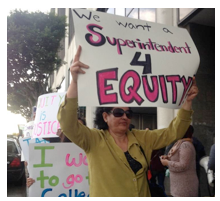 EDUCATION POLITICS-It’s decision time at LAUSD. With the end-of-year departure of Superintendent Ramon Cortines, LAUSD has some decisions to make. What are LAUSD’s policy goals for the next few years? Who is the leader to help LAUSD meet those goals?
  “At times, I lost over two weeks of learning in important classes like History and Algebra,” Haslem said. “When my counselors finally placed me in the right classes, I had to work extra hard to catch up, to make sure that I could still be college-ready. This is not fair! Why do black and brown students need to work harder to be college-ready when adults are the ones making the mistakes?”
  MILLENNIAL PERSPECTIVE--Watching condos overrun my hometown, I began to ponder my own gentrifying impact as a temporary resident of South Los Angeles. Each year, tens of thousands of students flood into the poor, gang-ridden area of South LA to attend the University of Southern California (USC).
  ANIMAL WATCH-