
QUID PRO NO
MY VIEW - Quid pro quo: Latin for “this for that.” English for “bribe.” In Assemblymember Schiavo-speak: quid pro no—“No more assistance for you.”
Representative government is simple: constituents ask elected officials for help, and voters judge them by the response. That is not a quid pro quo.
But after months of seeking meaningful help from Assemblymember Pilar Schiavo’s office, Sherwood Forest residents were accused of a quid pro quo—and effectively handed a quid pro no.
Sherwood Forest is a San Fernando Valley neighborhood of large properties, mature trees, winding streets and an equestrian heritage. Residents bought into more than houses; they relied on zoning, community plans and the expectation that the neighborhood would remain fundamentally single-family.
Then California changed the rules.
Among the laws changing residential development were SB 684 and its successor, SB 1123, which expanded a streamlined, ministerial (no public hearing) subdivision framework to qualifying vacant parcels zoned for single-family residential use.
Pilar Schiavo voted yes on both.
For Sherwood Forest, this wasn’t an academic debate about California’s housing crisis. Residents were watching their neighborhood redevelop in front of them.
It used to be that a developer might renovate and flip one of Sherwood Forest’s estate homes. Now state housing laws have dramatically changed what can be done on qualifying properties—and how much say neighbors get.
California has created what increasingly looks like an all-you-can-eat buffet of housing laws for developers. Sherwood Forest was discovering what that meant in real time.
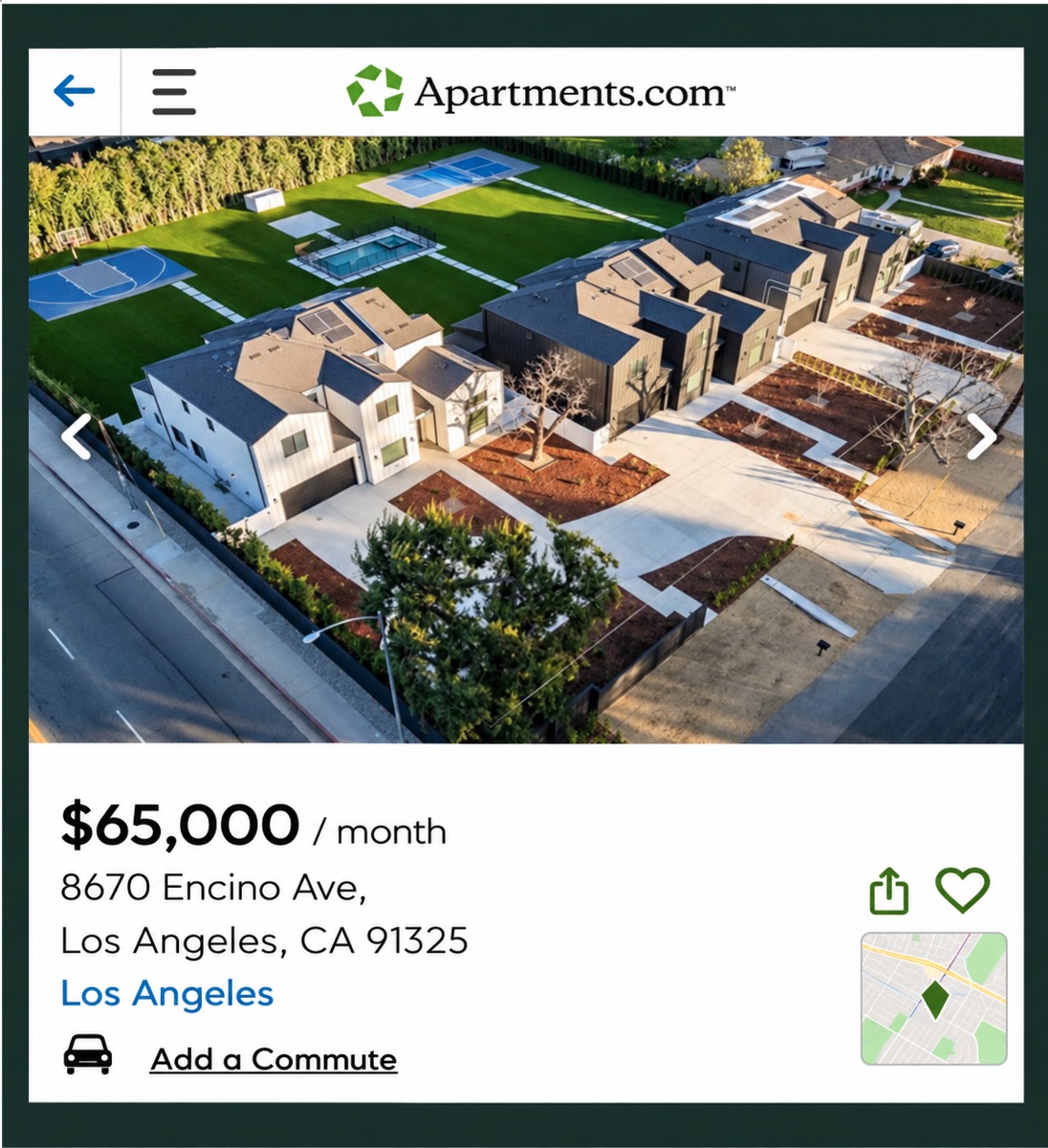
Developer Lior Mandelbaum had already redeveloped property in the neighborhood. At 8670 Encino Avenue, a newly built three-home compound with more than 10,000 square feet and 15 bedrooms was advertised for rent at $65,000 a month.
At 17545 Parthenia Street stood a single-family residence. It was demolished and finaled in March 2026; within weeks came subdivision applications. One of the City’s own Planning cases describes the proposal as a “STARTER HOME SB 1123 SUBDIVISION.”
Starter homes. Those are the City’s words.
The chronology caught residents’ attention because SB 1123 expanded streamlined subdivision to qualifying vacant single-family parcels. This property became vacant: there was a house, it was demolished, and weeks later came an SB 1123 application.
That does not establish a violation. But it explains why neighbors started asking questions—and why they went to a legislator who voted for the law.
The Sherwood Forest Coalition studied the laws, organized and sought a legislative solution. Members even prepared proposed legislative language for Schiavo to consider. They wanted something concrete.
Coalition members say Schiavo’s office repeatedly pointed them toward Councilmember John Lee’s office, while Lee’s office pointed them back toward Schiavo. Back and forth it went, with the coalition stuck in the middle while the development they were fighting kept moving forward.
Then came June 11.
Schiavo was not at the June 11 meeting; her representative, Julia Estrada, was. Coalition members say that near the end someone said, in substance, that if the community could not get meaningful help, they could not vote for Schiavo.
There is no recording, so I cannot quote the participant verbatim. But what was reportedly said and what it would later be called are very different things.
An elected official should never say, “Give me your vote and I’ll give you an official act.” But voters may say the reverse: “Do your job—or you may not get my vote.”
That is a constituent reminding an elected official who she works for.
Less than two weeks later, Estrada sent an email titled “Office of Asm. Pilar Schiavo: Update On June 11th Sherwood Forest Meeting Inquiry.”
“Our team is currently consulting with Assembly Legislative Ethics Committee legal counsel regarding the June 11th Sherwood Forest community meeting and will provide a written response soon.”
Silly constituents.
Coalition members say they initially took the email as a sign that their Assemblymember’s office was working on their behalf.
They later learned the legal consultation concerned what had been said at their meeting. What emerged was not a legislative solution.
It was Schiavo’s quid pro no.
Nearly seven weeks after Estrada’s email—and more than two months after the meeting—a letter from Schiavo arrived.
It landed like a poke in the eye.
Schiavo wrote that she had been “made aware” that at the June 11 meeting “statements were made to the effect of requesting action in my official capacity as an Assemblymember in return for support or opposition in a political campaign.”
“I view this as a quid pro quo.”
The accusation was stunning. Among the community members swept into it were two attorneys and the daughter of a former member of the United States Congress, along with longtime homeowners and other respected members of the community. These weren’t political operatives trying to buy an official act. They were constituents trying to save their neighborhood.
Read Schiavo’s words carefully.
She was not at the meeting. Her letter says she was “made aware,” offers no direct quote and says statements were made “to the effect of.” Then comes her conclusion: “I view this as a quid pro quo.”
Did Assembly Ethics counsel characterize what happened as a quid pro quo, or did Schiavo?
On August 26, I filed a Legislative Open Records Act request for records of that consultation—what was reported, who participated, how the exchange was characterized and what advice resulted. Assembly Rules acknowledged it. As of this writing, the substantive records have not been produced.
Schiavo’s letter also changed the relationship.
“Do not hesitate to email my office in the future,” Schiavo wrote. “However, my staff will not be joining future meetings arranged by this group outside of Neighborhood Council meetings on this issue.”
But Schiavo’s quid pro no did not stay with the people who had been at the June 11 meeting.
It traveled.
Attorney Christopher Le Gras received his own August 13 letter accusing him of conduct arising from the June 11 meeting.
There was a fundamental problem:
He was not there.
Le Gras responded: “Your letter accuses me of actions I never took at a meeting I didn’t attend.” Le Gras also wrote that the letter was copied to the entire Neighborhood Council board—including people he said were not at the meeting or involved in the conversations.
He disputed the accusation, cited legal authority and demanded a retraction and apology. Coalition members say he received no substantive response.
Coalition members believe the wider circulation could damage their reputations and alienate them from the community. They heard another message in it: push too hard, demand too much, and you may find yourself on the outside looking in.
Whether Schiavo intended that message, I cannot say. It is the message these constituents say they received.
And it leaves an obvious question: How did a man who was not at the meeting end up accused of what supposedly happened there—and who else received a letter?
Schiavo also directed future requests for Council action back to Councilmember John Lee.
The political game of monkey in the middle had come full circle.
By this point, it is difficult not to wonder whether the alleged quid pro quo had become a convenient reason to stop dealing with constituents who would not go away.
Schiavo still has questions to answer: What exactly was reported to Assembly Ethics counsel, and by whom? Did Assembly Ethics counsel call this a quid pro quo, or did Schiavo? What happened during the nearly seven weeks before the August 13 letter? How did Le Gras, who was not at the meeting, receive the same letter? Who else received letters or copies, and why? Why did Schiavo end future coalition-arranged meetings outside Neighborhood Council meetings?
And for Sherwood Forest: knowing how SB 1123 is landing here, would Schiavo vote for it again? Would she support corrective legislation and meaningful public participation? Will she sit down with the coalition again?
I sent those questions directly to Schiavo and Estrada on September 5, giving the Assemblymember an opportunity to respond before publication.
As of this writing, neither Schiavo nor her office has responded—or even acknowledged the inquiry.
Quid pro quo? Quid pro no? How about no vote for you.
The political consequences may already be showing.
I am in contact with hundreds of Valley residents, and I am hearing something that should make any incumbent read the room: voters talking openly about crossing party lines.
They are not necessarily convinced that another Assemblymember can simply walk into Sacramento and undo what has already been done. Their reasoning is considerably simpler:
He didn’t give us this problem.
Enter Rickey Hayes
I put housing questions to Schiavo’s Republican challenger, Rickey Hayes.
He answered them.
Hayes, who describes himself as a builder and master tradesman, didn’t mince words: “Sacramento isn’t building; they are bulldozing.” He called the state’s approach “a broad sword to what needed a scalpel” and said suburban communities have become its victims.
On public participation, Hayes was equally direct:
“Folks who spent 30 years paying off a mortgage deserve a seat at the table. A public hearing isn’t ‘red tape’—it’s basic respect.”
He said he would fight to repeal portions of SB 9 and newer fast-tracking mandates that strip authority from local governments and homeowners. For additional housing, Hayes pointed instead to commercial corridors, adaptive reuse and transit hubs—places, he argued, that can accommodate density without dismantling established single-family neighborhoods.
He also took aim at something residents across the Valley have been asking: If developers receive extraordinary benefits to bypass ordinary zoning and local review, why shouldn’t the housing they produce actually be affordable?
“Right now,” Hayes wrote, “Sacramento is just handing out free passes for developers to build market-rate complexes, line their pockets, and call it ‘affordable.’”
Whether Hayes could deliver on any of those promises in Sacramento remains to be seen. That is for voters to judge.
But there is a contrast that is difficult to miss.
Hayes didn’t give Sherwood Forest the laws it is now fighting. And when I asked him where he stood, he answered.
Sherwood Forest residents asked their representative to help change a law. When dissatisfied, one reportedly invoked the power every voter possesses: the power not to vote for her.
That isn’t a bribe. That’s political reality.
The residents didn’t disappear.
Their seat at the table did.
Quid pro quo?
I have looked for the “this” and the “that.”
They’re not there.
What is considerably easier to find is the NO.
QUID PRO NO
(Eva Amar is a West San Fernando Valley community organizer, contributor to CityWatch Los Angeles, and National Sexual Assault Victim Advocate.)