
Comments
GELFAND’S. WORLD - The following conversation was reported to me by a person who grew up in a previous generation. It was around 1964 and occurred at some alumni event for Stanford held down here in the south bay. A professor who was expert on international relations was asked about the (at that time) slightly accelerating conflict in southeast Asia. The professor’s response: “We can’t win, and we can’t get out. We’re stuck there.”
Of course we weren’t literally or physically stuck there. We were just stuck in what would have been an embarrassing position -- ceding the territory to the communist North Vietnamese government. There was pride involved and the likelihood of political damage to Lyndon Johnson should we retreat.
So there we were, “stuck” in Viet Nam, American boys getting drafted in increasing numbers, and a conflict that was to go on for another 8 years. It was only when the U.S. government was willing to accept a surrender under the guise of a tie that we finally left. And we left with 58,000 dead, lots more wounded, and an awful lot of veterans who suffered from what we now call PTSD.
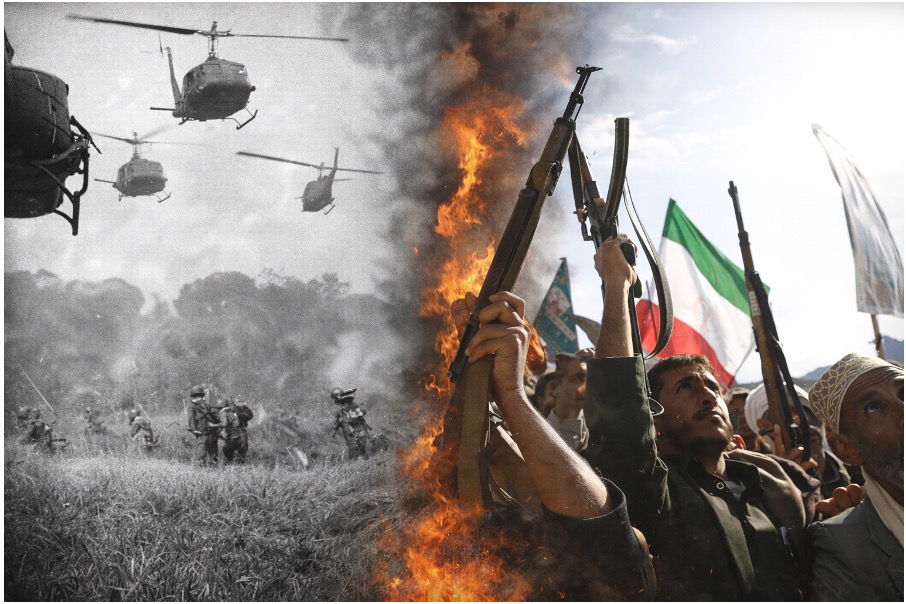
I bring this up not to pretend that our current situation along the shores of Iran is the same, but to point out that it is momentarily different. But there is a concern, and it is that we could create a situation which drags on and on, this time with serious worldwide economic damage as the consequence. The comparison that some writers use with the Viet Nam War is camouflaged in the word “Quagmire.”
And the definition of quagmire is, roughly speaking, that original comment by the learned professor way back then: We can’t win it and we can’t get out of it. We’re stuck. It’s like being lost in a swamp and up to your knees in quicksand. That’s because American control of the Strait of Hormuz would require a major military operation and continuing occupation by large numbers of troops.
One digression. The underlying strategy that got us into Viet Nam was known as “containment,” and went back to the late 1940s. It was based on the observation that between the end of WWII and the early 1950s, communism in its various forms had taken over much of eastern Europe and the bulk of Asia. There were a few Asian countries remaining as something other than communist, such as Thailand, Japan, Taiwan, and yes, South Viet Nam. There was even a game-board analogy for the spread of communism from one border to the next. It was called the “Domino Effect.” So the strategy of containment butted its head up against a situation in Viet Nam where the great mass of people were opposed to continuing colonialist control and were willing to fight for their independence.
There are a couple of additional points about this strategy and how it compares to our present situation. The first point is that the strategy itself was fairly straightforward. Containment was the aim, and – in spite of the loss in Viet Nam, it eventually succeeded. The other point is that, as much as the youth of America resented the national leadership, there were smart and ostensibly capable people put in charge of the government and the armed forces. (LBJ already had plenty of ego and didn’t need the kind of slavish devotion that the current president craves.) The LBJ cabinet got it terribly wrong at the start, but they and the rest of the country eventually figured out that we needed to make a turn.
Now consider the Iran question. There are a couple of major historical differences from that other quagmire. The first is that there are really two separate Iran questions. One is the danger of Iran developing nuclear weapons. This has been an American concern for quite a while now, and it doesn’t look like we are any closer to a permanent solution than we were under Obama. If anything, we (along with Russia) have created a pro-nuclear motivation by showing the world that the failure to own nuclear weapons puts you at risk from, respectfully, the Russians or the U.S. Just ask Ukraine or Iran.
The other strategic question is the control of and accessibility to petroleum. Trump complicates this unnecessarily by his hostility to the slow conversion to non-petroleum sustainable energy sources such as wind and solar. But even taking into account Trump’s schizoid approach to the petroleum economy, it is a definite issue in the current conflict. It is also a reason for people to use the word Quagmire with respect to the Iranian situation. Even if we were to settle our issues with respect to oil, there would continue to be a problem in terms of the nuclear threat – we would never really know for sure what the future holds, short of an armed occupation of the whole country which would itself require something on the order of a million troops. We’re not going to go there, so – although it is a different sort of quagmire – it is a quagmire just the same. It’s just a quagmire involving unending worry, competing military intelligence efforts, and ever-rising costs in a middle eastern arms race.
Here is where those conflicting aims – nuclear control vs. oil access – come into play. The first requires some kind of continuing hostility in the relationship, essentially making Uncle Sam into the policeman and arms control agency for the middle east. The second requires a cooperative commercial relationship which implies negotiations between equals. They are different ends and require different means to accomplish.
And meanwhile, the Trump administration has created a situation which, as far as the oil goal is concerned, is about as bad as one could have imagined, short of all out regional war. And that’s because we have – just in the past month – given the Iranian government the excuse to assert their own control over the Strait of Hormuz and along with that, the broad control over shipping through and out of the Persian Gulf. As so many observers have now pointed out, one possible outcome is that Iran will end up in complete control of the Strait to the point that it will enjoy putting a monetary toll on all the oil that flows through that area. This would of course damage the world economy through increasing the world price of oil.
One other point. This is where a realistic view of what has happened – and who has actually benefitted – begins to overlap with a kind of realistic paranoia. In the past few days, the Russians have gained in their ability to sell oil, even as the United States has been humiliated in terms of its inability to defend the freedom of the oceans. On the net, the Russians have gained and the United States has suffered, and all due to the actions of the elected President of the United States. It’s “Russia, Russia, Russia” all over again.
Finally, at a point well into the second year of Trump’s second term, we are developing a pretty good idea of what all those threats by Trump actually mean. Consider, for the moment, the attacks on Venezuela and Iran. They came as surprises, unannounced and unthreatened. Oh, there were lots of comments by Trump in the preceding weeks and months, but not unlike threats against most other countries we deal with. The take-home lesson would appear to be that you can ignore Trump’s threats, but the world has to worry about unthreatened military surprises.
(Bob Gelfand writes on science, culture, and politics for CityWatch. He can be reached at [email protected])