

Developers Feast at the All-You-Can-Eat Legislative Buffet
HOUSING & DEVELOPMENT - Sacramento sets the table. Los Angeles serves dessert. If you are a developer, why wouldn’t you build in Los Angeles? Environmental review? Never mind. Public hearing? Never mind Joe Public. Even when he gets to speak, we’ll give him sixty seconds to explain what the project might do to his neighborhood.
Then—ding! Microphone cut. On to the next complainer. Developers, wear your all-you-can-eat pants.
Need more density? Parking getting in the way? Setbacks? Height? Open space? Waivers. Concessions. Incentives. Density bonuses. Deviations. Sacramento stocks the buffet. Los Angeles keeps the plates warm. Community opposition? Sorry. That’s not on the menu.
Think you’ll have better luck on appeal? Another sixty seconds. Then—ding! Time’s up again. Consider the City Planning Commission the dessert cart. They’ll put the cherry on the sundae.
But wait. It gets sweeter. Guess who picks up the check? You guessed it. Joe Public.
The Legislature writes the rules; local offices administer them. Constituents live with the consequences. Ask for help, and you may discover Quid Pro NO. As I reported, Assemblymember Pilar Schiavo accused Sherwood Forest constituents of a quid pro quo and said her staff would no longer attend the coalition’s meetings on the issue outside Neighborhood Council meetings.
These aren’t dots on a zoning map. They’re people’s homes, retirement savings, streets, schools, evacuation routes and neighborhoods. They aren’t fighting for sport. They’re fighting for their survival.
I stopped asking only how these projects were getting approved and started asking why. Why nearly 400 housing units on the Woodland Hills Country Club in a Very High Fire Hazard Severity Zone, surrounded in part by narrow, winding streets? In California, fires and earthquakes are a matter of when, not if.
Then came Del Moreno. How do you get from a single-family house across from Taft High School to a proposed 71-unit assisted-living facility with zero parking? I asked Councilmember Bob Blumenfield’s office to explain it. To their credit, they tried.
Getting to the bottom of Del Moreno became an exercise in legislative archaeology: state law over city law, density-bonus provisions over zoning, waivers over development standards. Every answer revealed another layer. You almost expect City Planning to say: Just kidding. Except the project, zero parking, fire concerns and people living next door are real.
Why is California so hungry for development? We’re told these laws address a housing crisis. But the crisis staring me in the face is affordability—for extremely low- and very-low-income Californians, working families being priced out and people without homes.
If affordability is the emergency, why isn’t affordability the price of admission? California grants extraordinary development benefits—streamlined approvals, density, reduced parking, concessions, waivers and diminished local discretion—and even changes to zoning—without necessarily requiring predominantly affordable housing.
So I started looking at what else accelerated development was being asked to accomplish.
Governor Gavin Newsom supplied part of the answer. Unveiling his May 2025 streamlining proposal, he declared: “We’re done with barriers. Let’s get this built.” His administration described the policies as “advancing policies that create jobs, attract private investment, and accelerate housing and economic development.” Sacramento was also selling development as economic policy.
The Legislative Analyst’s Office reported that the Newsom administration estimated an $18.5 billion operating deficit for 2026-27. Construction creates an economic burst. But eventually the building is finished. The crane comes down. The workers move on. To get another burst, you need something else to build.
Enter redevelopment. Sacramento cannot create another acre of California, but it can allow more development on occupied land. One house becomes several; several become an apartment building. And when the easy opportunities are gone? Does today’s nine-story building become tomorrow’s “underutilized” parcel?
There is another problem: capacity. Roads, sewers, water, electrical infrastructure and emergency services have limits. An evacuation route can move only so many people when everyone needs to leave at once. California can pass a law allowing more density. It cannot pass a law making a two-lane evacuation route four lanes wide.
Consider a thought experiment: how much additional housing construction would generate enough General Fund revenue to offset an $18.5 billion operating deficit? This is neither a forecast nor a claim that California enacted housing laws to erase the deficit. Assume $500,000 in development and construction activity per unit, and generously assume 5 percent reaches the General Fund through income, corporate, sales and use taxes and related revenues.
Producing $18.5 billion would require $370 billion in additional construction activity. At $500,000 per unit: 740,000 housing units. In one year. California authorized 103,856 housing units by permit in 2025. Permits aren’t completed homes; this is simply a benchmark for scale. Our hypothetical would require housing production equivalent to more than seven times that permit volume.
And that’s the generous calculation. At 4 percent: approximately 925,000 units. At 3 percent: 1.23 million. At 2 percent: 1.85 million. In one year.
That isn’t an economic plan. That’s a mathematical absurdity.
Even if California somehow produced 740,000 units, the construction ends. If a comparable fiscal gap remains the following year, what do we do? Another 740,000? Three years: roughly 2.2 million units. Five years: 3.7 million. Ten years: 7.4 million. And that doesn’t account for the infrastructure and evacuation capacity needed to support growth on that scale.
You cannot streamline or density-bonus your way out of a structural deficit. Temporary construction cycles cannot substitute for durable, recurring economic activity.
The exercise exposes the limits of treating accelerated construction as an economic strategy. What happens to neighborhoods, infrastructure and public safety if growth outpaces capacity?
There has to be another way. Build a durable productive economy. Housing and construction are necessary. But they cannot substitute for industries that produce again tomorrow—batteries, semiconductors, medical devices, aerospace, grid equipment, water technology and advanced manufacturing—creating recurring jobs and economic activity. Give businesses a reason to build things in California—not merely buildings.
California already has pieces of this strategy. Expand California Competes. California has “Made in California.” Put some meat on the bones. Tie incentives to financing, workforce development, exports, infrastructure and investment.
Stop rezoning neighborhoods. Prepare appropriate industrial and commercial sites with power, water, transportation, broadband and coordinated permitting. If Sacramento can streamline an apartment building, surely it can streamline a factory.
Then give businesses a reason to remain. Pay Them to Stay. Tie incentives to jobs, investment, production and reinvestment. And California itself is a customer. Where legally permissible and fiscally responsible, use procurement to support manufacturers investing and employing Californians here.
Make California Customer Number One. Build it here. Make it here. Buy it here. Stay here. Until legislators close down the buffet and build a durable economic model, look at what is happening to the house next door.
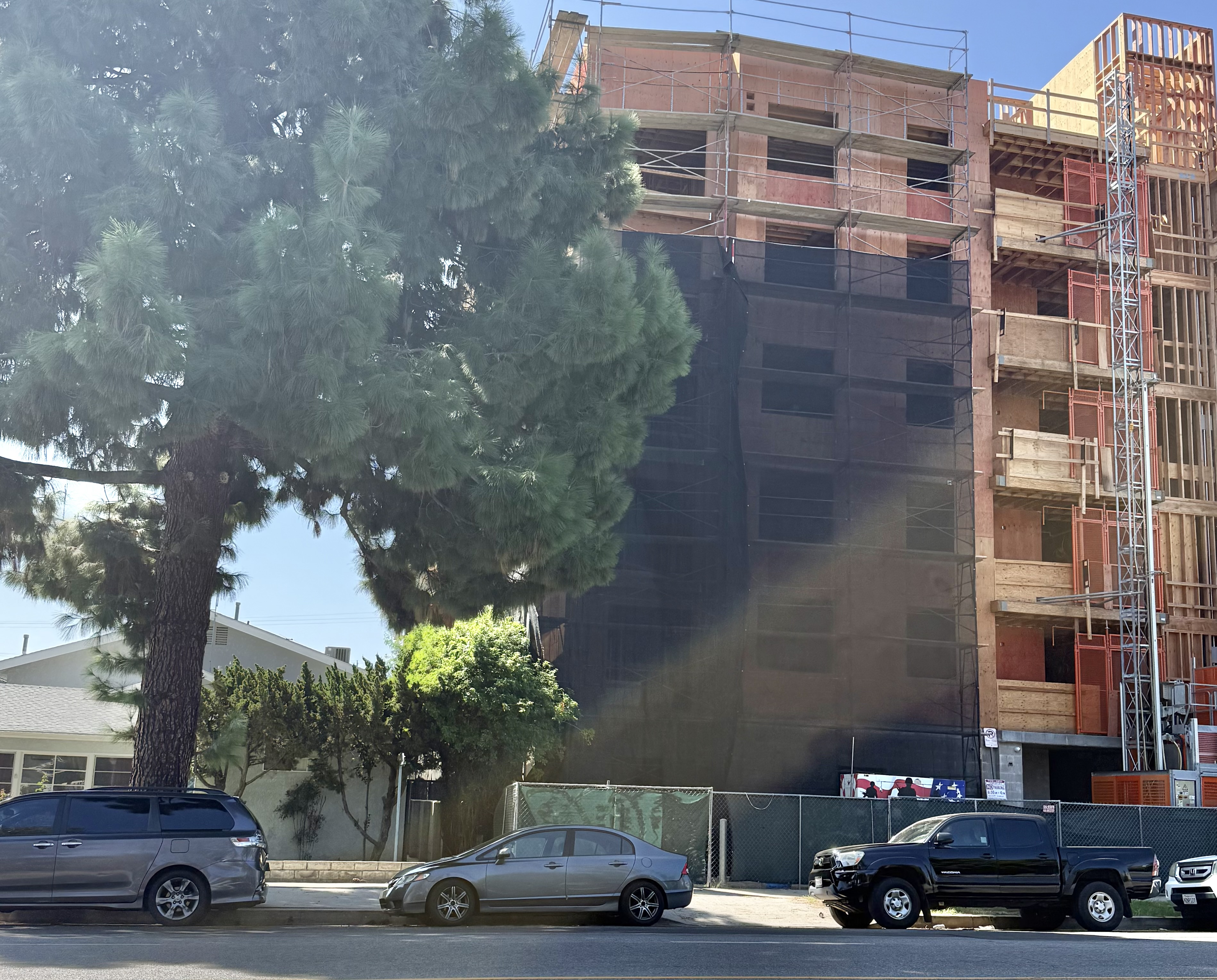
There’s the house next door, with six stories of development towering over it without so much as one parking space. Thank you, Sacramento. Hope you enjoy the buffet.
My father once said, “If you bite off more than you can chew, you’ll choke.”
(Eva Amar is a West San Fernando Valley community organizer, contributor to CityWatch Los Angeles, and National Sexual Assault Victims Advocate.)