
They Once Taught About A Hero. Now Faculty Rethink César Chávez Lessons After Allegations
CAL MATTERS - Some faculty have dedicated their careers to researching César Chávez’s life, legacy and labor movement leadership. Following the New York Times’ investigation that revealed a long pattern of Chávez sexually abusing women and girls, college faculty across California are evaluating their research and curriculum about California’s farmworker movements.
Welcome to CalMatters, the only nonprofit newsroom devoted solely to covering issues that affect all Californians. Sign up for WhatMatters to receive the latest news and commentary on the most important issues in the Golden State.
The same day The New York Times published its investigation of labor rights leader César Chávez’s alleged actions of sexual abuse, Bakersfield College professor Oliver Rosales was scheduled to teach his class, History of Chicanos in the Southwest. His planned lecture happened to be on the farmworker movement.
But on that day in March, he swapped out a reading on the Delano Grape Strike for The Times investigation, including a testimony by Dolores Huerta, co-founder of the United Farm Workers, who revealed that Chávez raped her on two seperate occasions. The Times investigation also revealed a pattern of Chávez sexually abusing women and girls who were a part of the UFW.
“Some students used words like ‘shock,’ ‘devastating,’ ‘gut wrenching,’ ‘soul shaking,’” Rosales said. “I was glad that it’d be in that moment with students at that time. I wouldn’t want to be anywhere else in the world, if you will, when that story broke.”
As a historian who has studied and taught about the farmworker movement for years, Rosales, along with many other scholars, was just as shocked. Now, college faculty across California are evaluating the research and teaching approaches they will take when it comes to California’s farmworker movements.
“I was in a text chain with different professors from across the country, and we were just in shock, because no historian knew about this,” Rosales said. “This definitely feels like a second, social death.”
Chávez died at the age of 66 in 1993, leaving a legacy that has grown in California history. Over 130 public spaces and monuments have been named after Chávez nationally. In California, over 65 streets, schools and parks carried his name. Since 2000, the state recognized his birthday as a state holiday.
Higher education institutions immediately responded to the allegations against Chávez by renaming and removing public markers. Now California faculty are navigating what it means to teach and research figures like Chávez and finding ways to broaden farmworker history beyond one leader.
How schools initially reacted
State lawmakers swiftly renamed César Chávez Day to Farmworkers Day in March. California universities also quickly renamed or removed monuments and buildings commemorating Chávez.
At both Fresno State and Cal State San Marcos, statues of Chávez were covered and removed within two days of The Times story publishing.
At San Joaquin Delta College, a ceramic relief and plaque memorializing Chávez was replaced with a mural honoring farmworkers painted by Delta College students. UC Berkeley removed Chávez’s name from a student center. UCLA’s department of Chicano Studies removed Chávez from its name.
While some suggested replacing Chávez’s name with Huerta’s, faculty are instead advocating for an approach that is more deliberate, and can commemorate the collective rather than one leader.
“If Dolores Huerta’s name comes up, I want it to go up based on her own achievements and merits, not based on reaction to allegations against César Chávez,” said Lorena Oropeza, professor of Chicanx Latinx Studies at UC Berkeley.
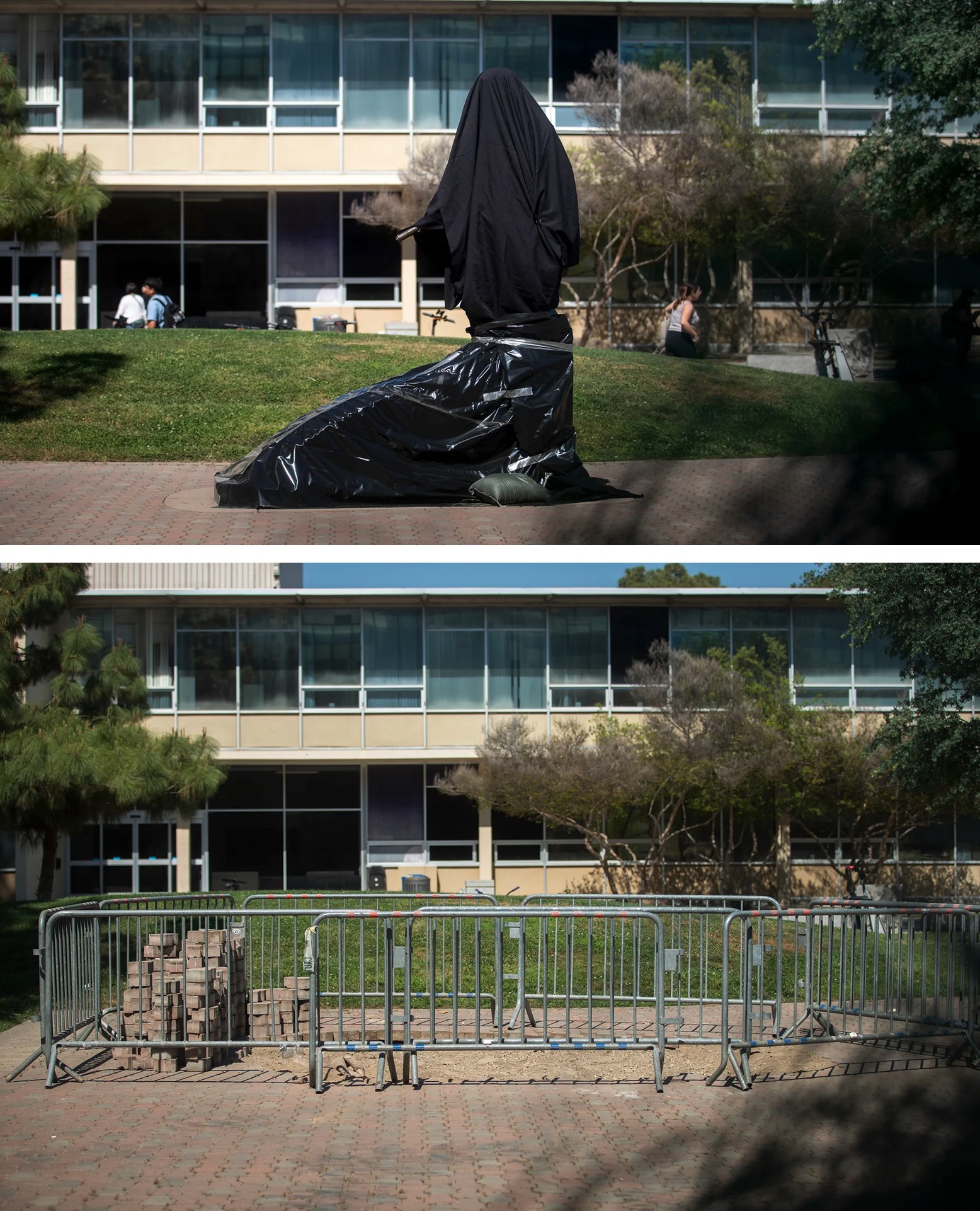 First: A statue of César Chávez is covered with black fabric and a plastic tarp at the Fresno State Peace Garden in Fresno on March 18, 2026. Last: A pile of bricks and guard rails surround the area where the César Chávez statue stood before it was removed from the Fresno State Peace Garden on March 20, 2026. Photos by Larry Valenzuela, CalMatters
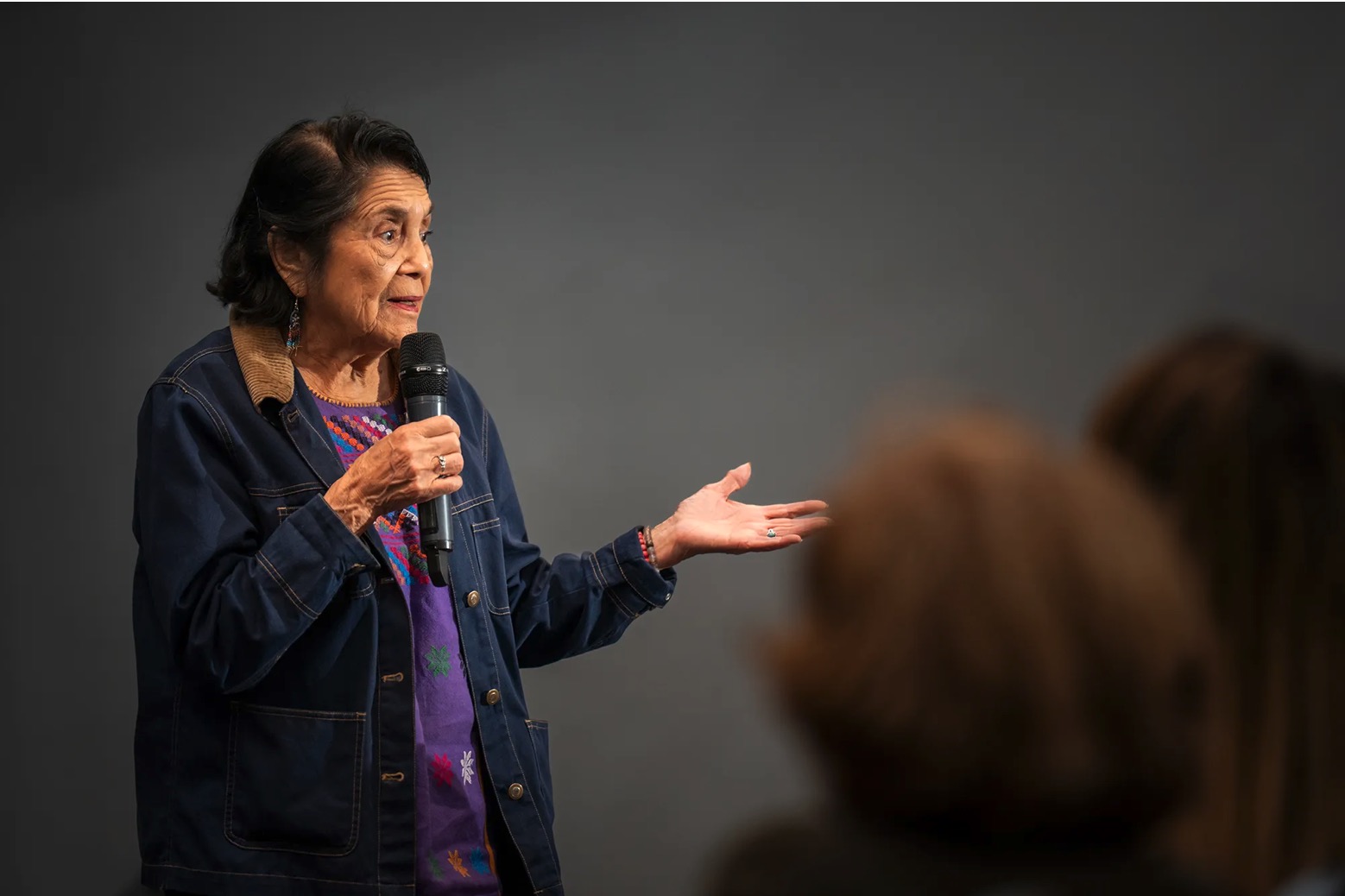
Dolores Huerta speaks at the CalMatters event “Farmworker Health: How Can California Protect its Essential Workers?” in Bakersfield on Feb. 22, 2024. Photo by Jules Hotz for CalMatters
Campuses are also grappling with changes to curriculum involving Chávez. At Bakersfield College, some faculty advocated for the immediate elimination of the César Chávez Leadership Certificate, a program that teaches students about community organizing through the history of Chávez’s legacy in the farmworker movement in the southern San Joaquin Valley.
Rosales, who created the certificate program, said that any changes to curriculum should be deliberated and thought through, rather than just removed. While no faculty has yet made a motion to the Academic Senate for changes, he said he and department colleagues support any name change going through the senate process.
“If you actually look at the curriculum, it’s exactly the curriculum that we need, because it basically broadens the history beyond the UFW,” Rosales said.