
Dear Los Angeles Leaders: When Will You Tell Us the Truth?
iAUDIT! - On June 30, the US Postal Service announced it was permanently closing its office in Skid Row, after having shuttered it in January. USPS cited ongoing vandalism and crime in and around the location as reasons for the closure. Despite having its own police force, and even though it is a few blocks from the LAPD’s headquarters, the post office has been plagued by crime and damage. The LA Times story on the closure quoted Estela Lopez, the executive director of the L.A. Downtown Industrial District Business Improvement District, who said, “Have we reached a point in this city where we are unable to address criminal activity, even when it threatens the right of every resident to be served by the Postal Service? [Criminals have] already claimed the streetlights, fire hydrants. They have wreaked havoc on city infrastructure, and now taken away the right to postal services. … It’s surrender. We are surrendering in Los Angeles.” The article also quoted unhoused people who depend on the post office to receive benefits checks and stay in contact with family, and who will now have to go to another facility two miles away.
The post office’s closure is just the latest blow to the Skid Row area. Almost four years ago, independent reporter Sam Quinones wrote an in-depth story about how the city and advocacy groups have failed the neighborhood’s unhoused and business owners. Quinones interviewed Lopez for the article, who argued Skid Row represented the natural consequences of the city’s obsession with Housing First combined with its inability or unwillingness to address the very real flood of powerful methamphetamines and fentanyl on Skid Row’s streets. A passionate advocate for area business owners, Lopez encountered apathy from the city’s bureaucracy and outright hostility from homelessness services organizations. (She told Quinones her hearing was damaged when activists from the Los Angeles Community Action Network--LACAN--blew an air horn in her ear during a tour of the area).
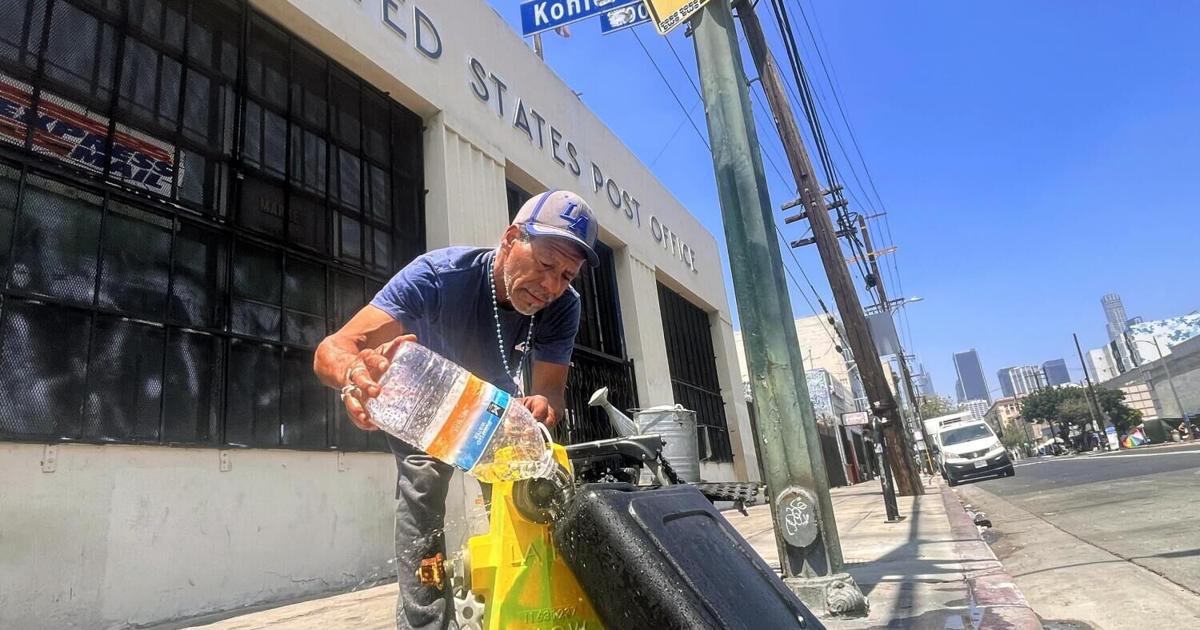
As Quinoes wrote, Skid Row has become a zone bereft of the services that make living in a city possible, while supporting a system that makes human life itself almost valueless: “Meanwhile, Skid Row has become a place of ironic outcomes: where you can buy almost any illegal drug but can’t fill a prescription; where owners of 1930s-era buildings are sued under the Americans with Disabilities Act yet tents block sidewalks, forcing those in wheelchairs into the street where [illegal bike chop shops] can do business for years while tax-paying employers trim staff or abandon the area”. Meanwhile, the city seems trapped in a cycle of inaction. Lopez told Quinones, “I can’t even be in the same room with the people who lead this city because, to them, this is OK. They tell you it’s not, but actions speak louder than words.”

Just as the post office’s closure is a microcosm of Skid Row’s problems, Skid Row itself is an exemplar of the homelessness narrative in Los Angeles as a whole. Leaders tell us homelessness is decreasing and more people than ever are being sheltered. But almost every day, we see news stories of problems in interim shelters, providers who failed to deliver needed services, or a new audit that shows city and county programs in disarray. In every story, we see that the people who suffer are residents, small businesses, and the unhoused themselves. Providers are almost never held accountable for their program outcomes, and questions are typically met with strident blowback. It is the lack of effective program management that drove HUD to pull LAHSA’s federal funding. (The funding suspension has been put on hold while federal Judge David Carter reviews HUD’s actions).
The absence of meaningful services and being unresponsive to communities’ legitimate concerns seems to be the norm throughout the city. As I’ve written before (for example, here and here), the city and nonprofits are more concerned about controlling the narrative than they are about achieving results. As social researcher Stephen Eide wrote in a 2020 study, rhetoric has replaced rigorous empirical testing as the measure of homelessness program success. The defense of rhetoric has gone so far, that Councilmember Yaroslavsky and Mayor Bass continue to champion a development on Shelby Drive in Cheviot Hills, despite the fact its owner is embroiled in a federal criminal fraud investigation. Notwithstanding allegations the City may have paid $11 million more than true market value for the property, leaders insist the project must carry through to completion.
One of the worst-kept secrets in LA is that interim and transitional shelters are poorly managed and do a dismal job moving people into permanent housing. As I wrote in April, the City’s Chief Legislative Analyst found contracts with LAHSA are vague, provide no central administrative authority, and lack meaningful measures. The result is a shelter system plagued by crime, drug use in and around facilities, and that achieves an anemic permanent housing rate. And yet local leaders continue to insist more of the same is the only way forward. At a June 30 community meeting, city staff and representatives of the nonprofits Venice Community Housing Corporation (VCHC) and Safe Place for Youth (SPY) heard from residents who reported multiple incidents of criminal activity in and around two shelters in Venice.
Despite preparing a slick presentation on how well the shelters are managed, providers found themselves confronted by the reality of what it is like to live near their facilities. Ater being asked what can be done to deter antisocial behavior, VCHC Co-executive Director Allison Riley said, “Our process is about issuing lease violations that can escalate to … an eviction and that process takes, unfortunately, a significant amount of time.” Other representatives said there needs to be better coordination with the LAPD for criminal activity, yet residents were given no concrete plans for a timeline for improvements.
Interestingly, the community meeting did represent a case where replacing results with rhetoric and trying to control the narrative didn’t work. Despite the well-prepared presentation, residents quickly took control of the agenda and forced representatives to respond to real-world issues. As one resident said, “We don’t need to hear from everyone on your end as much as I think you have to hear from us”. Perhaps there needs to be more events where residents, who pay about $4 billion per year for homelessness programs, insist that they are listened to, instead of being passive recipients of leaders’ latest public relations campaign.
The Venice community meeting should serve as a wake-up call to leaders and residents. We, both the housed and the unhoused, must demand honesty from public agencies and providers. Simple rhetoric and press events are not the same as actual performance. The pall of misinformation, unreliable data, and obfuscation must be excised before anyone can have open, informed, and honest discussions about homelessness program performance. Its is time we demand the truth from local leaders.
(Tim Campbell is a longtime Westchester resident and veteran public servant who spent his career managing a municipal performance audit program. Drawing on decades of experience in government accountability, he brings a results-driven approach to civic oversight. In his iAUDIT! column for CityWatchLA, Campbell emphasizes outcomes over bureaucratic process, offering readers clear-eyed analyses of how local programs perform—and where they fall short. His work advocates for greater transparency, efficiency, and effectiveness in Los Angeles government.)