

The Ellis Act: Protecting Landlords, Losing Affordable Housing
HOUSING UNAFFORDABLE - The Ellis Act is a California state law passed in 1985 that gives landlords the legal right to evict tenants and “go out of the rental business.” The law was originally enacted to prevent local municipalities from forcing small property owners to remain landlords against their will, thus intending to protect small “mom-and-pop” property owners.
However, the intent of the Ellis Act has been corrupted by real estate developers, speculators and corporate entities whose sole objective is to acquire rent-controlled housing, destroy it, evict tenants and replace existing housing with high-priced luxury housing. Studies have documented that many of the Ellis Act evictions are being done by developers who have owned the property less than a year.
What’s Happening in Los Angeles?
In Los Angeles, most Ellis Act evictions lead to the demolition of affordable rentals, which are then replaced by new luxury units with rents that are unaffordable for most tenants.
Subscribe for free to receive new posts on tenants’ rights, affordable housing and other progressive issues & campaigns.
What If a Landlord Continues to Rent After Evicting?
If a landlord returns the building to the residential rental market within 5 years of withdrawal, the units must be offered at the same rent price the evicted tenants were originally paying.
For up to 10 years, displaced tenants hold a right of first refusal to move back into their old units if they are placed back on the rental market.
This year, Los Angeles has maintained a trend of considerable loss of rent controlled affordable housing because of the Ellis Act. Los Angeles has seen the largest number of Ellis evictions in the entire state.
The CES Ellis Map
The Coalition for Economic Survival (CES), using the mapping expertise of the Anti-Eviction Mapping Project, has been providing regular updates for years on a web-based interactive map. This map shows the locations in LA City where rent-stabilized affordable units have been eliminated due to the Ellis Act. (Click Here to View Eviction Map)
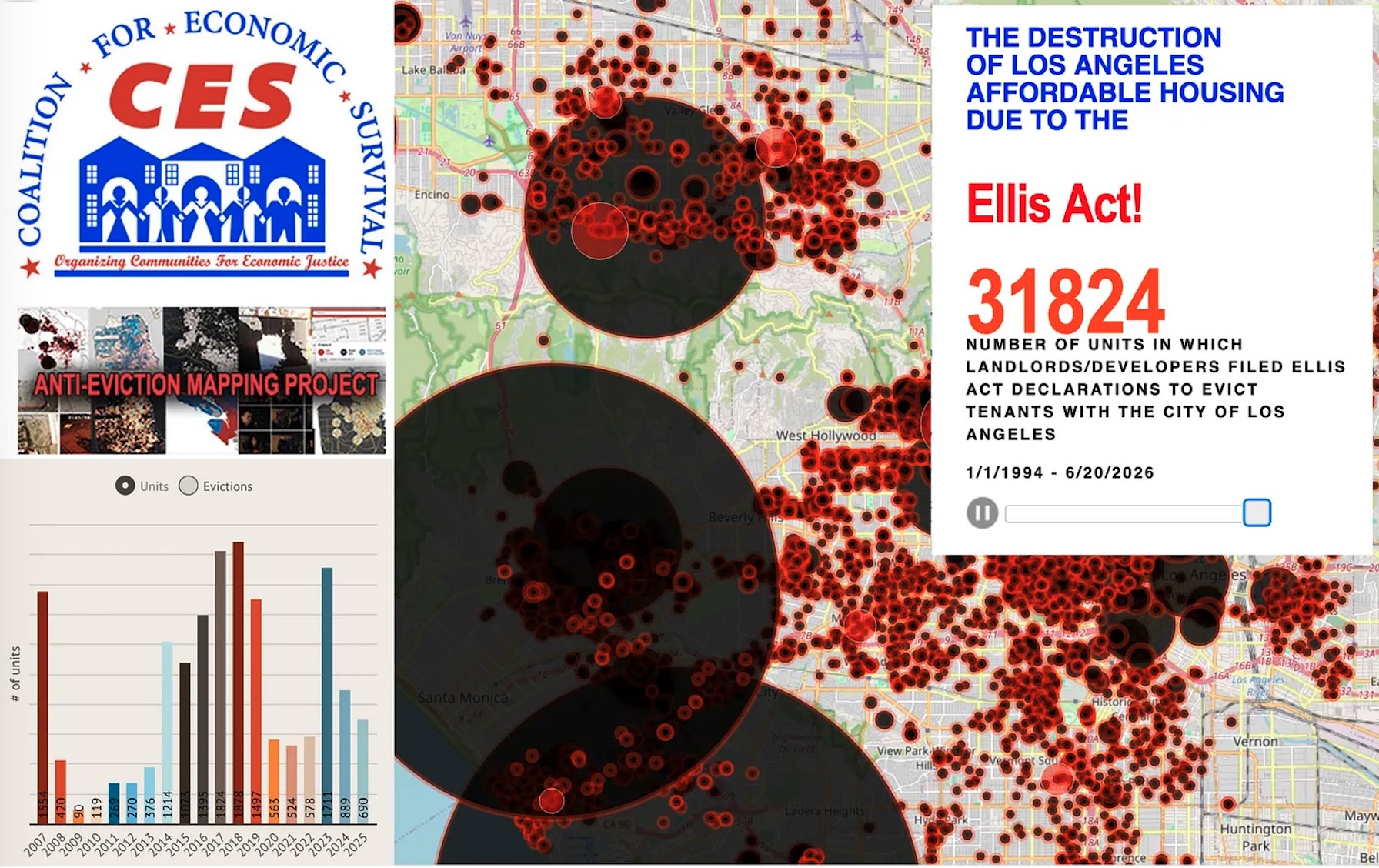
During the first six months of 2026, LA saw a loss of 337 more units. A staggering 31,824 rent-controlled units have been removed from LA’s rental housing stock since 2001 courtesy of the Ellis Act.
When you factor in illegal evictions, voluntary move outs where tenants are unaware of their rights, and cash for keys, the number is likely to be even higher. Developers can circumvent the Ellis eviction process using these methods.
Data for the map is provided by the Los Angeles Housing Department (LAHD). The visuals highlight where the Ellis Act has tragically led to tenants losing their homes and affordable, rent-controlled housing disappearing. The addresses of the buildings and the Ellis Act-induced unit losses can be seen by hovering over the dot with a mouse or touchpad.
Included in the major Ellis filings are a 40-unit building at 800 S. Fairfax Ave., a 33-unit structure at 2913 S. Flower St. near USC, a pair of buildings comprising 9 units at 840 and 844 S. Holt, and an 8-unit building at 1423 W. 11th St.
CES and organized Barrington Plaza tenants with the legal assistance from the law firm of Campbell and Farahani’s legal team stopped the state’s largest-ever Ellis evictions at Barrington Plaza Apartments. The courts determined that Douglas Emmett Inc., a corporate landlord, violated the Ellis Act and LA’s Rent Stabilization Ordinance, because of their intentions to return the units to the rental market at higher rents after renovations, even if those renovations took years to complete. (Click (Here for More Info on Barrington Plaza Case)
The Profound Effects of Eviction on Renters
Eviction and displacement leave a lasting impact. Families who lose rent-controlled apartments due to the Ellis Act are unlikely to find affordable housing nearby. Those affordable units are seldom replaced, often giving way to market-rate or luxury housing. Consequently, evicted renters are often forced to pay new rents two to three times higher.
The effects reach much further than just housing. Displacement often severs the social and support networks people rely on for stability. The consequences for seniors and people with disabilities can be the loss of access to their trusted support network, including caregivers, family, and healthcare providers they rely on. When common errands like going to the pharmacy, grocery store, or community center are interrupted, it becomes more challenging to manage one’s health, preserve independence, and remain socially engaged.
The impact on families with children can be particularly unsettling. Students frequently have to change schools because of moves, sometimes even during the academic year, which disrupts their learning, social progress, and support networks. Many times, displacement pushes families farther from jobs, transportation, and essential services, creating additional long-term instability.
State Legislators Fail to Act
Despite a surge in Ellis evictions, state legislators have failed to act to stop the hemorrhaging loss of these affordable units.
And, in spite of consistent efforts by the Coalition for Economic Survival over many years, state elected officials have been unwilling to change or repeal the law, making it an almost impossible undertaking. The core difficulty is challenging the real estate industry’s political sway and its financially backed connections through their enormous campaign contributions.
The Real Estate Lobby -- Power Through Money
Big monied real estate groups such as the California Apartment Association, the Apartment Association of Greater Los Angeles and the California Association of Realtors have used their financial influence to quash attempts to repeal or even reform the Ellis Act.
Throughout California, the Ellis Act has led to gentrification of neighborhoods and the displacement of tenants due to the removal of many affordable housing units.
This situation has worsened our homeless crisis. By forcing more people onto the streets, only exasperates our homelessness numbers. Our housing crisis persists because we’re demolishing more affordable units than we’re constructing. The majority of the rental units being built, with the full support of YIMBYs, are mainly high-priced market rate housing that are far beyond the cost for most renters.
Action That Is Needed
The Ellis Act and the state Costa Hawkins Housing Act, which limits local rent control, significantly hinder efforts to meet affordable housing demands. These laws need to be eliminated.
Short of eliminating the Ellis Act all together, which CES fully supports, the State Legislature should, at the minimum, take action to amend the Ellis Act in the following ways:
· Restrict the ability to use the Ellis Act to property owners who have owned the property for 10 years
· Limit how many times a year a developer can use the Ellis Act.
· Provide all tenants, regardless of age or family status, with a one-year notice of eviction.
We urgently need to construct more truly affordable housing. At the same time, preserving and protecting our existing affordable housing is essential. Without decision-makers understanding the necessity to preserve and produce simultaneously, our housing policy is destined for failure, exacerbating the crisis.
(Larry Gross is Executive Director of the Coalition for Economic Survival (CES), a Los Angeles-based organization advocating for tenants’ rights, affordable housing, and economic justice.)