Comments
PLANNING WATCH - There are vacant houses and apartments across Los Angeles, yet LA’s City Hall insists that we have a housing shortage that can only be met with widescale up-zoning that allows more housing on existing land. Unstated is the obvious, that developers will swoop in to buy up vacant stores and housing sites when SB79 is finally adopted in Los Angeles.
Is something fishy about these contradictory claims? The metropolitan area is simultaneously experiencing year-after-year of population loss, yet there is still a housing shortage. Either this claim is incorrect, or those who remain in LA are moving into larger apartments, but as individuals. But, if this were the case, then the percentage of people living in overcrowded conditions would be going down, but this this type of overcrowding is still rising.
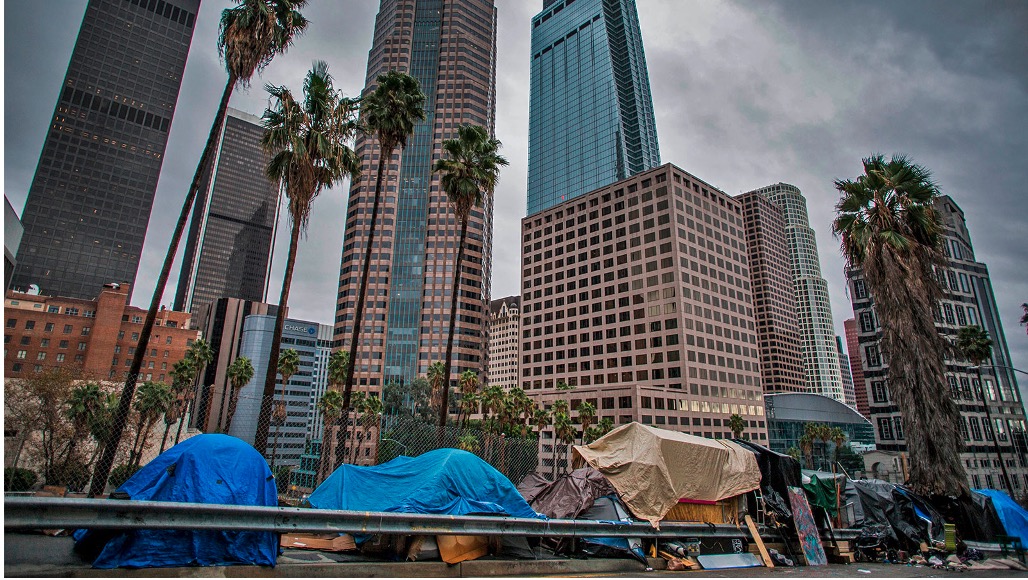
There is an explanation for this contradiction though. An increasing number of Angelenos are either homeless or live in overcrowded conditions – despite nearby apartments (that they cannot afford.) This is the explanation which makes the most sense, and it also explains the photo above. People living in tents cannot afford to move into expensive and vacant housing, even when it is nearby.
Even the official housing numbers reveal the dimensions of this housing crisis. Officially greater Los Angeles has 68,000 homeless people, yet there are 110,000 vacant homes. If we then add in people living in overcrowding conditions in LA County – over 1,000,000 people – the dimensions of LA’s housing crisis are undeniable.
While these are official statistics, they only hint at the extent of LA’s housing crisis. “More than 400,000 people have left Los Angeles County since 2016. During that period, home prices and rents have nearly doubled.”
Furthermore, there are tremendous differences among neighborhoods. For example, South LA, Skid Row, Venice, Koreatown, and Hollywood have the highest rates of renters and overcrowding in Los Angeles. Renters spending, on average, 47 percent of their income on rent in these poor neighborhoods. Furthermore, not only does South LA have an unusually large proportion of renters, but those renters live in the most overcrowded neighborhood in the United States.
In contrast, Los Angeles neighborhoods with the lowest rates of homelessness are:
· Pacific Palisades has one of the lowest ratios of people experiencing homelessness, compared to its resident population.
· Brentwood is a wealthy westside enclave featuring large hillside estates and few unsheltered individuals.
· Encino and Sherman Oaks are located in the San Fernando Valley. These leafy, family-friendly communities have some of the lowest homeless populations in Los Angeles.
· Playa Vista is a master-planned community near the coast with modern developments and strict property management practices that limit encampments.
· Playa del Rey is another small coastal community that experiences low rates of street homelessness.
These neighborhoods are mostly white and upper-income. The segregation of Los Angeles neighborhoods by income strata ensures that little else is about to change for the foreseeable future. We can also assume that the ability to build in-fill apartments through SB79 in Los Angeles will not pan out because Los Angeles has so much existing vacant housing.
(Dick Platkin is a retired Los Angeles city planner who writes about planning issues in LA. He is a board member of United Neighborhoods for Los Angeles (UN4LA). Previous columns are available at the CityWatchLA archives. Please send questions to [email protected].)