
My 8-Minute Call with the New York Times: After Kristof’s Column
GUEST WORDS - The global media erupted on May 11, 2026, when The New York Times (NYT) published a harrowing 3,700-word column by two-time Pulitzer Prize-winning journalist Nicholas D. Kristof. His piece detailed deeply disturbing testimonies of sexual violence and systemic abuse targeting Palestinian detainees within the Israeli prison system. Within days, Prime Minister Benjamin Netanyahu and the Israeli Foreign Ministry slammed the piece as a modern-day “blood libel”, threatening a defamation lawsuit against the paper.
The pushback against Kristof has pulled in heavy hitters from politics, social media, and the wider media world. Many publicly challenged the validity of Kristof’s sources, accusing him of leaning on activist Palestinian networks. Some critics even compared him to Walter Duranty, the infamous 1930s NYT reporter, who used his Pulitzer credentials to obscure Stalin’s atrocities. Pro-Israel advocacy groups organized a protest outside the paper’s Manhattan headquarters to denounce the column.
Yet, the NYT editorial board has stood fiercely behind Kristof's decades-long track record of on-the-ground human rights reporting, completely rejecting all retraction demands. It was at this high-stakes standoff, that NYT editor Sue Mermelstein reached out to me for an 8-minute phone conversation. She asked if I knew what had happened following the publication of the column, and if I stood by the lines I submitted. My response was unwavering, I support the democratic ideals of Israel and the Jewish people, but the authoritarian shift under Netanyahu's current government cannot excuse human rights violations. And Ms. Mermelstein listened to me with a lot of patience and attention.
Ultimately, this battle extends far beyond a single op-ed; it is a foundational fight for the First Amendment and the freedom of the press. When foreign powers weaponize the legal system to silence investigative journalism, the public must stand up. By selecting my voice out of hundreds of submissions, the NYT is ensuring that ethical public debate cannot be litigated into oblivion.
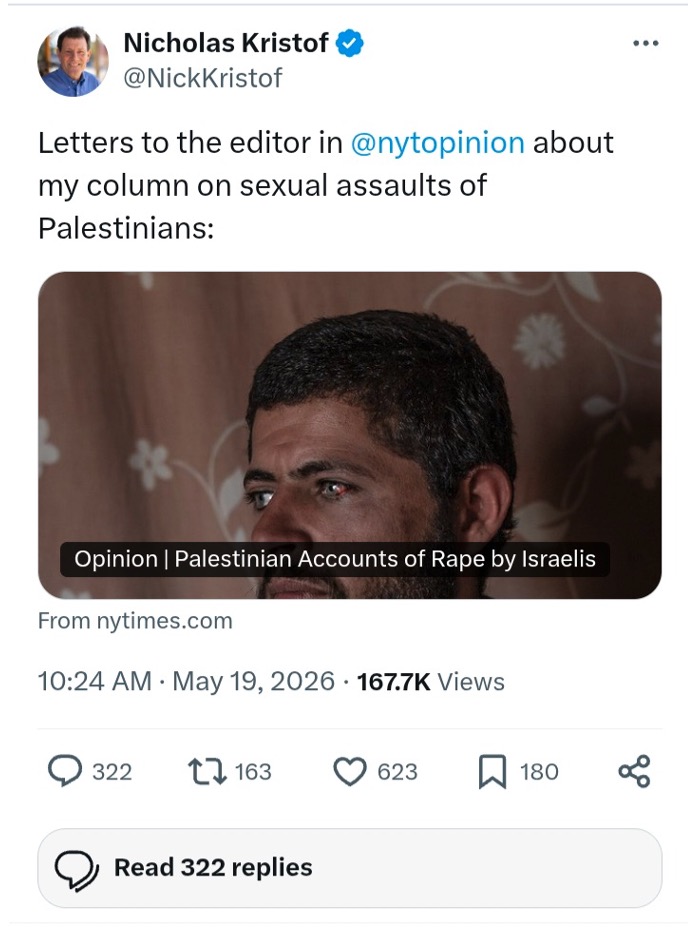
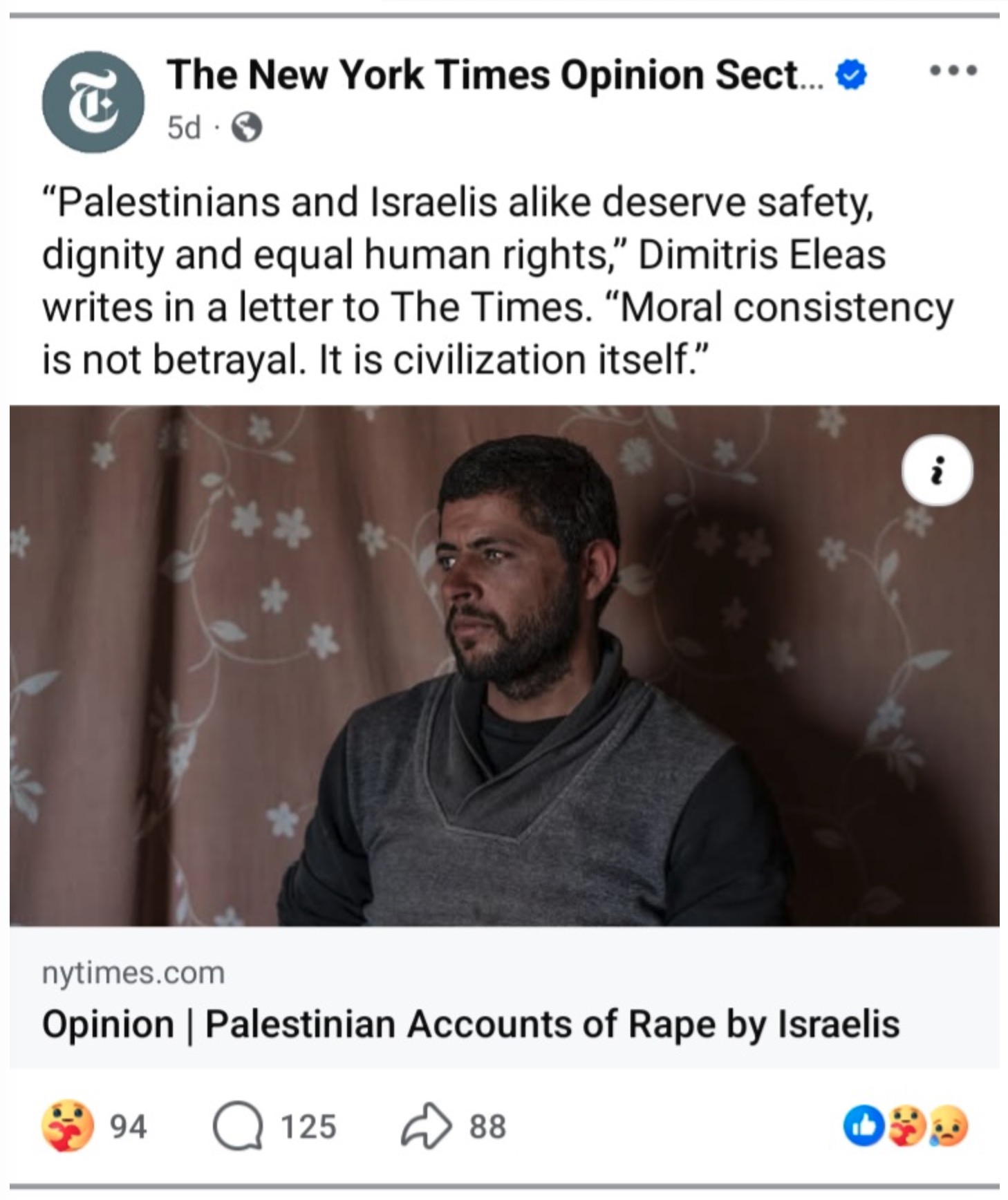
Below is my text, which I worked on for over ten hours, and which was published in The New York Times as the lead letter. It also used “the same photo” as the one that accompanied Kristof’s column. It appeared online on May 18 and in print on page A23 on May 19, 2026. And here, it would be an omission not to mention the thanks I owe to Sue Mermelstein.
To the Editor:
Re “The Silence That Meets the Rape of Palestinians,” by Nicholas Kristof (column, nytimes.com, May 11 [in print, it appeared inside the Sunday edition on May 17]):
Mr. Kristof’s reporting raises painful but necessary moral questions. The horrifying allegations from Palestinians — men, women and even children — must be investigated seriously and independently.
The allegations of beatings, humiliation and sexual torture in prisons are deeply disturbing. Mr. Kristof writes that “this is sexual violence in which the United States is complicit.”
One can support Israel, admire the resilience of the Jewish people and still insist that no nation is above moral scrutiny. I walked through Auschwitz-Birkenau years ago and stood before the remnants of humanity’s darkest abyss. The Jewish people suffered beyond words, and that history must never be forgotten. Yet precisely because of that history, the world hopes Israel will embody the highest standards of justice and human dignity.
Fear and trauma shape nations. Israelis live with memories of persecution, and the horrors of Oct. 7 deepened those fears. But terror and insecurity can never excuse cruelty. If even a fraction of these allegations are true, silence becomes complicity.
Palestinians and Israelis alike deserve safety, dignity and equal human rights. Moral consistency is not betrayal. It is civilization itself.
Dimitris Eleas
Brooklyn
(Dimitris Eleas is a New York-based writer and independent researcher. He is currently completing a fifteen-year research project and manuscript on the Holocaust and antisemitism, 'The Black Birds of Warsaw'. His e-mail is: [email protected].)