
Comments
ACCORDING TO LIZ - “We have come to a clear realization of the fact that true individual freedom cannot exist without economic security and independence. Necessitous men are not free men. People who are hungry and out of a job are the stuff of which dictatorships are made.”
So declared President Franklin Delano Roosevelt in his 1944 State of the Union address.
Today, overwhelmed by the wars and waste of taxpayer money that we as individuals can’t resolve, perhaps it’s time to address an issue that may have actual solutions Americans can fight for at home.
Today, it’s an axiom that corporate greed has off-shored too many American jobs in manufacturing and technology to foreign countries with workers willing to accept a pittance wage and government regulators only too happy to overlook environmental as well as health and safety violations in return for padding their own incomes.
But it’s not entirely on business leaders.
The American workforce has not kept pace with the skills that are needed.
And the federal and State governments have been lax in their obligation to retool education and job development to keep our country competitive in this rapidly changing world.
Don’t claim it’s too expensive.
Economic resilience for America should not be about allowing bankers and the mega-wealthy to hide assets in overseas accounts and invest in foreign countries to avoid taxes. Or put more of the tax burden on people living and working in the United States.
Real resilience would be repatriating jobs by developing national infrastructure, training up the workforce, and rebuilding economies, especially in rural areas and dismembered industrial centers.
Expanding service jobs in healthcare. Hyper-localizing renewable energy and dispersed grids. Aggressively promoting teaching, infrastructure maintenance, and revamping communities across the country, jobs that can’t be outsourced and others for which private industry can partner with state and local governments to create hubs of fresh economic energy.
Generating expanded prosperity through the consequent demand for restaurants, schools, sports, tourism, cleaners, garages, IT support, and... further expansion.
Evening out the economic divide by attracting younger workers who can’t afford to live in major cities to help rebuild hollowed out communities through encouraging private-public partnerships to source outside funds to ramp up downstream businesses – infrastructure construction, maintenance, service systems, supply industries, and local venture capital promoters.
Savings in office infrastructure and maintenance will more than offset travel costs for teams to meet up periodically, especially if they are grouped around smaller centers rather than one monolithic campus headquarters.
Developing technical expertise, compensating people appropriately so they can step away from minimum-wage dead-end jobs to obtain training for careers that will enrich their neighborhoods and families. And not fizzle out. Not drive them to urban ghettos, eviscerating small-town communities, leaving both in a spiral of welfare and addiction.
A consequence that is far more expensive for the country.
Don’t blame education
The country’s public school system was redeveloped to provide qualified workers for the burgeoning factories of the twentieth century. And then monetized under corporate-friendly presidents.
It is now 2026 and the world has spun around again. In a more complex and rapidly changing society, the United States needs coders and engineers not assembly line workers. Even basic maintenance and service jobs now require a sophisticated comprehension of systems and, and the appreciation and respect of their supervisors .
It needs analytical thinkers and problem-solvers, not regurgitation of facts to score well on standardized tests.
It needs scientists who grasp the complexities of the interconnectedness of life, not lawyers who seek to apportion more for the ruling class.
Purveying greed is not American. Educating an engaged and contributing workforce is.
Don’t blame the workers
There are five components to a successful company – owners, investors, suppliers, workers and customers. A company fails if it doesn't support and satisfy ALL of these.
The bosses by necessity must include workers’ voices: the most successful businesses in countries around the world are those in which employees have a say and, as a result, run more smoothly, boast happier workers, and have far less turnover.
For decades, the federal minimum wage has been locked at $7.25 an hour with the tipped minimum wage stuck at $2.13 an hour.
If minimum wage had continued to track productivity as its growth did from 1938 to 1968, it would be $25 an hour today.
In 1965, the average CEO of a top American company earned a little over twenty times a typical worker. Now with stock options and equity, that CEO hauls down more than 350 times what an employee makes.
This is common knowledge. To right the top-heavy ship of wealth disparities, America must pay people what they are worth.
Can the United States do this overnight? Maybe not, but the change cannot be incremental. And the impact of its waves would be highly beneficial, far more so than the much ballyhooed but spectacular failure of trickle-down economics.
It must be backdated for fairness which will also help with reparations to minority sectors of society. And allow for needed investment in the care economy, providing all the missing services for the middle and working classes: healthcare, childcare, elder care.
Furthermore, this will reduce overall taxes as fewer and fewer Americans will have to depend on welfare and food stamps and the high costs of hospital care in extremis for the indigent.
Don’t blame automation
Use it intelligently to allow workers to increase skills and move into better paying more satisfying jobs overseeing and improving assembly of goods, using their experience to increase efficiency and justifying the return of manufacturing to America.
And giving their families the resources to purchase more American-made goods themselves, promoting a virtual upwards spiral, benefiting the economy and boosting the tax base to pay for transition and improvements.
Instead take aim at the unsustainable corporate practices of mergers and offshoring, of stock buybacks and short-term profiteering that puts the economic health of whole sectors in jeopardy and impedes the long-term sustainability and prosperity of the nation.
Rejigger the taxation system, this time not to allow those who have the most to keep more but to empower working Americans and increase their value.
Strip out current depreciation provisions and corporate write-offs, especially those that specifically incentivize replacement of man by machine.
Our government must stop believing high-paid lobbyists who paint glomming onto dying industries with glitter because they made some Americans millionaires in part generations.
Reverse subsidies and bottom-basement taxes for coal, oil and gas and demand they pay into funds to repair the planet their plundering has damaged.
Look to the future.
Before its scything by Trump, renewable energy was on target to bring 3.6 million jobs online by 2035, three times the estimate for those for fossil fuels. Jobs that are safer, healthier, and provide well-paying careers rather than the most short-term replaceable labor digging for oil, mining for coal, and refining these toxic products.
Furthermore, we have an endless free supply of sun and wind while fossil fuels face constant issues with damages, wells running dry, mine collapses, costs of transport and refining, and ongoing challenges in the courts.
Don’t blame the high cost of doing business in the United States.
Selectively address key issues to ensure American companies can maintain their competitive edge against foreign companies.
Medicare-for-All would remove large part of employers’ spend on workers, allowing big businesses to be more competitive internationally and smaller ones to be better able to compete with larger ones avoiding buyouts and job-destroying mergers.
Not only do Head Start and similar programs benefit the children of lower-income families before they begin their formal schooling, but they also provide good jobs for those instructing them with corresponding trickle-down spending and have permanent impact, improving lifelong earning potential and providing a real boost to the economy.
More equitable and affordable childcare at all levels of income will provide more jobs and improve the outcomes of both children and their parents.
Priorities must be forcefully addressed. Who has more value to society – a teacher or a CEO. And yet the average teacher makes one five-hundredth of the average CEO.
How many teachers can support a family on $40,000 a year let alone provide the excellent education American kids need for a bright future?
Don’t blame the unions
Demonized by today’s plutocracy as the direct cause of inflation to divert people’s attention from the truth that it is the oligarchs and the Wall Street financial class, not Main Street that is to blame.
Whether fighting for their membership or bought out by those with whom they are negotiating, they provide some sort of counterbalance to both corporate and civil service abuses.
Unions have advocated for the 8-hour day, to end child labor, and for sick pay as well as fair wages and benefits – all things we now take for granted. They also provide social activities and assess federal and state policies that impact their members and help raise awareness and organize support for worker-specific issues.
Truth? Just over 10% of American workers are unionized: about 35% of public sector jobs but less than 7% of those in for-profit companies. Millions more would like to organize but the plutocracy and the elected officials they control directly and indirectly exploit loopholes in U.S. labor law to aggressively shut down their efforts.
In 1960, over 30% of workers belonged to unions in the United States and Canada. While unionized workers here have dropped pretty precipitously, Canadian numbers rose. Plus Canadians have universal healthcare and a far better social safety net.
Don’t point fingers at the Pentagon slurping up over 50% of the taxes Congress can allocate
DARPA-driven science funding has helped develop and deploy American-made products, creating many more well-paying jobs across the country.
But the budget tagged for the Department of Defense has soared to almost $900 billion and, today, the newly-monikered Department of War needs an extra $1 billion each and every day for its illegal assault on Iran.
Of its fiscal 2026 allocation by Congress, 95% is discretionary, dependent on cajoling votes from the cats in Congress. So one tactic the Pentagon developed early on was to locate bases and defense contracts in each and every district in the United States.
So if a Representative or Senator is digging in their heels over approving the military-industrial complex’s demands, it can threaten to pull contracts. Keeping jobs and a humming economy at home is key to winning future elections.
To wean those dollars away from the military, borrow a page from their manual and actively promote new jobs, better jobs, improved and sustainable economic gains that soothe the concerns of the electorate in ways that can be seen in constituents’ pocketbooks.
To pry elected officials in each and every district away from accepting donations from military contractors, an economy freed from traditional urban hubs could empower local citizenry with solutions that recreate the halcyon days of their dreams with a bustling dynamic economy.
A call for the future
Do call into question the increasing power of the plutocracy, gutting worker protections and the evisceration of benefits that underlie employment in almost every other first world country and many others striving to join them.
And their constant shirking of responsibilities so they can pocket more of the profits by converting employees into gig workers who lose what benefits they do have, are saddled with unpaid paperwork, and too often drift into becoming a burden, directly or indirectly, on taxpayers.
And the focus on 90-day stock prices and GDP as better metrics for the country’s health than the lived experience of ordinary Americans.
Do call into question persistent and fallacious assumptions.
Unemployment is not the natural state of affairs. Consciously or sub-consciously, it has been carefully cultivated by the plutocracy for generations to ensure the optimum ‘wage-pressure balance’ treating people’s work as a commodity to maximize corporate profits.
Using supply and demand pricing to keep the costs of labor as low as possible.
Many millions of Americans are unemployed and countless millions more make subsistence wages if that. The result? Rising crime, rising poverty, rising taxes to support those who have fallen out of
Rising inflation and rising prices may benefit the captains of industry but continues to bedevil ordinary people and the taxpayers.
People are unemployed and yet there is so much important work that is not being done – modernizing the energy system, fixing our cratered streets and highways, spurring scientific development, providing decent human services for all.
FDR instituted a grand solution to dig the country out of the Wall Street-precipitated Great Depression, creating relief programs aimed at providing employment through public works projects.
The government could choose to again sponsor full employment which would reduce the private sector’s ability to suppress wages. This in turn would force increased competition for labor, pushing up wages, pulling millions out of poverty, decreasing their dependence on taxpayer money, and cycling their larger incomes back into the economy through purchasing power and boosting what they pay in tax.
The greatest beneficiaries would be those who have been structurally disadvantaged by immigration status, race, and/or education. And their families.
The United States emerged from World War II with a booming economy and nearly full employment, with many Americans experiencing vastly improved working conditions and standards of living.
“If full employment can be maintained in a war for destruction, it can also be maintained in peace for construction.” So proclaimed A. Philip Randolph, a key leader in the civil rights and labor movements.
Columbia University researchers report less-educated voters have consistently and overwhelmingly favored federal jobs approaches over welfare for the past 80 years.
What the United States needs now is a return to the Founding Fathers’ belief that all companies and corporations be regulated and prove their value to the people, not their executives.
Rightly suspicious of the greed and power of such entities as the East India Company and its tea monopoly that drove the American Revolution, the fledgling Congress called for strict protections for the new country’s citizens.
Early American regulations on corporations were restrictive, requiring companies to apply for charters from state legislatures, which limited their scope of operations and size.
Unfortunately these only lasted until they generated enough power, and the money to buy it, to rescind these early safeguards and replace them with greater and greater freedom to exploit the laboring classes.
In a 2022 “Trump’s Kryptonite” survey by the Center for Working Class Politics, a jobs policy advocating an FDR-style federal jobs guarantee drew overwhelmingly support across diverse demographics.
Most popular among working-class respondents of all parties.
DNC leadership, take note: Regardless of class, those who identified as Democrats supported the federal jobs guarantee by a margin of almost four to one.
And one only has to look at the rise of Donald J. Trump to see the truth of Roosevelt’s premise: “People who are hungry and out of a job are the stuff of which dictatorships are made.”
To reclaim democracy and decorum, we-the-people must in turn rise, to push the current government of the profits for the profiteers from power.
And gift back a kinder, gentler leadership to all Americans.
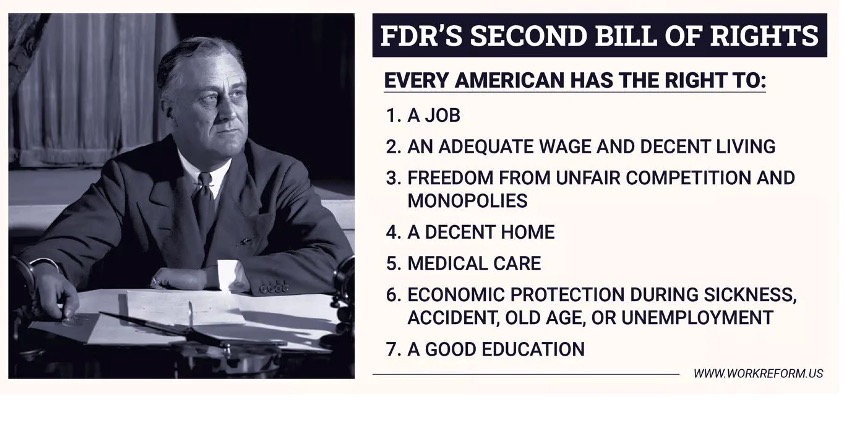
We must embrace FDR’s proposed second Bill of Rights for useful jobs paying enough to provide adequate food, housing, clothing and recreation; for a good education; for farmers to make a decent living and businesses, large and small, to be freed from unfair competition and monopolies at home or abroad; for adequate medical care and good health; for protection from the economic fears of old age, sickness, accident, and unemployment.
That his visionary second Bill of Rights was never implemented doesn’t mean we can’t embrace it today, updated for the twenty-first century.
Ensuring that there are well-paying jobs for every American. And qualified Americans for every job.
It won’t be easy; nothing truly worthwhile ever is. But I believe we must try if we are to guarantee the survival of future generations.
The above was inspired by Progressive Capitalism, a book by Silicon Valley Rep. Ro Khanna, who ought to run for president; by a segment in Kim Stanley Robinson’s future history The Ministry for the Future; and by Louise Penny who writes in the afterward of her novel The Black Wolf about the need for love and choosing kindness, of choosing decency and acceptance, and the courage to be a dissenting voice.
(Liz Amsden is a former Angeleno now living in Vermont and a regular CityWatch contributor. She writes on issues she’s passionate about, including social justice, government accountability, and community empowerment. Liz brings a sharp, activist voice to her commentary and continues to engage with Los Angeles civic affairs from afar. She can be reached at [email protected].)