
Comments
ACCORDING TO LIZ - Headlines about competing schemes to take over Warner Bros. Discovery have emphasized multiple underlying illegalities of either option but two of the issues have been brewing for decades.
First is the further undermining of the intent of the Consent Decrees aka the Paramount Decision from over 75 years ago that firmly established antitrust parameters to protect consumers from anti-competitiveness and collusion in the entertainment industry.
Secondly, and the greater tragedy, has been the sacrifice of American artistic integrity on the altar of short-term financial profit.
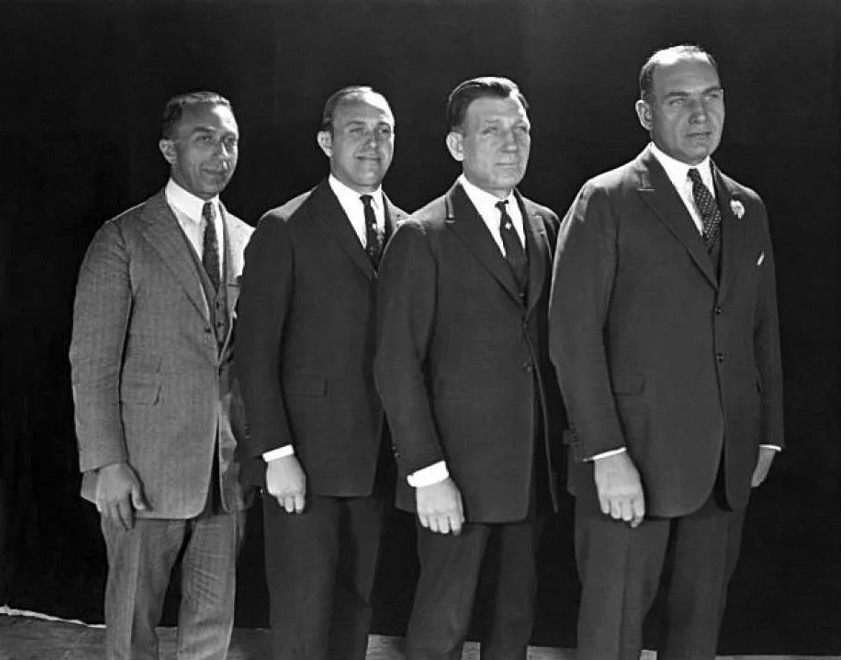
The four brothers who established and operated Warner Bros. in its early years epitomized the quintessential movie moguls people loved to hate but whose energy and chutzpah did as much to put Hollywood on the motion picture map as any organization then or since.
The industry was comprised of the making of movies and their distribution to a paying public with the former split further into the development of properties and their production, and the latter into marketing and theatrical exhibition.
Each of these were expensive undertakings with high risk of financial loss. Development that went nowhere so there was no ability to recoup the costs. Productions where costs were often unpredictable and could easily go off budget due to illness, weather, or a star’s histrionics.
Distribution entailed construction of movie-specific venues and technology and were labor-intensive requiring the employment of everyone from projectionists and front-of-house staff to accountants. Marketing ballooned from simple word-of-mouth and listings of times in local papers into a multi-million-dollar industry in its own right often costing multiples more than the movie itself.
In those early days actors were owned by the studios along with directors, writers and a majority of creative technicians from cameramen to editors.
And it was those moguls, the producers who risked their own money and future profits on their creative acumen and an accurate interpretation of what their audience wanted who were the impresarios of a nascent industry.
Sure, there were starlets and leading Lotharios a-plenty, more often than not with stories manufactured and controlled to titillate the public’s fancy as an additional way to gin up attendance by a paying audience.
But the real power was behind the scenes. And while the goal was profitability, the key focus was the magic they created with their movies.
At some point, principally after distribution became national and then international galvanized by the metrics of scale, the bean counters of Wall Street took notice of the vast amounts of cash and credit swirling through the industry – generating huge paybacks for some investors and spectacular losses for others.
And decided that they could make movies more efficiently, cut out the losses, and pocket the difference.
At the time, studios would sift through thousands of scripts, executives would listen to hundreds of pitches, from which they might select a few dozen to develop further, maybe one in ten would move forward with stars and directors attached, and maybe one in ten of those would get greenlit for production.
With costs being racked up all along the way.
Some projects might be sold to a competing studio because of relationships with one or more of the stars or the agencies that controlled them but with those pre-existing costs appended made the financing more of a challenge and would require huge success at the box office to break even.
Then Wall Street with its obsessions about profits at all cost, and magnifying their personal take through mergers and buyouts got into the action.
The stars of the saga roiling the news today are what’s left of Warner Bros., the darling of Hollywood in its heyday, what’s left of Paramount Pictures, another of Hollywood’s shabby ex-royalty, and the upstart Netflix that parlayed a DVD-by-mail business into a production powerhouse, albeit with an emphasis on the ancillary markets.
All the players in this dance seemingly committed to eviscerating true creativity and condemning artists to suffer as the pawns of Wall Street.
Furthermore, both current bids seem to lead through the White House… a dangerous proposition if one values artistic independence. Especially given that Trump sees himself as the ultimate arbiter of creative endeavors when he is primarily the master of heavy-handed self-promotion and low-brow entertainment.
Warner Bros. was founded on April 4, 1923, by Harry, Albert, Sam, and Jack Warner. In 1972, after a century of side-affairs, it begat Warner Communications before merging with Time Inc. in 1990 to become Time Warner. Time Warner acquired Turner Broadcasting System in 1996, then tragically merged with America Online, forming AOL Time Warner in 2001 but dropped the AOL part of its moniker in 2003.
In 2009, Time Warner spun off its cable division as Spectrum and booted out AOL. Then disposed of Time Inc. in 2013.
AT&T acquired Time Warner in 2018 begetting WarnerMedia, which merged with Discovery in 2022 spinning off AT&T, reconfiguring itself as Warner Bros. Discovery under Wall Street titan David Zaslav.
Whose agenda appears to have been to hang with the movers and shakers and talk the good talk while leaving the movie and television divisions to rot under an endless stream of perhaps-not-so-strategic micro-modifications.
Now Paramount and Netflix are squabbling over the remains under the Machiavellian oversight of the Economic-Disruptor-in-Chief.
If Warner Bros. Discovery wants to re-emerge as an independent and innovative entity, it needs to embrace radical simplification and jettison all but its core creative components: Warner Bros. Pictures, WBTV, HBO and various iconic and still profitable franchises including Harry Potter, Lord of the Rings, DC Comics, Dune, Mad Max and the still-going-strong Looney Tunes characters.
The proceeds from selling the cubic zirconia dregs should be enough to pay off the mountain of debt which Wall Street has lumbered it with to become the lean, mean creating machine of yore.
Further using the licensing of its properties to fund creatively risky projects, some of which will die ignominious deaths while others will become the blazing successes of the future.
Built on story, not Wall Street mergers and acquisitions. And winning back the respect of audiences who want to watch human genius, not A.I. rehashing of what once was.
With the recent launch of the Creators Coalition on A.I. (CCAI) by a group of industry insiders, Hollywood has put forward a call to action. “This is not a dividing line between the tech industry and the entertainment industry, nor a line between labor and corporations. Instead, we are drawing a line between those who want to do this fast, and those who want to do this right.”
In other words, a direct challenge to the Silicon Valley tech start-ups who spawned the current cancer of unregulated artificial intelligence growth with their dangerously disruptive motto to “move fast and break things,” intending to make as much money as possible before the long arm of the law and responsible oversight could clip their wings and protect all Americans, especially our children.
Specifically, CCAI is striving “to establish shared standards, definitions and best practices as well as ethical and artistic protections for if and when A.I. is used in entertainment projects” with four central tenets: 1) transparency, consent and compensation for content and data; 2) job protection and transition plans; 3) guardrails against misuse and deepfakes; and 4) safeguarding humanity in the creative process.
Unregulated technology, propped up by short-term Wall Street mentalities has repeatedly upended the entertainment industry, almost always at the expense of creativity and humanistic innovation.
In an age where, perhaps too late, mankind is seeing the danger of capitalism’s infinite encroachment on finite resources, CCAI knows it cannot shove the A.I. genie back into its bottle, but can battle to do as much as possible to establish strong and enforceable guardrails and consequential oversight across all sectors of society to mitigate jeopardies, now known and yet to be revealed.
The proliferation of data centers now under way – and maximally more demanded by the explosive expansion of A.I. and all its ancillary exploitation – is already generating massive environmental impacts. As it has in the past, Hollywood may be leading the way, providing an existential “action road map” for many tangentially related spheres such as manufacturing, medicine, and education.
Looping back to the threatened absorption of Warner Bros. by either Netflix or Paramount does nothing to benefit Warners. It is not a Pixar being given a home-base, financial support and extensive infrastructure by a Disney but a stealthily planned raid by corporate marauders intent on extracting as much as it can for those with their fingers in the pie, fully intending to shuffle off the husks to the homeless encampment strewn streets of LA, leaving a demise of creativity, ruined careers, businesses, huge losses of jobs and a devastated economy behind.
The end of the quintessential American industry
In return, consumers will be fed A.I.-generated cookie-cutter pablum, while a bunch of suits living high on the hog, scratch their heads wondering why the proletariat has turned away from such entertainment.
Fewer films will be made on location in Los Angeles, fewer series shot in its studios.
Fewer tourists will be drawn to Hollywood to be wowed by the magic of moviemaking and further contributing to the economic demise of Los Angeles.
Ultimately, the question is do people want an entertainment industry controlled by the likes of Trump? Or inspired by the Rob Reiners and Oprah Winfreys, the George Clooneys and Meryl Streeps.
Do theatregoers and TV-viewers want to watch material dumbed down to the lowest common denominator to make it more useful to sell single use polluting products and partisan politics?
Or exciting and diverse programming produced for a wide range of audiences designed to lift people up and help them face the challenges life today brings.
We have a choice and the time to make it is now.
Contact your state and federal representatives, asking them to use laws already on the books to protect the greatness of American filmmaking. That what made Hollywood internationally famous does not deserve to die an ignominious death.
Support the industry that put Los Angeles on the map and drove its growth. Defend the people who create what A.I. and bean counters can’t: generate real human emotions to lift audiences into the wonderful worlds of movie-making teams’ imagination.
(Liz Amsden is a former Angeleno now living in Vermont and a regular CityWatch contributor. She writes on issues she’s passionate about, including social justice, government accountability, and community empowerment. Liz brings a sharp, activist voice to her commentary and continues to engage with Los Angeles civic affairs from afar. She can be reached at [email protected].)