

Facts Are Stubborn Things. AB 130: Streamlining While Infrastructure Is Crumbling
PERSPECTIVE -
“Facts are stubborn things.” — John Adams, 1770
California lawmakers asked Californians to accept one of the most significant reductions in environmental review in decades.
Legislators argued that California simply could not continue building housing under the existing system if ordinary families were ever going to afford a home.
This series examines those laws one at a time.
Each article will compare four things:
• What lawmakers promised.
• What the statute actually says.
• How it is being implemented.
• What the facts ultimately show.
We begin with AB 130.
Using Los Angeles as the principal case study and comparing it with a representative sample of publicly documented projects across California, this article asks a simple question:
Is AB 130 being implemented the way the Legislature intended?
Why CEQA Matters
Before we go any further, let's talk about something most Californians have probably never heard of.
CEQA.
A few years ago, I couldn't have told you what those four letters meant. Like most homeowners, I assumed planning and zoning laws simply existed to make sure development happened responsibly. I had no reason to learn the details.
Then a 98-unit assisted-living and memory-care project called MorningStar was proposed on my neighborhood's primary wildfire evacuation route.
Suddenly, CEQA wasn't just another government acronym.
It became personal.
CEQA—the California Environmental Quality Act—is far more than legal jargon.
It asks the difficult questions before the first shovel goes into the ground.
Will roads safely accommodate additional traffic?
Can emergency vehicles reach the site?
Is there enough water?
Can aging sewer systems handle additional demand?
Can residents safely evacuate during a wildfire?
What impacts can be avoided before they become permanent?
Those aren't bureaucratic exercises. They are the questions communities depend on government to ask before approving major development.
AB 130 changes that equation.
For projects that qualify, the Legislature created a statutory exemption from CEQA, allowing housing developments to proceed without a traditional Environmental Impact Report if they meet the law's eligibility requirements.
That is one of the most consequential policy choices in the legislation.
Whether one agrees with it or not, Californians deserve to understand what is being set aside—and what public benefit lawmakers believed justified that trade-off.
According to AB 130's authors, that public benefit was helping solve California's affordable housing crisis.
If Affordable Housing Was the Promise…
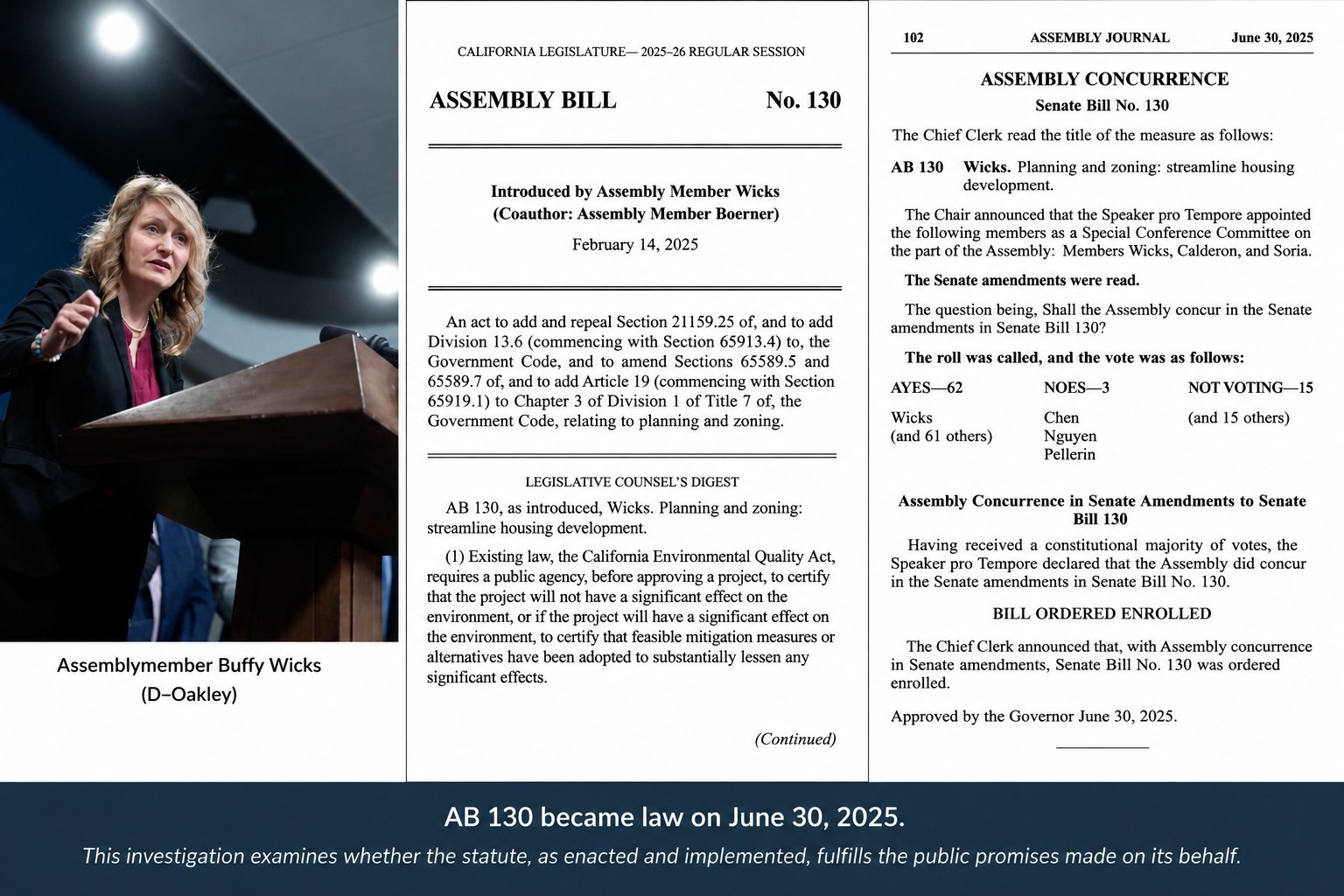
Assemblymember Buffy Wicks, the principal author of AB 130, called the legislation "a major step toward building desperately-needed homes faster, fairer, and with more certainty."
She said it would move California's housing goals "from promise to reality."
Her office further stated that AB 130 would make it easier and less expensive to build and "ultimately achieve — more affordable housing."
Assembly Speaker Robert Rivas called streamlining approvals "essential to making California more affordable and expanding opportunity."
Senator Scott Wiener described the legislation as "a bold step toward tackling the root causes of California's affordability crisis."
Those are powerful promises.
But one statement by Assemblymember Wicks stopped me in my tracks.
She described AB 130 as "a long-overdue step to stop CEQA from being weaponized against housing."
Let's stop there for a minute.
Weaponized against whom?
I understand why developers view CEQA as an obstacle.
But after learning what CEQA actually requires government to evaluate before approving major projects, I came to see it very differently.
That is why Assemblymember Wicks' description of CEQA being "weaponized against housing" became one of the questions that drove this investigation.
I read AB 130 looking for the affordable housing requirement.
I found no general statutory requirement that projects receiving AB 130's extraordinary streamlining benefits actually provide affordable housing.
That finding led to another question.
If the Legislature intended AB 130 to apply to projects like MorningStar—a licensed Residential Care Facility for the Elderly consisting primarily of assisted-living and memory-care units—surely the bill's author could say so.
So I asked.
I contacted Assemblymember Wicks, members of her legislative staff and members of her communications staff.
I asked whether the Legislature intended AB 130 to apply to licensed Residential Care Facilities for the Elderly consisting primarily of assisted-living and memory-care units.
I also asked where the statute requires projects receiving AB 130's benefits to provide affordable housing.
As of this writing, I have received no substantive response.
Without answers from Sacramento, I turned to the projects themselves.
Following the Evidence
Rather than beginning with one development, I assembled a database of publicly documented AB 130 projects in Los Angeles and elsewhere in California.
The purpose was simple: to see how the law was actually being used.
The database included nine publicly documented projects, eight confirmed through official public records, representing 1,584 proposed housing units. Among them, I identified 151 deed-restricted affordable units—about 9.5 percent of the total. Of those, 125 were designated for Very Low Income households.
Those numbers alone raised questions about whether AB 130 was producing the affordable housing lawmakers had promised.
But the comparison revealed something even more significant.
The Threshold Eligibility Requirement
Before a project can receive AB 130's extraordinary streamlining benefits, it must first satisfy a threshold eligibility requirement.
It must qualify as a housing development under the statute. AB 130 repeatedly uses that term, but it does not redefine it.
That threshold issue caught my attention because licensed Residential Care Facilities for the Elderly have long been regulated as a distinct land-use category. In Los Angeles, they are not processed in the same manner as conventional multifamily residential developments. Because of the licensed care, supervision, staffing, and operational services they provide, they have historically required discretionary land-use approvals, including a Conditional Use Permit.
That history does not, by itself, answer whether an RCFE may qualify as a housing development under AB 130.
It does explain why the question deserves careful examination.
As I reviewed the projects in my database, a pattern quickly emerged.
Every project except one involved what most Californians would recognize as conventional residential housing—apartment buildings, mixed-use residential developments, student housing, condominiums, and other forms of independent residential living.
Only one project was different.
MorningStar.
It was the only licensed Residential Care Facility for the Elderly in my statewide review using AB 130.
It was also the only project I identified in a Very High Fire Hazard Severity Zone.
It was the only project for which I found no project-specific AB 747 evacuation analysis in the public record I examined.
And it was the only project with no deed-restricted affordable housing.
No single characteristic made MorningStar unusual.
It was the combination of all of them.
That fact does not resolve the legal question.
It does make MorningStar an anomaly among the publicly documented AB 130 projects I reviewed.
It also raises an obvious threshold question:
What legal analysis led Los Angeles City Planning to conclude that a licensed Residential Care Facility for the Elderly satisfied AB 130's threshold eligibility requirement as a housing development?
The Documentary Record
The statewide comparison explained why MorningStar deserved closer scrutiny.
The public records explained what happened next.
To understand how Los Angeles arrived at its interpretation of AB 130, I submitted California Public Records Act requests.
They produced internal emails between City Planning staff and the applicant's representatives, along with legal memoranda from the Los Angeles City Attorney's Office concerning AB 130.
Taken together, those documents tell a story that has never been publicly explained.
MorningStar was filed in July 2021.
For nearly four years, it proceeded through the traditional Environmental Impact Report process. Transportation, utilities, noise, biological resources, and fire protection were under review.
Then the law changed.
On June 30, 2025, Governor Gavin Newsom signed AB 130.
Just over two weeks later, Los Angeles City Planning reached out to the applicant—not the other way around—to discuss “the potential of utilizing the AB 130 Infill Housing Statutory Exemption for the project.”
That email marked a turning point.
MorningStar had not been submitted as an AB 130 project. The possibility arose only after the legislation became law.
What followed was not routine processing.
The documents show Planning and the applicant working through eligibility questions that did not exist when the project was filed. Planning requested written justifications. The applicant responded. Questions were discussed with the City Attorney's Office. Planning ultimately concluded that MorningStar qualified to proceed under AB 130.
Why was so much effort devoted to finding a path into AB 130 for a project that was already unlike every other project in my statewide review?
A licensed Residential Care Facility for the Elderly.
No deed-restricted affordable housing.
A Very High Fire Hazard Severity Zone.
A constrained evacuation route.
And no project-specific AB 747 evacuation analysis found in the record I examined.
That question became even more significant after another document surfaced.
An internal legal memorandum from the Los Angeles City Attorney's Office.
When the City's Own Lawyers Raised Questions
Had anyone inside City government questioned whether MorningStar actually qualified under AB 130?
The answer was yes.
Among the documents produced through my public records requests was an internal legal memorandum prepared for City decision-makers implementing the new statute.
What mattered was not that the memorandum rejected AB 130. It did not.
What mattered was what it acknowledged.
The memorandum recognized that there was "no clear answer in the law" regarding parts of AB 130's application.
It acknowledged reasonable legal arguments on both sides.
It warned of "significant risk" that a court could reject the City's interpretation.
And it recommended pairing reliance on AB 130 with another CEQA clearance rather than relying on the exemption alone.
The memorandum did not say the issue was settled.
It said the opposite.
That mattered because the Planning Department was not simply applying long-established law. It was interpreting a brand-new statute whose application, by the City's own legal analysis, remained uncertain.
The question was no longer simply whether MorningStar qualified.
The larger question became whether Los Angeles City Planning's interpretation reflected what the Legislature actually intended.
That led me back to the statute itself.
Back to the Statute
Every investigation eventually arrives at the same place.
Not politics.
Not press releases.
The law itself.
After reviewing projects across California, examining the Los Angeles Planning Department's file, obtaining internal City emails through the California Public Records Act, and reading the Los Angeles City Attorney's legal memorandum, I found myself asking the same question that began this investigation:
What did the Legislature actually enact?
AB 130 repeatedly uses the term “housing development.”
It does not redefine it.
The Legislature could have expressly stated whether a licensed Residential Care Facility for the Elderly consisting primarily of assisted-living and memory-care units qualified as a housing development for purposes of this new streamlining law.
It did not.
Instead, Los Angeles City Planning was required to interpret the statute and determine whether MorningStar qualified for AB 130's streamlined review.
MorningStar proposes 65 assisted-living units, 30 memory-care units, and only three independent-living units.
If Planning's interpretation is ultimately upheld, MorningStar could become one of the earliest publicly documented examples of a licensed Residential Care Facility for the Elderly qualifying for AB 130's streamlined review.
That possibility reaches far beyond Granada Hills.
Other jurisdictions may look to the City's interpretation.
Other applicants may cite it.
Other planning departments may follow it.
That is why this case matters.
It is not simply another land-use dispute.
It is an early test of how AB 130 may ultimately be interpreted and applied across California.
And it brings us back to the question that has followed this investigation from the beginning:
Is this what the Legislature intended?
John Adams said, "Facts are stubborn things."
So let's end with the facts.
California has millions of residents who cannot afford housing.
I reviewed nine publicly documented AB 130 projects representing 1,584 proposed housing units.
Among them, I identified 151 deed-restricted affordable units, including 125 designated for Very Low Income households.
Every affordable unit matters.
But you don't have to be a mathematician to ask whether those numbers come close to addressing California's affordability crisis.
AB 130 itself does not generally require projects receiving its streamlining benefits to include affordable housing.
AB 130 itself does not generally require statewide reporting so Californians can measure whether the law is producing the affordable housing lawmakers promised.
AB 130 itself does not generally establish a statewide mechanism for tracking whether affordable units created under projects using the statute remain affordable over time.
If affordable housing was the promise, where is the accountability?
How will Californians know whether AB 130 succeeded?
How will lawmakers know?
The burden should not be on citizens to build databases, file California Public Records Act requests, and compare projects one by one to determine whether a law is accomplishing what its authors promised.
That responsibility belongs to the Legislature.
If affordable housing was the promise, why doesn't AB 130 itself generally require it, measure it, or track it?
Facts are stubborn things. Californians deserve answers. The Legislature owes them.
(Eva Amar is a West Valley community coordinator and national sexual assault victims' advocate.)