
Comments
NICK’S VIEW - Over the past 25 years, the Los Angeles Unified School District (LAUSD) has lost about 330,000 of its students. Officials predict that enrollment will continue to drop by another twenty-eight percent by the 2030-31 academic year. High housing costs have pushed many families out of the area and into less expensive states, while those who remain often delay or forgo having children because of financial uncertainty.
To add to what is viewed by demographers as ‘California’s fertility collapse,’ are the low immigration levels which are much lower now, and immigrant families are having fewer children than earlier generations. And Los Angeles has aged. Consequently, the share of residents in their prime childbearing years has declined.
In my book, “The Making of Modern Los Angeles,” I noted that because it often took a decade to build a new school, LAUSD had to estimate future enrollment years before many students were even born. The projections were inevitably imperfect. The district used a model that incorporated birth rates, in-migration, out-migration, dropouts, and other factors to forecast the need for classroom seats-and therefore new schools-many years into the future.
A prime example is Robert F. Kennedy Community Schools, a 24-acre K-12 campus built on the former site of the Ambassador Hotel, one of Los Angeles’ most iconic landmarks. After years of legal and political battles, the hotel was demolished in 2005, and the nation’s most expensive public-school complex was built there at a cost of $578 million. The enrollment forecasts that justified the project proved wrong. As impressive as the RFK schools are, they were probably unnecessary.
Although LAUSD is currently preparing for school consolidations and closures, it has not released specific numbers. Nearly half of all zoned elementary schools are half-full or less, and fifty-six schools have lost more than 70% of their students.
The obvious result is that the school district has a vast amount of underused space. What some see as a liability, I see as an opportunity.
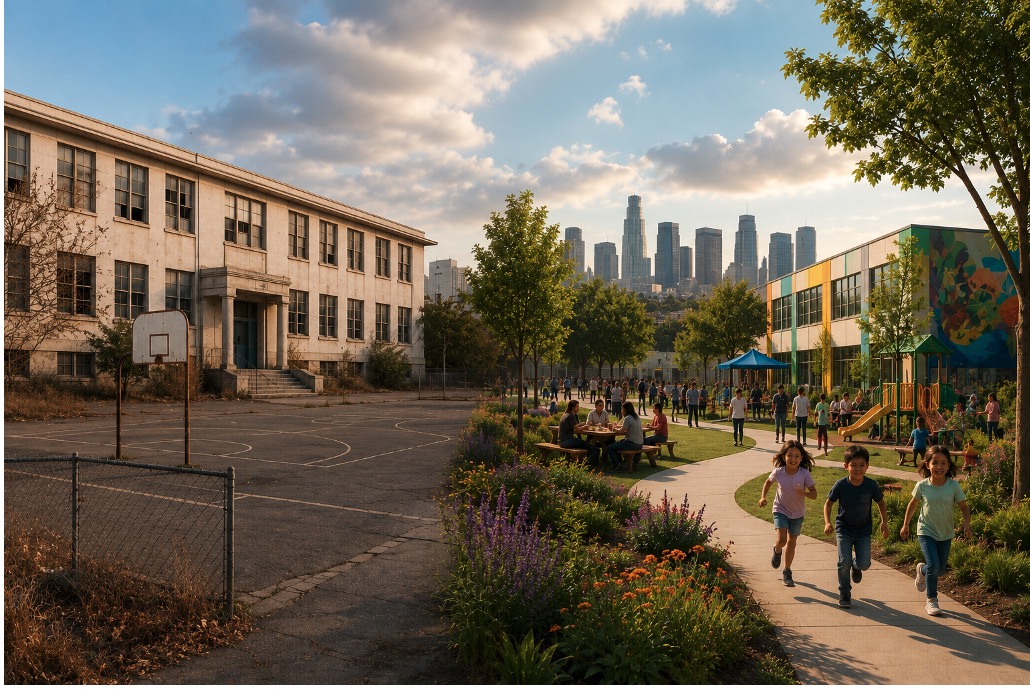
Converting closed schools into parks and community centers would be more than a land-use decision; it would be a rare step that benefits multiple systems at once, advancing equity, climate resilience, public health, youth development, neighborhood stability, and stewardship of public land.
Los Angeles now ranks 93rd out of the100 most-populous U.S. cities in Trust for Public Land`s 2026 ParkScore Index, reflecting weak performance across the five core measures of a strong park system: acreage, access, investment, amenities, and park space equity.
San Francisco devotes more than 8 percent of its land to parks, Seattle more than 15 percent, New York 17 percent, Los Angeles a paltry 5 percent. Without question, park shortages create measurable inequities in social, environmental, and health outcomes. Research consistently shows that when parks are scarce or unevenly distributed, the heaviest burdens fall on low-income, Black, Latino, and other historically marginalized communities. Few public investments deliver benefits as broad and well documented as parks. In larger, denser areas, those benefits are even greater.
The park comparison is stark: Los Angeles has just 4.3 acres of parkland per 1,000 residents—less than half of San Francisco’s total, well below Chicago and Washington, D.C., far behind Dallas, and even slightly below New York City.
There is, however, the potential to create ecological linkages with parks and greenway corridors as a lace-like overlay weaving a city together and moving away from how separated and siloized communities are in Los Angeles.
Converting a closed school into a park is complex, requiring coordinated legal, financial, and interagency action. In Los Angeles, that process is especially cumbersome because LAUSD—not the city—owns the land. And LAUSD cannot sell, transfer, or repurpose a school until it is formally declared surplus property under the California Education Code.
However, when this step is taken, the City and LAUSD can begin to negotiate a land arrangement. The most common pathways are a long‑term 99 years lease whereby LAUSD retains ownership while the City operates the complex.
There is precedent in cooperation between LAUSD and another public agency, as it relates to land use. The Young Oak Kim Academy, Middle School at Wilshire / Vermont subway station and the East Valley High School at North Hollywood subway station were built on Metro owned surplus land through the efforts of former LAUSD board member Caprice Young as detailed in my book.
Many cities across the United States have turned former school properties into parks, and it has become one of the most effective, high‑impact strategies for adding green space in built‑out urban areas. New York City’s “Schoolyards to Playgrounds” initiative has converted almost three hundred schoolyards into public parks, and it is one of the most successful models in the country.
Chicago has repurposed dozens of closed schools due to enrollment decline and turned into community parks, playgrounds, athletic fields, and open green space. That has been the case with many more American cities.
Los Angeles County has also converted some school properties into parks, but far less often than other major U.S. cities—and typically through joint-use agreements rather than full conversions.
David Tokofsky, former LAUSD board member, offers a compelling idea: instead of simply closing or consolidating schools, we should re-envision them.
That vision echoes" New Schools, Better Neighborhoods," (NSBN), the Los Angeles civic initiative closely associated with David Abel, founder of NSBN and publisher of the Planning Report. NSBN advanced the idea that public schools should serve not only as educational facilities, but also as neighborhood-centered, shared-use civic assets.
Hopefully what was not accomplished over 20 years ago with billions of dollars in new construction, it can be achieved today out of necessity.
Shuttered campuses could become much-needed community assets and civic anchors, providing parks and green space, cultural heritage centers, community arts campuses, rehearsal studios, galleries, film, and media labs, and more. School sites can be reimagined as "intergenerational villages' combining senior housing with nursery and pre-kindergarten facilities. The same model could also include workforce housing for firefighters, police officers, teachers, nurses, and other essential workers who are increasingly priced out of the city. Because many of these workers have young families, on-site childcare and early education would be a major benefit. Done thoughtfully, this could become a model with statewide potential
Michael Maltzan, designer of the Sixth Street Viaduct is a collaborator on the Bakehouse Arts Complex’s plan to expand this existing Miami arts facility with affordable studios as well as 200 units of affordable housing for artists, all around an expansive community garden shared by the Bakehouse community and the surrounding neighborhood. He added that Los Angeles risks losing a creative young generation as the cost of living and working space becomes prohibitive.
There can also be unique applications made at parks on the land of a closed school. One is the Edible Schoolyard program, as developed at the Martin Luther King Jr. Middle School in Berkeley. Neighbors can participate in planting, harvesting, and preparing fresh food, making a connection among food, health, and the environment. Not only are fresh vegetables grown, but cooking classes are provided. The garden is integrated with the correct food preparation that can be taught.
Park-starved Los Angeles must confront this inequity. Leaders should use the public land and facilities already available through closed schools. These taxpayer-funded properties offer one of the lowest-cost, highest-impact ways to expand park access and affordable housing opportunities True leadership means making full use of existing public assets.
When a school closes, its land remains a public asset. Leaving it unused risks vacancies and blight while wasting one of the most cost-effective opportunities to expand park access and strengthen communities.
There is no time to waste. Los Angeles City, Los Angeles County and many municipalities know the need for affordable housing and more parks and that the land and opportunities already exist. Now is the time for sincere coordination and creative action.
(Nick Patsaouras is an electrical engineer, civic leader, and a longtime public advocate. He ran for Mayor in 1993 with a focus on rebuilding L.A. through transportation after the 1992 civil unrest. He has served on major public boards, including the Los Angeles Department of Water and Power, Metro, and the Board of Zoning Appeals, helping guide infrastructure and planning policy in Los Angeles. He is the author of the book "The Making of Modern Los Angeles.")