
Comments
WESTSIDE - California has a myriad of problems, homelessness, housing costs, gas prices, and you can add to that list the government's inability to count votes in a reasonable manner.
As government efficiency is at all time low, just how many government election workers does it require to determine a winner in a reasonable manner?
As of this writing, we still don't know who the general election candidates will be and it's a week since the polls closed on June 2nd. The longer it takes, the less reliability and legitimacy one tends to have confidence in a system that is clearly flawed and in need of reform.
As of this writing, the race for second in the Los Angeles mayoral primary has narrowed between Spencer Pratt and Councilwoman Nithya Raman while Xavier Becerra has clinched the first-place position, but the second-place finisher remains in doubt between Republican Steve Hilton and billionaire Democrat Tom Steyer. Incumbent Mayor Karen Bass has advanced to the general election.
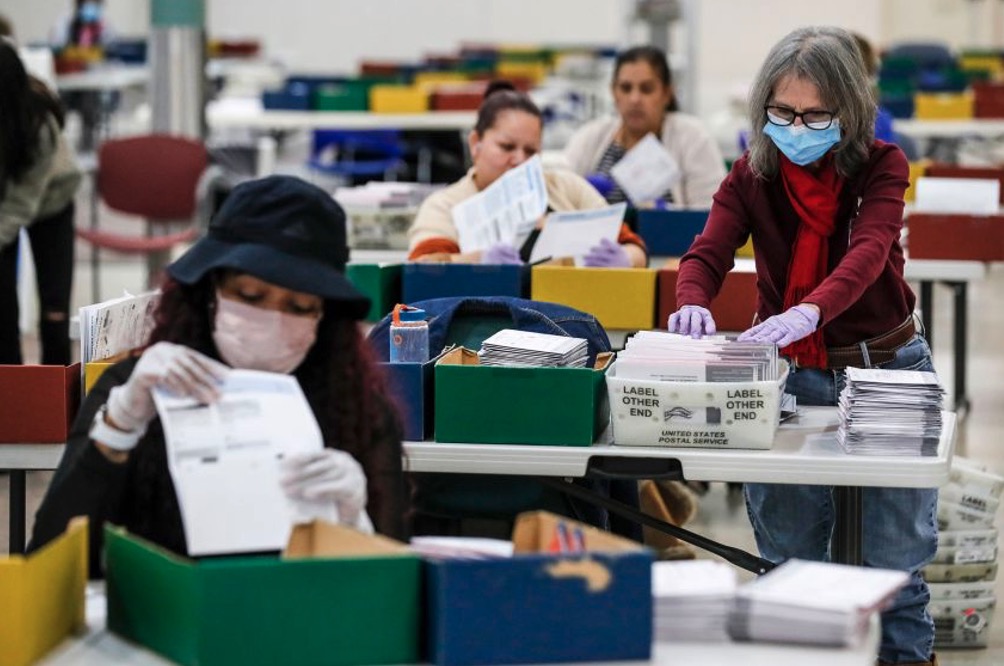
California's vote-counting process is deliberately designed to maximize ballot access and accuracy rather than speed. Unlike states that require most ballots to be received before Election Day, California accepts any ballot postmarked by Election Day that arrives within seven days, and millions of voters cast mail ballots that require signature verification and processing.
Are speed and accuracy in conflict?
Here are some of the primary reasons the count takes so long:
- Universal Vote-by-Mail
Every registered voter receives a ballot. In recent statewide elections, well over half of all votes have been cast by mail, creating millions of envelopes that must be individually verified before counting.
- Late-Arriving Ballots
Ballots postmarked by Election Day can arrive up to a week later and still count. Close races often remain unsettled while counties wait for these ballots.
- Signature Verification
Election workers compare the signature on every mail ballot envelope against the voter registration record. If there is a discrepancy, voters can "cure" the issue, adding additional days to the process.
- Provisional Ballots
If there are questions about a voter's eligibility or polling location, a provisional ballot is issued. Each one must be researched individually before it can be counted.
- California's Size
With nearly 23 million registered voters spread across 58 counties, California administers one of the largest elections in the world. Large counties such as Los Angeles County alone often process more ballots than entire states.
What can be done to speed things up?
1. Allow Earlier Mail Ballot Processing
Many states permit election officials to begin opening and verifying mail ballots weeks before Election Day (without releasing results). California allows for some preprocessing, but expanding and standardizing this statewide could significantly reduce the obvious post-election backlog.
2. Shorten the Ballot Receipt Window
Reducing the seven-day postmark acceptance period to two or three days would produce faster results, though would suggest it could disenfranchise voters whose ballots are delayed by the postal system. There needs to be some accountability by voters to take the process seriously.
3. Election day staffing and efficiencies need to be improved for more reliable results
Temporary election workers, high-speed envelope sorters, and improved signature-matching software could help counties process ballots more quickly while maintaining accuracy. The current system needs to improve sooner than later.
4. Encourage Earlier Voting
Public campaigns encouraging voters to return ballots several days before Election Day would spread the workload over a longer period rather than creating an enormous surge at the end. Ending or eliminating a post-election day process needs to be considered.
5. Reform the Provisional Ballot System
Better real-time voter database integration across counties could reduce the number of provisional ballots issued, eliminating one of the slowest parts of the counting process. Provisional ballot voting need to be a choice of last result.
At the end of the day, California is too slow, and democracy is undermined due to this ongoing delay. Compared with states like Florida, which permits extensive preprocessing and generally reports nearly complete results on election night, California is slower. However, it is not necessarily less accurate. Election experts often describe the tradeoff as one between speed and maximizing voter participation.
In most California elections, the winner of races with comfortable margins is known on election night. The prolonged counting process primarily affects very close contests where the remaining mail and provisional ballots could still change the outcome. But when several races are mired in delay due to the quirky open primary process, is it good for democracy to take this much time to simply who advanced to the general election runoff?
In the case of Los Angeles County spent roughly $300 million developing and deploying its Voting Solutions for All People (VSAP) system, a project that began in 2009 and was fully rolled out for the 2020 election cycle. It was designed to replace aging equipment and create the nation's first publicly owned voting system.
Incredibly, the $300 million voting system is not primarily a vote-counting acceleration system. It was intended to allow voters to cast ballots at any vote center in the county, support 11 days of in-person voting, improve accessibility for disabled and multilingual voters, provide a voter-marked paper audit trail, and modernize election administration and security.
In fact, one could argue that some of the features that make voting easier also create more work after Election Day. For example. voters can vote at any county vote center; the system integrates with California's universal vote-by-mail model. Every mail ballot still requires signature verification, and provisional ballots must still be individually researched. None of those labor-intensive processes are eliminated by VSAP.
When VSAP debuted during the March 2020 primary, it experienced well-publicized technical and operational problems that contributed to long lines and delays at vote centers. Those issues were largely addressed by the November 2020 general election, where the system generally received positive reviews.
But why was the speed of count tabulation ever considered in a $300M expenditure?
Many critics therefore ask the obvious question: If taxpayers spent $300 million, why doesn't Los Angeles County produce election results faster?
The answer is that the principal bottleneck is California law, not the hardware itself. As long as the state continues to accept ballots arriving after Election Day (if timely postmarked), permits ballot curing, and requires extensive verification procedures, even a highly modern voting system cannot instantly produce final results.
If California's legislators really wanted dramatically faster counts—closer to what voters see in states like Florida—they would likely need to change election procedures, not simply buy better technology. Earlier preprocessing of mail ballots and a shorter postmark acceptance window would probably have a greater impact on reporting speed than another investment in voting equipment.
Accuracy is important and critical, but speed and reliability matter.
There is no justification for voters and candidates to wait for verified results in this fashion.
It undermines faith and confidence in the results and only adds to the assumption that elections by nature are not processed in a way that increases participation in the democratic process.
(Nick Antonicello is a thirty-three-year resident of Los Angeles who covered the numerous races on the June 2nd Primary ballot. A regular contributor to City Watch LA, he can be reached via e-mail at [email protected] )