
Comments
THE PORT - Change, often difficult, is usually considered a good thing, especially when it is deemed necessary to improve situations, circumstances, and outcomes. Alternatively, changing for the sake of change often yields an unsettling result that can cause disruption and chaos. Unfortunately, it appears the latter is about to happen at the San Pedro Bay port complex and could upend its critical rail ecosystem and negatively impact the nation’s supply chain.
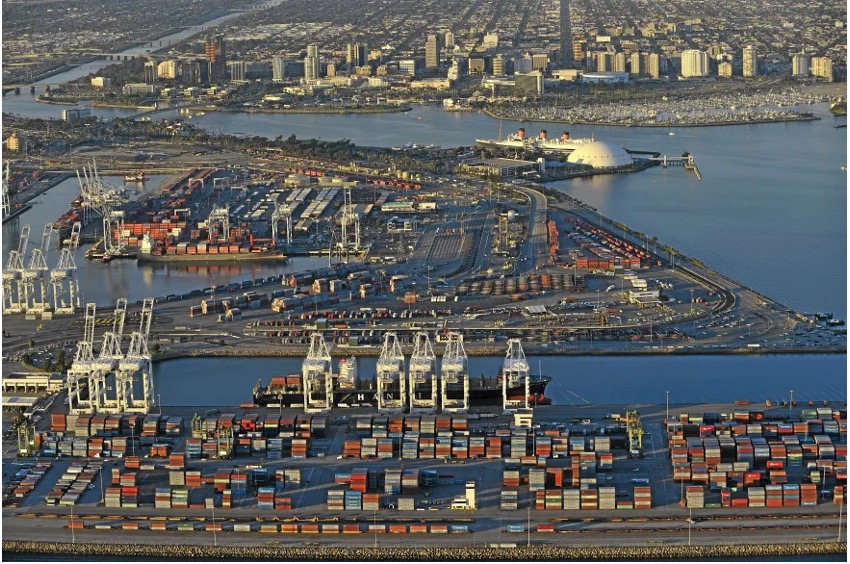
It is widely known that San Pedro is the busiest port complex in the Western Hemisphere, moving over $500 billion in cargo annually. But what is not widely known is the port complex also serves as one of the most vital interchanges within America’s national freight rail network. Nearly 30% of the 20 million containers that arrive via ocean vessels leave the complex via on-dock rail, heading to key inland rail hubs such as Chicago, Kansas City, and Memphis. It is therefore imperative that efficient, reliable, and resilient rail service be a core component of port operations. For nearly 30 years, Pacific Harbor Line (PHL), an independent, neutral short-line railroad, has met that need and has been consistently heralded for its exceptional service. PHL has also been recognized for its role in enabling the ports to realize record container growth. It was both surprising and puzzling when the ports launched an unwarranted RFP for short-line rail services across the San Pedro Bay port complex and subsequently awarded this critical function to an untested railroad that has yet to operate its first locomotive.
Unlike this current situation, PHL came to the ports during a time of crisis. In the mid-1990s, when container traffic began its meteoric rise, on-dock rail service at the complex was provided jointly by Class I railroads Union Pacific, Santa Fe (today BNSF), and Southern Pacific. The Class Is were highly competitive, territorial, and ultimately proved incapable of working collaboratively on behalf of the ports and their terminals. As a result, rail service was consistently dysfunctional and severely hampered port operations and growth. In 1995, the ports, tired of the inefficient and poor rail service offered by the Class Is, awarded on-dock rail responsibilities to PHL.
This proved to be a good change. When PHL began operations in 1997, the impact of its centralized traffic control and highly disciplined rail service was an immediate boost to on-dock rail operations and continues to pay dividends decades later. Today, PHL handles nearly 2.8 million containers per year and successfully launches and lands more than 30 stack trains per day. It also provides tailored service to nearly thirty local carload customers, which has strengthened the local economy and boosted rail growth. More importantly, the success of PHL’s on-dock rail service has greatly influenced the Port of Long Beach’s $1.8 billion Pier B Rail Support Facility, which will double its yard capacity, adding five new arrival and departure tracks as well as a locomotive servicing facility.
As the saying goes, if it ain’t broke, don’t fix it. However, it seems the fix is in motion, and the successful 30-year partnership between the ports and PHL is at risk of falling by the wayside. Its chosen replacement, the Alameda Belt Line (ABL), though relatively new, already has a troubling past. ABL was created from a tenuous partnership between Union Pacific and BNSF, two railroads that, as in the 90s, are fierce rivals and often struggle to work together. In fact, ABL was initially created not to service the ports, but as a neutral third party to dispatch freight trains along the Alameda Corridor, due to ongoing disputes between Union Pacific and BNSF over the Corridor’s dispatching and oversight responsibilities.
Moreover, the bad blood between these two railroads has only intensified over the last year, with Union Pacific’s announcement of a proposed transcontinental merger with Norfolk Southern. In December of 2025, BNSF filed a petition with the Surface Transportation Board (STB) to “address UP’s longstanding pattern of obstructive conduct, which has eroded competition and harmed customers.” Is this really the change the ports want, or do its customers need an unproven short line railroad whose parent companies are at war with one another?
In 2024, during my time as Chairman of the STB, I visited the port complex and spent several days meeting with officials from both ports, their marine terminal operators, customers, and labor unions, as well as with PHL, Union Pacific, and BNSF. Because of the critical importance of the ports to the nation’s supply chain and economy, I wanted to witness firsthand how the complex operated in concert with freight rail. I came away not only impressed but also encouraged by what I thought was a strong partnership between PHL and the ports, and by a shared commitment to growing freight rail within the port complex. When I consider the headwinds currently facing America today – tariff and economic uncertainty and a rise in global conflicts that is adversely affecting trade – the last thing the country needs at the San Pedro Bay port complex is a change in rail service from an accomplished and reliable neutral carrier to a neophyte railroad caught in the middle of a battle between its Class I owners. Hopefully, the officials overseeing this process will reconsider this unnecessary change before it is too late. There is simply too much at stake for the ports and the nation.
(Robert E. Primus has served as a Member of the Surface Transportation Board since January 2021, later confirmed for a full term through 2027, and held leadership roles including Vice Chairman (2021–2022) and Chairman (2024–2025). He brings over 30 years of experience in Congress and federal policy, working for multiple members of the House of Representatives, serving as Chief of Staff to Representative Michael Capuano for over 15 years, and advising on transportation, national security, and healthcare issues, along with time in private-sector lobbying.)