Comments
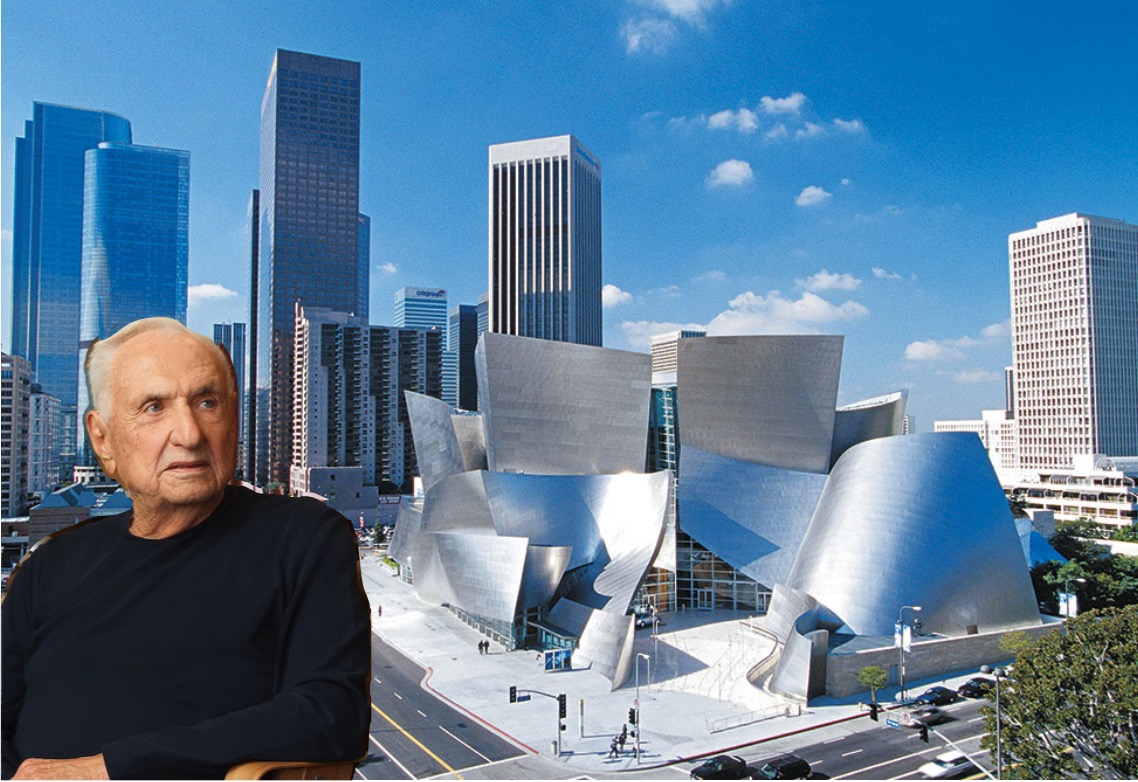
FRANK GEHRY’S IMPACT - Though it was conceived before Gehry’s world changing Bilbao Museum, a Guggenheim Museum satellite museum, for years, Los Angeles’ Walt Disney Concert Hall was more myth than reality.
A generous $10Million dollar donation from Lillian Disney, Walt Disney’s widow, for a concert hall with perfect acoustics, started it all. The hall was to be the new home of the Los Angeles Philharmonic.
Architects were selected to submit proposals for the new hall, and through perseverance, good luck, insight and some adventuresome spirits, Frank Gehry’s radical design was chosen.
The luck was not all good. Raising enough funds to add to Lillian Disney’s donation for construction was a very slow process, which paused and almost stopped.
Discussions about the new hall continued, but the flow of money did not. There were whispers and gossip that the project was stopped. Support dwindled. The then Philharmonic Music Director Essa-Pekka Solonen expressed his doubts about the will of the city and its leaders commitment to building the hall.
Before Disney Hall, the home of the Los Angeles Philharmonic was the Dorothy Chandler Pavilion. A beautiful building, with a combination of neo-classical and the end of the mid-century styles. The interior was very large and inviting, but it was a multi-purpose auditorium.
With its proscenium arch over the stage, the auditorium presented the philharmonic, and operas, musicals, theater, the later art forms which need the proscenium arch and curtains for the stage. But this creates the situation of two rooms: one for the audience and the other for the stage.
For a symphony orchestra this is not ideal. The orchestra sounds are carried up into the rafters, reducing the sounds going out to the audience. The full brilliance of the Los Angeles Philharmonic was not heard.
In the 1980s I frequently attended Philharmonic concerts at the Chandler Pavilion. In those days I would park on Grand Avenue and walk past the then dirt lot where Disney Hall now sits. Members of the orchestra would park there.
Using the back entrance and climbing the stairs to the Music Center Plaza I would pass a wooden structure which housed a mock-up of the interior. Peering inside to see the mock-up was a wonder and transformational. There was no proscenium, the orchestra and audience were in the same room. It was new, brilliant, exciting. I could almost hear the music from the orchestra.
But the mock-up was like mythical rendering of an unrealized dream. It sat there for years, and there was no construction.
It was not until the Los Angeles Philharmonic, on a tour with Salonen, performed at the Théâtre du Châtelet in Paris where the stage extends into the audience space, that the audience could fully hear the orchestra. It was a revelation. Major donors of the philharmonic became aware of the power of the philharmonic, and the need for Gehry’s new hall to showcase the orchestra.
While Lillian Disney’s donation is the cornerstone of the beginning of the hall construction, enough cannot be said about industrialist and philanthropist Eli Broad, and then Los Angeles Mayor Richard Riordan-another industrialist-who became forces of nature to restart fundraising for the now Walt Disney Concert Hall.
Walt Disney Concert Hall opened in 2003. Its stainless steel exterior of rolling and weaving panels were a welcome intrusion of modernism into Downtown Los Angeles. Gehry was an avid sailor, and the exteriors are said to represent sails of a ship. I see that, and with my dearest and greatest respect to the memory of Frank Gehry, I also see waves, and with the very sharp edges and peaks, mountain ridges like the Sierra Nevada. But those are my flights of imagination.
These days I walk more frequently than drive in DTLA, and when I walk past Walt Disney Concert Hall the freshness and boldness of design never fade. It is a wonder of art, architecture, engineering, construction and boldness.
The backside of the hall shows Gehry’s intellectual rigor with a wall of uniform squares and rectangles window set in a straight wall of limestone to balance out with dignity the movement of the front.
Gehry was born in Toronto and moved with his family to Los Angeles as a teenager. His early architecture career showed great innovation, but it was not until he was 68 that he became the world renowned architect with Bilbao.
The power of Disney Hall demands we look at it. Gehry conceived the hall as the living room for Los Angeles. And it is.
There is a grand staircase facing Grand Avenue, to welcome the audience. The box office has an inviting wide glass window to welcome guests. The audience has different levels to enter the hall, and inside, it is Gehry at his warmest, inviting us inside.
But there is no one, grand lobby, but a series of lobbies on various floors for the audience to mingle. The feeling is an easy SoCal vibe. We are now guests to Gehry’s, Walt Disney’s and the Los Angeles Philharmonic’s hall, and they seem grateful and thankful for the audience attending.
Inside the hall is, to me, the living room Frank Gehry wanted for the city. While not centered in the middle, our eyes are drawn to the proscenium free orchestra space. As we sit, the audience face each other. This is a large, welcoming communal space.
Nothing on this earth is completely perfect, but the “perfect acoustics” Lillian Disney wanted are very closely realized through the magical work of acoustician Dr. Minoru Nagata.
I have sat in every level of the hall, and the sound remains remarkably clear, and warm. The loudest sounds are never squashed, but loud and balanced. And a solo violin is heard fully, without loss.
The acoustics are another miracle to add to the miracle of the architecture.
Spruce walls line the hall for the remarkable acoustics. Gehry also radicalized the organ pipes which to me resemble smash-up of pipes. Supposedly there is no official name. There are nick-names” the very unfortunate “French fries,” and the humorous Terry Riley “hurricane Mama.” I will call the Manuel Rosales built organ “starburst.”
The sides of the hall have large spruce panels for the sound enhancement, and in more of my imagination, to me they seem to represent fish. Gehry was a Pisces, the sign of two fish. He created a sculpture of fish. There is a story that while living in his home in Toronto fish would be stored in the bathtub before they became gefilte fish.
At a concert at Zipper Hall in the Colburn School, across the street from Disney, I told Gehry how much I appreciate him and Disney Hall. He graciously accepted the compliment. Then I asked him about my fish images on the side walls. He did not reply, and that is okay.
Few men, if any, have made as great an impact on architecture, and listening to live music in a concert hall, than Frank Gehry. Walt Disney Concert Hall is the immigrant Gehry’s gift to Los Angeles. We are very fortunate, indeed, to have his legacy in this city.
(Matthew Hetz is a Los Angeles native and composer whose works have been performed nationally. He is the former President of the Culver City Symphony Orchestra and Marina del Rey Symphony. A passionate transit advocate, Matthew is dedicated to improving the rider experience and encouraging drivers to embrace public transportation as a solution to air pollution and climate change. He teaches at Emeritus/Santa Monica College and is a regular contributor to CityWatchLA.com.)