

Soccer Fan Missing in Action and the FIFA Scandal
GELFAND’S WORLD - Sometimes sport leads to unintentional humor. Before we get into the case of Folarin Balogun, there’s the story of an English fan who disappeared for more than a week, leaving his family to fret, worry, and think about whether they would soon be mourning. It seems that he was intending to fly to Boston to celebrate his team. His airline plans included a transfer in Barcelona where he got off and – this is the part of the story that differentiates generations – he lost his cell phone.
And apparently he had the boarding pass information on that cell phone and he didn’t really know what to do. After all, the telephone numbers he might have used to call home or ask for help were on that lost phone.
So, he sat in Spanish bars watching the World Cup and, as the news later explained, “blissfully unaware that the world was searching for him for 10 days.” And now he has been found.
What’s funny about this story is that, in his own mind, he was never lost. You may recall that in the first couple of weeks of the tournament, there was a lot of soccer to be seen, and a lot of beer to be swallowed. He did and did. So if nothing else, this is a tribute to the British soccer fan.
An aside, but a story that is too good not to be remembered. It involves a game the Dodgers played back in the days when extra innings really meant extra innings. It may have been this game, which went 22 innings and took more than 7 hours. So the next night, Vin Scully was talking about that game and recited this story: A Dodger fan was on vacation in Hawaii and watched the first part of the game, but he had to leave early to catch a flight. He then went to the airport, flew to Los Angeles, traveled home to Palm Springs, and saw the last part of the game from his own living room.
So now, let’s talk about the current FIFA scandal. I mean, if it’s FIFA there has to be a scandal, right?
The particulars: The United States was playing in the Round of 32 against Bosnia Herzegovina. The star player for the U.S., Folarin Balogun, was defending against a Bosnian player and, in kicking out towards the ball, he stepped on the back of his opponent’s leg. The referee more or less ignored the insult until he was contacted by the people who now do video surveillance of everything that happens on the field. By the way, that procedure is called VAR which stands for something or other that is never translated by the announcers. (It turns out that VAR stands for Video Assistant Referee, and refers to the official who watches the banks of monitors as play unfolds and then, on rare occasions, provides relevant video clips to the referee.)
For whatever reason, the referee agreed with the VAR that there was a serious penalty, and said ref awarded a red card to Balogun. The rule is that the red card gets you kicked out of the game immediately (it’s sort of like the targeting foul in American football) but, in addition, makes you ineligible for the next game.
The effect of the red card would therefore be to keep Balogun out of this evening’s big match between the U.S. and Belgium.
And why is this such a big match, and what is my view of that red card?
Basically, the U.S. has been a consistent loser in World Cup soccer since its inception. It’s true that the U.S. finished third in the 1930 inaugural World Cup, but that was due to circumstances like the Great Depression and a lack of interest by European teams, not to mention its distant location in an era of travel by ocean liners. So basically, the U.S. has suffered through World Cups, with one recent near-success about 20 years ago, and that was just making it into a later round, and nothing like getting into the final.
Anyway, this could be the year that the U.S. Men’s National Team has a chance to win in the round of 16 and make it to the quarterfinals. It would be considered success to get that far, even if our team would be expected to be snuffed by France or England or Spain or whoever else gets that far.
So now the scandal. By some mysterious circumstance, Balogun’s suspension for the Belgian game was itself suspended. Translated into English, he is now allowed to play. There is one irritating geopolitical element of this latest update, which we shall take up below. But for now, the bottom line is that the U.S. will face Belgium with its original starting team, including its highest scorer and its other best player, Christian Pulisic. What is important about Balogun returning to the lineup is that Belgium will have to defend against two dynamic scorers, which makes defense about four times harder than defending against only one.
Here’s my take on the original red card: I haven’t the faintest idea whether the penalty was correct, marginally correct, or unfounded. I’ve heard experts give weighty opinions. I’ve heard fans give emotional arguments. Many of the arguments read like this: “Ninety-nine percent of experts say that the red card was not merited.” Now this is a curious statement, because it does not appear to be backed up by statistical studies. But amongst announcers on American television, there was at least a modest majority who questioned the red card. Some suggested that at worst, the next lower penalty might have been indicated. (A yellow card does not involve expulsion from the game nor does it involve suspension from the next game.)
One last bit of amusement. We have another story which you can read here. The summary is that FIFA stands by its decision not to stand by its former decision. In other words, Balogun can play. The part that I find amusing is that the party that filed the appeal was referred to as the Royal Belgian Football Association. Just my New World, post-colonial take here, but in a post-WWI, post-WWII world, the idea of royalty is a bit outmoded. We would have been better off absent Franz-Joseph and the Kaiser in the lead-up to modern history. Maybe to the tune of fifty million fewer dead people. Just a thought.
Belgium does have a point, in that the team and coaches had been preparing for a game without Balogun, which is obviously a very different game. But so had the U.S., so perhaps things even out.
But in any case, Belgium will face exactly the same U.S. team that played in 4 other World Cup games. Based on pre-World Cup standings, Belgium should be favored. The fact that it has had a spotty record in this World Cup is on Belgium, not the U.S. or the referees. So let’s play this game with both teams’ first strings and let the chips fly.
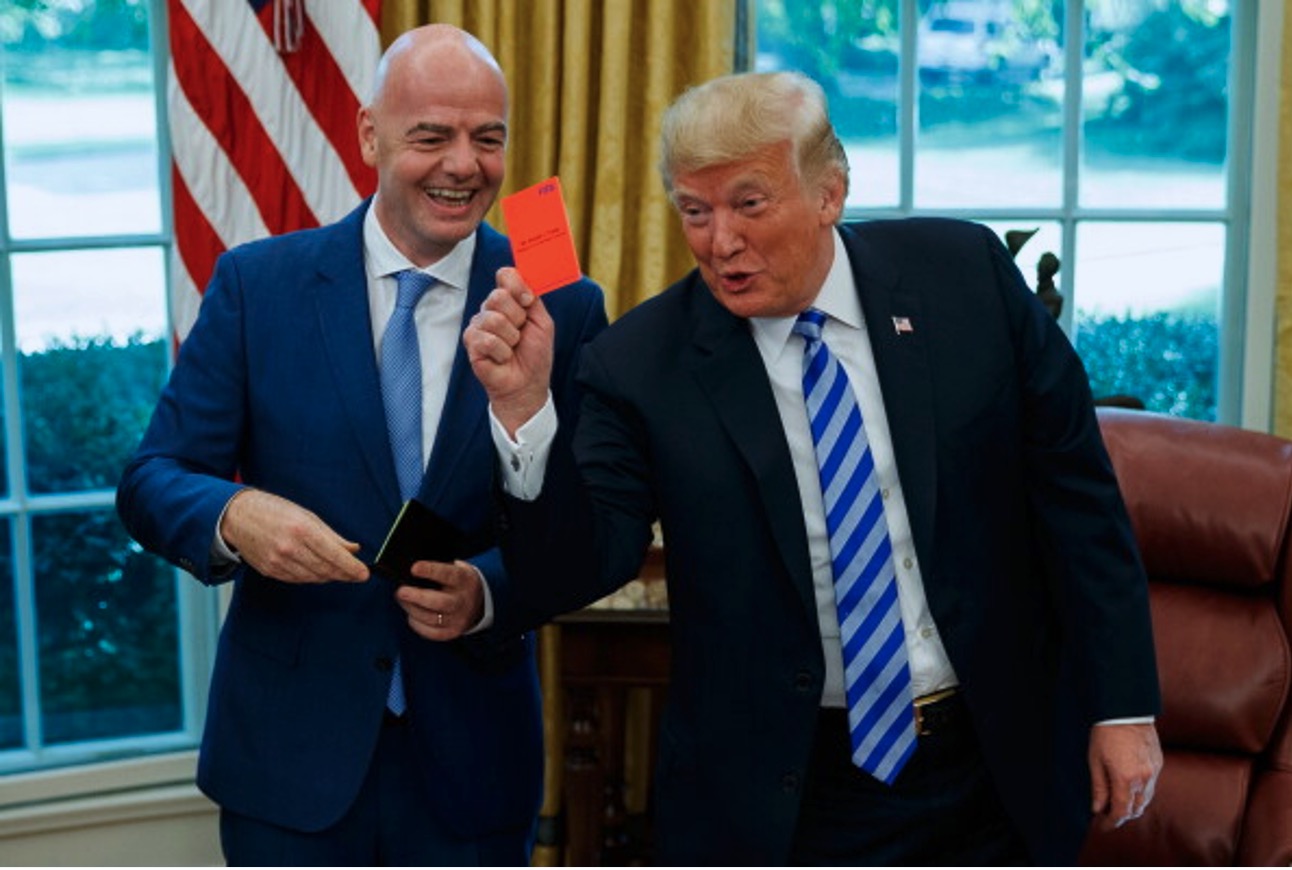
Now as to that other element. Donald Trump claims that he called the head of FIFA and asked for a review. Trump also claims expertise in soccer, although he also claims expertise in war-fighting and international trade. As in all things Trump, we have no real idea of what actually happened (if anything) but we do notice that once again, Trump has tried to make things about him. Not so, Donald. This game is about the players and what they do on the field.
The best argument U.S. fans can make – and not all that great an argument to be sure – is that this is not a unique occurrence. Back in 1962, a Brazilian player was reinstated prior to the World Cup final.
And there is one more argument to be made, although it verges on the philosophical and once again involves a baseball anecdote. Back in the old days, a Dodger pitcher was going for the record of most consecutive scoreless innings. (I think it was Orel.) Anyway, the pitcher gets into a situation which is likely to give up a run. He throws a strike, but it hits the batter. The umpire then intervenes, ruling that the batter had to make an attempt to get out of the way of the pitch. You can’t just stand there and let a strike hit you simply to get hit. Sports columnists argued that some situations demand a higher standard of compliance by the opposing players since the results are of such importance.
Let’s see how this game goes. If Belgium wins, then the whole argument becomes moot. If Belgium loses, it can either accept the result with good grace or argue in effect that the U.S. team was too good with its star player on the field, and that this should not have been allowed to happen. They might think twice before dusting off such a hackneyed argument.
Good health to both teams.
(Bob Gelfand writes on science, culture, and politics for CityWatch. He can be reached at [email protected])