Comments
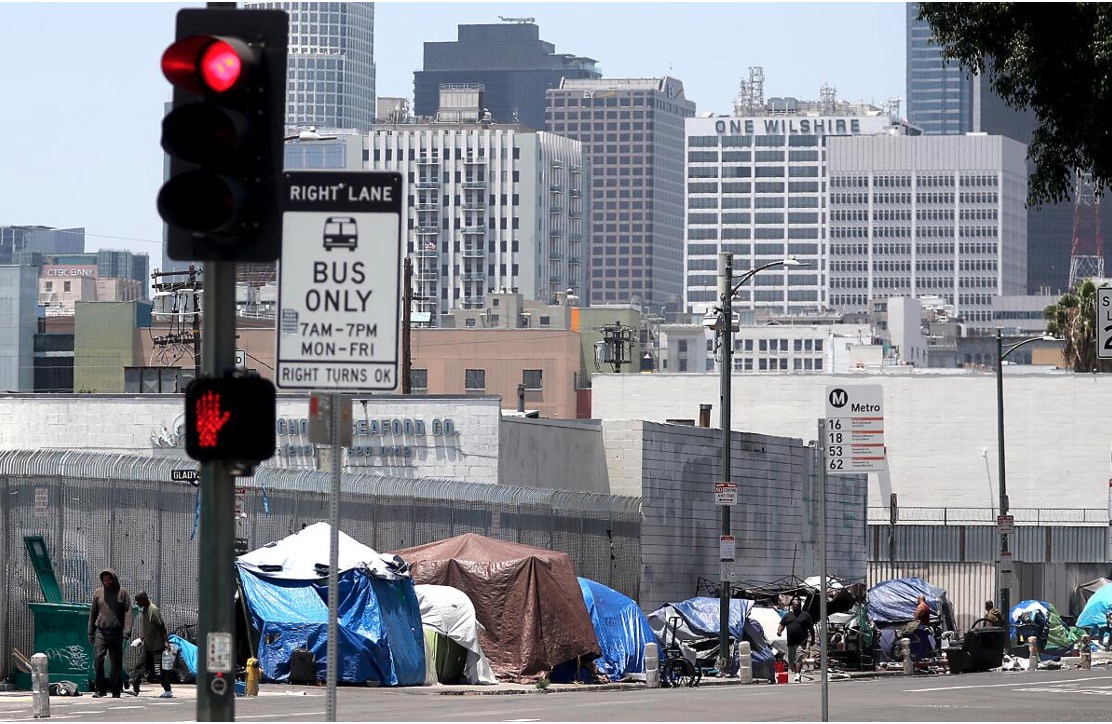
PLANNING WATCH - If you have lucked out in the Los Angeles area, you have a decent house or apartment to live in. If not, you live in a car, sleep on the sidewalk, or double-up like the overcrowded family in this photograph.
Homeless and overcrowding is not new; in fact they have been a major social problem in the United States since the Civil War, and they are now getting worse.
Sometimes it is dealt with as humor, such as in Charlie Chaplin films, even though it is very serious matter.

100 years after this movie scene, homelessness and overcrowding is again on the rise, especially in Los Angeles, because few incomes have kept up with the cost of housing. Furthermore, the current crisis is getting worse for a growing portion of the population, despite large amounts of local public money that is supposedly allocated to solve local homelessness (but not overcrowding).
What can be done? Some other countries -- notably Finland, Austria, and Japan -- do not have homeless and overcrowded crises like the United States, so we know that solutions are available, such as public housing, sometimes called social housing.
In the case of the United States, especially the Los Angeles area, the crucial decision responsible for the homeless and overcrowding crises was made a half-century ago, by the Nixon administration. Nixon ended public housing programs. except for Section 8 Voucher Programs, which are severely underfunded and leave most homeless and overcrowded people unaffected.
This means that public housing is a legacy from 50 years ago or more. While over 3000 local public housing agencies still exist, they have not built any new public housing since the early 1970s. Low-priced housing became the responsibility of non-profit agencies, which are plagued by underfunding and fraud. As a result, the lack of accessible low-priced housing is responsible for the growing number of homeless and overcrowded people in American cities, such as Los Angeles.
Their is ample vacant housing, mostly apartments, and a growing number of homeless and overcrowded people who cannot afford first and last month rent, plus a damage deposit, to rent these units. While the mass media portray this population as drug addicts, most simply don’t have enough money to afford a place to live. Even though many residents leave for cheaper housing markets, their ranks are soon filled with other local people who cannot afford a place to live unless they opt for overcrowded apartments. This is why 16 percent of renter-occupied units in the Los Angeles area are severely overcrowded. In some neighborhoods, like Koreatown, 34 percent of the population live in these conditions.
ALTERNATIVES: What do Finland, Austria, and Japan do differently to avoid the housing crisis of the US? They provide public/social housing to eliminate homelessness and overcrowding. The US could do the same, but it would depend on an agreement among Republican and Democratic officials. Since both parties long ago handed over the production of low-priced housing to the private sector and non-profits, it will be a long wait until this changes. Until then, the public must depend on officials who serve these non-profits and private home builders. Since these contractors are devoted to profitable housing construction, it will be a long wait until circumstances change for those frozen out of unprofitable low-priced housing.
(Dick Platkin is a retired Los Angeles city planner who writes about planning issues in LA. He is a board member of United Neighborhoods for Los Angeles (UN4LA). Previous columns are available at the CityWatchLA archives.)