Comments
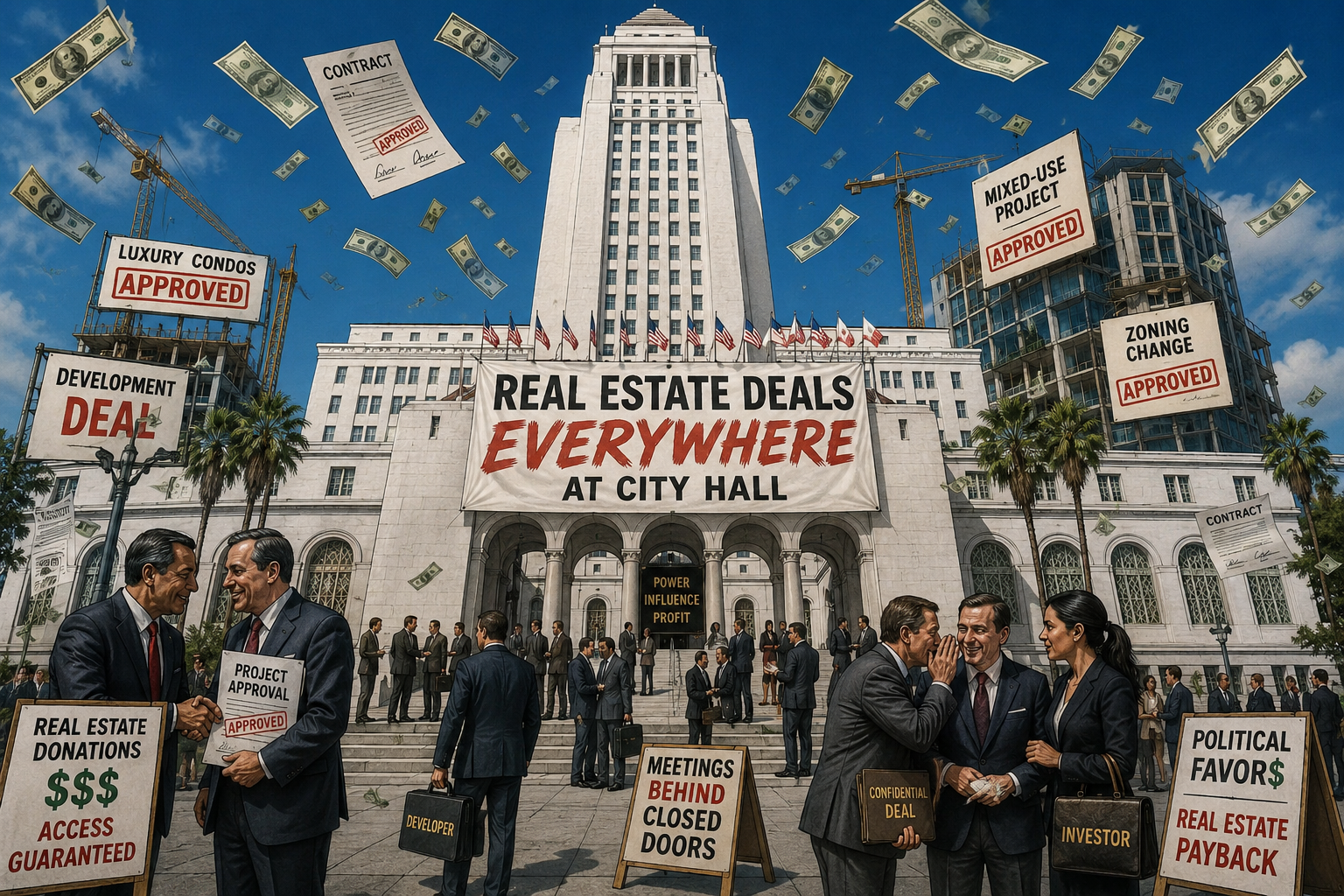
PLANNING WATCH - Anyone, like me, who has worked at LA’s City Hall, knows that real estate investors (i.e., capitalists) are everywhere in the building. They comes in all sizes, from big capitalist investors to small, but they are there, including a few at the staff level and on the City Council.
While three of the 15 members of the City Council have a connection to the Democratic Socialists of America (DSA), this hardly means that real estate investors don’t play an outsized role at City Hall, including on the City Council.
For example, the three members of the City Council with a DSA connection -- Hugo Soto-Martinez (District 13), Nithia Raman (District 4), and Eunisses Hernandez (District 13) -- have not proposed legislation based a key socialist principle: eliminating the ownership and sale of private property in Los Angeles. They did not pursue this option because this was never one of their proposals. Instead, the three DSA members support local legislation that gives tenants more clout, sometimes with support from non-DSA elected officials, but without any changes in underlying property ownership.
The priorities of the three DSA members on the LA City Council have been to replace some police officers with unarmed City employees assisting tenants in their relationship with apartment owners. This is essentially a municipal New Deal in Los Angeles, but without Federal Department of Housing and Urban Affairs (HUD) public housing, which was sidelined nationally 50 years ago, during the Nixon administration. It also does not require any structural changes in municipal government, a shared position of the three DSA-connected City Councilmembers, with the 12 non-DSA Councilmembers.
This is the essence of municipal “socialism” in Los Angeles. It is vaguely progressive, but does not require any real changes in City Hall operations.
The Community Redevelopment Agency for Los Angeles, a separate agency, did fund local low income housing projects through 2012, when it and 400+ other Community Redevelopment Agencies for other communities in California were dissolved. At present only a fraction of local, privately-owned housing is eligible for underfunded HUD Section 8 vouchers in Los Angeles, for which there are no open lists.
The reason there are so many homeless and overcrowded people in the Los Angeles area is primarily related to the end of most HUD public housing programs, beginning 50 years ago. At present, locally funded alternatives depend on municipal grants to multiple non-profit organizations. They have no interest or are unable to replace defunded public housing programs. Instead these non-profits aid those in urgent need of housing, ignoring the million who live in overcrowded conditions in LA County since they are already housed.
The result is a local housing crisis that is the worst in the entire United States, even though 54,000 people left Los Angeles County last year. The cost of housing continues to rise, with increases in homelessness and over-crowding among those who remain in Los Angeles.
LA’s housing crisis is not necessary, but solutions require the Federal government to spend much more on affordable housing. Until this bipartisan agreement is broken, there is no reason to expect appreciable change.
(Dick Platkin is a retired Los Angeles city planner who writes about planning issues in LA. He is a board member of United Neighborhoods for Los Angeles (UN4LA). Previous columns are available at the CityWatchLA archives. Please send questions to [email protected].)