
I, California Hypocrite
ELIOT'S CORNER - California thinks it can prevent global warming by telling you what car to buy and what tires you must drive on. Meanwhile, Asian pollution wafts over the Pacific, raising our ozone levels; sewage and encampments contaminate our southern coastline. Poor forest management fosters conditions for hellish wildfires, negating all the effort California has put into decarbonization.
This is environmentalism turned upside down. Its purpose should be to improve human life: cleaner water, breathable air, safe neighborhoods, affordable energy, and the freedom to build a better future. When policy makes ordinary life more expensive while tolerating persistent contamination of public space, you can politely call it hypocrisy. I call it eco fascism. California’s pollution-control effort is like trying to clear a beach of sand with a teaspoon.
The state is also hoping to phase out new gasoline-only passenger-car sales by 2035. Federal reversals and litigation have complicated its enforcement. But the political ambition is unmistakable: use regulatory power to narrow the consumer’s choices and make people poorer by policy decisions. For a homeowner with solar panels and a garage charging, an EV may be economical. For an apartment renter without dependable charging, government enthusiasm does not solve the practical problem of finding an empty charging stall and waiting over an hour for a full battery. So convenient, right? (cpuc.ca.gov)
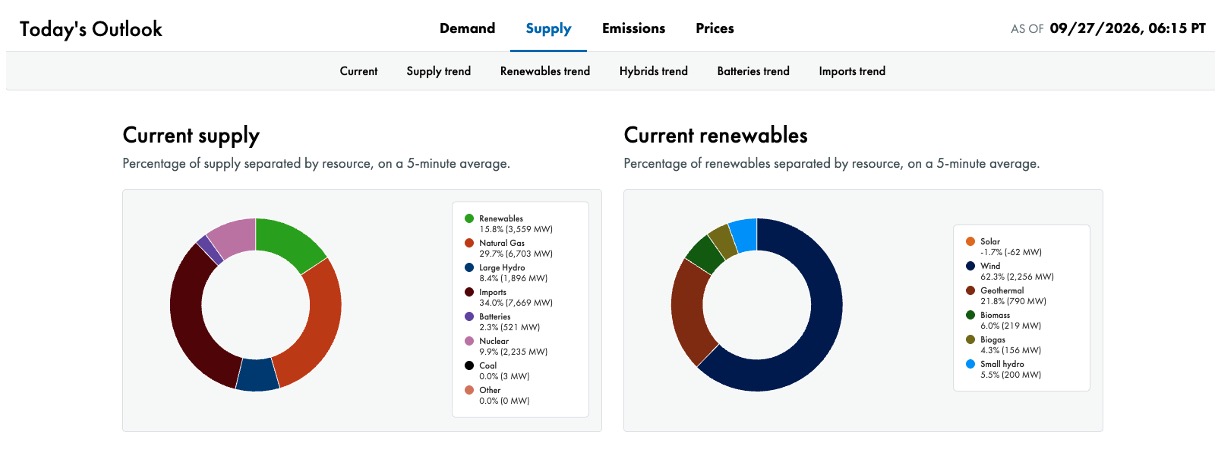
Then comes the electricity bill. In January 2025, California’s Legislative Analyst’s Office reported that residential electricity rates averaged close to twice the national average. Rates had increased about 47 percent between 2019 and 2023, compared with approximately 18 percent inflation. The report identified climate policies as a meaningful contributor alongside wildfire costs and utility-specific factors. Prices vary substantially by utility. (lao.ca.gov) When the sun is down, we must import about ~30% of our electricity and run gas-fired generators for another about ~30% of our needs. (https://www.caiso.com/todays-outlook/supply)
The central contradiction remains: politicians want more of your life to depend on electricity while the price of that electricity keeps going up and up. A retiree deciding whether to run the air conditioner is living with the consequences. So is the small business that is absorbing higher operating costs. Calling those costs a transition to a “clean energy” utopia does not make them disappear.
Now step outside the regulated home and examine the environmental conditions Los Angeles has allowed to persist. ABC7 reported that LAFD recorded 16,982 fires classified as homeless or encampment-related from January through mid-December 2025. The corresponding 2020 figure was 7,165. “Related” does not establish that an unhoused person deliberately started every fire. It does establish an enormous, recurring public-safety burden, stretching firefighting resources to the limit. (abc7.com) (California Post)
A records request for each year since 2020 returned a staggering total: more than 75,000 incidents. Consider the emergency responses, the smoke, the damaged property, and the danger to people living in and around encampments. Every response requires personnel and equipment that might be needed elsewhere. Taxpayers finance the response while their neighborhoods bear the risk, and insurance companies must charge sky-high rates to cover potential losses. Where is the uncompromising environmental urgency when the combustion occurs under a freeway overpass or in the Sepulveda Basin?
That obligation makes tolerating dangerous encampment conditions indefensible. Provide shelter, sanitation, and treatment where needed, and enforce rules against hazardous fires. Compassion should be measured by whether people become safer. Leaving mentally ill addicts playing with fire amid combustible materials is a recipe for disaster.
Human waste belongs in the discussion. California’s own Central Coast water board identifies trash and human waste from streamside encampments as threats to water quality and public health. Fecal contamination left on streets, in parks, or beside waterways will be carried by runoff into creeks, rivers, and coastal waters. No honest accounting should blame every contaminated beach on homelessness, but ignoring this source is equally dishonest. (waterboards.ca.gov)
Residents should not have to step around feces on a sidewalk or wonder whether a park is full of fleas carrying typhus. People living outdoors need usable toilets and waste collection. Neighborhoods need prompt cleanup and consistent enforcement. These are basic responsibilities of a functioning city. We should not require a constitutional/philosophical debate every time someone asks government to perform basic services.
Street vending exposes another uncomfortable contradiction. A restaurant operates within an inspection and permitting system. Yet unpermitted operations escape effective enforcement; those who follow the rules compete against businesses avoiding large burdens. Is this fair? Public sidewalks become cooking and dining space, and neighbors inherit the smoke, waste, and congestion.
The concerns are documented. In April 2026, the Pacific Palisades Community Council approved a request to investigate street vendors’ cooking practices. The concerns include charcoal and propane cooking next to parked vehicles, missing handwashing facilities, no proper refrigeration, and allegations that cooking grease was washed into a storm drain. These are community observations submitted for enforcement. (Pacific Palisades Community Council)
Los Angeles itself acknowledged the pollution problem when it announced a grease-collection pilot for vendors along the Salvadoran Corridor. The city said the program would keep fats, oils, and grease out of storm drains, Ballona Creek, and Santa Monica Bay. That is if any of the Taqueros use it. It also confirms that questions about street-food waste reaching waterways are grounded in an actual municipal concern. (Council District 1 Welcome Site)
Why should a new homeowner pay for expensive gas-stove upgrades when outdoor kitchens can go wild with smoke and grease? Indoor and outdoor exposures differ; regulations need not be identical. But public-health principles must be consistent. A flame does not become environmentally virtuous simply because the business using it is on a sidewalk, “undocumented”, or camping under a freeway overpass.
Then there is the Tijuana River, where decades of cross-border wastewater contamination make California’s environmental failures easy to smell. On September 23, federal health officials released an assessment for public comment warning that hydrogen sulfide and odors in the river valley can negatively affect health. Residents have been living with the consequences while governments dither. (www.atsdr.cdc.gov)
“Industrial chemicals and untreated sewage have polluted the Tijuana River for decades, recently causing >1300 consecutive days of California beach closures. In summer 2024, wastewater flows surged to millions of gallons per day despite no rain, enhancing water-to-air transfer of hydrogen sulfide (H2S) and other toxic gases at a turbulent hotspot. High wastewater flows and low winds led to nighttime H2S peaks, reaching 4500 parts per billion (ppb)—exceeding typical urban levels of <1 ppb. Recent studies validate long-dismissed community voices and highlight an environmental injustice.” (Science.org)
Mexico and Washington bear major responsibilities, and California cannot rebuild another country’s sewer system. Some treatment improvements are ongoing, and state funding is real. But people living near the pollution deserve completed infrastructure and measurable relief. They should not have to breathe the stink between one government’s promise and another government’s jurisdiction. (www.epa.gov) California has done a poor job enforcing water quality permits, monitoring, warning about health risks, controlling trash and sediment, and restoring the estuary before the water enters the ocean.
But two San Diego County Supervisors, Paloma Aguirre and Terra Lawson-Remer, want the county to stop waiting for a federal solution and study a system that would capture and treat all the water in the river. Of course, this requires raising sales tax, but it might be worth it.
A UCLA-led study estimated that California’s 2020 wildfires released roughly twice as much greenhouse gas as the state’s annual emissions reductions between 2003 and 2019. Protecting forests and communities deserves urgency commensurate with the scale of the destruction wrought by such fires. (ph.ucla.edu)
Put these failures beside the restrictions imposed on ordinary residents. The political system can specify what equipment belongs in a new home, yet cannot deliver sanitary sidewalks, or safe food vending, fewer encampment fires, and clean coastal water. Taxpayers finance the regulatory apparatus, pay the energy bills, and then finance cleanup and emergency response. Their reward is another tax increase.
California also talks about wind and solar power as though producing electricity without a smokestack makes the equipment pollution-free. Wind turbines do not arrive carbon-free. A life-cycle assessment by turbine maker Vestas puts the upfront manufacturing and materials footprint of one 6.2-megawatt turbine, including its share of the foundation and wind farm infrastructure, at roughly 3,900 metric tons of carbon dioxide equivalent before it produces electricity. Its fiberglass composite blades are difficult to recycle, and many end up in landfills. Not to mention the trillions of insects and thousands of birds these wind farms kill.
Solar panels likewise take materials and energy to manufacture, and their disposal cannot be waved away: some retired panels contain enough lead or cadmium to require hazardous-waste handling. Wind and solar may reduce emissions from generating electricity; that does not erase the environmental costs of building them or answer who pays to clean up when they wear out.
Environmental policy should advance human flourishing. Affordable cooling, reliable transportation, safe cooking, productive businesses, clean parks, and usable beaches all belong in that definition. A policy that treats comfort, mobility, and prosperity as expendable while turning a blind eye to cumulative environmental problems, both small and large, cannot be a guardian of sustainability.
Build reliable energy. Make cleaner choices affordable. Stop sewage discharges. Provide sanitation and consistently enforce fire and food-safety rules. Demand evidence that public money improves public conditions.
Until then, the message is unmistakable: sacrifice more, pay more, accept fewer choices, and try not to notice the smoke, sewage, and trash outside.
I, California Hypocrite.
(Eliot Cohen is a longtime civic advocate who has served on the Neighborhood Council, the Van Nuys Airport Citizens Advisory Council, and the Board of Homeowners of Encino, where he was president of HOME for over seven years. A retired Wall Street executive with a 35-year career, Eliot brings a sharp eye to local governance. He critiques the bureaucratic missteps of City, County, and State officials. Eliot and his wife split their time between Los Angeles and Baja Norte, Mexico.)