

From Homer to Hollywood’s The Odyssey: The “Oppenheimer of Ithaca”
SOME THOUGHTS - I watched Christopher Nolan’s The Odyssey, but for three hours I was transported somewhere much older than Brooklyn. As the opening images appeared, I wasn’t only watching the screen. I was watching my childhood classroom return to me – only this time, it belonged to someone else’s imagination.
That is the strange privilege of watching Homer as a Greek living abroad. The story first told in my native language is deeply familiar, yet it can still surprise me. Long before I understood Homer as foundational Western literature, I knew him as part of growing up.
This deep cultural connection is why I believe the film has divided audiences. Many expected the literal Odyssey they remembered from school. Instead, Nolan gives us something unmistakably his own: not ancient Greece exactly, but Nolan’s Greece.
I found myself repeatedly forgetting that I was watching an adaptation of a poem I grew up reading, discussing, and reciting passages from aloud (third grade of primary school, seventh grade of middle school, and tenth grade studying Homer in the original Ancient Greek). Nolan turns Homer into an immersive cinematic experience, aided by an extraordinary score. Yet its biggest strengths are also its biggest weaknesses.
The piercing light of the Aegean is missing. Reports indicate some shooting took place on the black sands of Iceland’s beaches. But Greece is more than ruined temples and spectacular landscapes. It is a particular light, a blue sea, and an atmosphere that generations of Greeks instinctively recognize. That light is not merely aesthetic. It is part of the world in which a particular conception of humanity emerged: the individual, the citizen, the political community, and democracy. Watching the film, I often felt I was seeing an imagined Greece rather than the one that existed – and still exists.
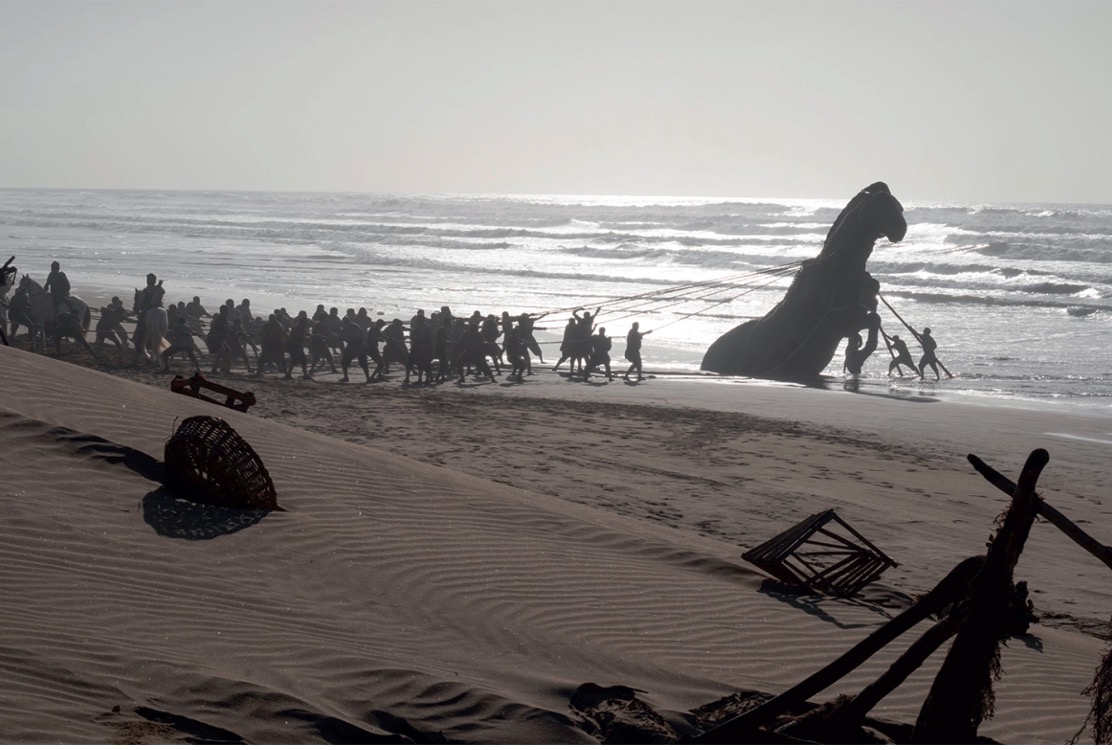
Furthermore, Homer’s Odyssey is, above all, a story about the grueling journey home rather than the glory of war. The resourceful Odysseus of the classroom is now a complicated man who is existentially tormented, carries immense guilt, and remembers the Trojan Horse. Odysseus is transformed into... the Oppenheimer of Ithaca. In that respect, Nolan’s interpretation is far more thoughtful than many critics have acknowledged. Perhaps fidelity to Homer lies less in reproducing every episode than in keeping alive the impulse to reinterpret him.
Like every great work of art, the film is both brilliant and flawed. But perfection was never the point. The Odyssey has survived nearly three millennia because every generation finds a new way to reinterpret it.
That may be Christopher Nolan’s greatest achievement. It isn’t that he perfectly recreates the ten-year journey of Odysseus. It is that millions of people around the world are talking about Homer again. The passionate arguments the film has provoked suggest that The Odyssey was never meant to end discussion, but to begin it.Every reader carries a private Homer. Nolan could only give us his own.
Tradition tells us Homer himself was blind. He could never have envisioned IMAX cameras, 70mm film, or a packed cinema with a Hollywood blockbuster. Yet within all of us there is an Odysseus, a Penelope, a childhood, or even a Cyclops (the darkness and chaos within us). We recognize ourselves in these ancient Greek figures because their struggles are still our own.
An expanded version of this article first appeared in The National Herald of New York, the leading newspaper of the Greek diaspora and the Greek American community.
(Dimitris Eleas (NYC-based, originally from Athens, Greece) is a writer and political scientist. His essays and articles have appeared in the Washington Examiner, Foreign Affairs (Hellenic Edition), and The Books’ Journal, while his letters have been published by The New York Times, The Wall Street Journal, and The Washington Post. He is the author of the Greek novel-essay When Shakespeare Was Lost, 1585–1592 (Govostis Publishers, 2025) and is currently developing an English novel-essay, The Black Birds of Warsaw, set against the backdrop of the Holocaust. He can be contacted at: [email protected].)