

How One Supportive Housing Provider Held Venice Beach Hostage
WESTSIDE - On a single day in January, 2014, the bodies of two dead residents were discovered in their apartments at 15 Horizon, a 20-unit supportive housing facility adjacent to the Venice Boardwalk. Representatives from Venice Community Housing Corporation (VCHC), who have owned and managed the property since 2011, told the LA Weekly “much of the staff had been out for the holidays, possibly leading to the discovery of both bodies on the same day” from a building the Weekly said “serves as an alcohol and drug recovery house of sorts”. The victims were both men in their forties. One died of a drug overdose, the other from natural causes.
According to a longtime neighbor of 15 Horizon, “Basically, VCHC would not address anything let alone hire security for years. The drug dealing got so bad there would be 3 big busts a year with multiple people being arrested…Finally, they moved all the drug dealing and the hookers around to the back door, and we thought that was a victory.”
According to their website, VCHC currently owns and operates 196 units of supportive housing in Venice Beach. Publicly available tax data shows that as of 2024 they have $134 million in assets, $39.9 million in revenue and $16.8 million in expenses.
Four of VCHC’s Venice properties, totaling 81 units, were approved during the tenure of former CD11 Councilmember Mike Bonin. In one of his final acts as Councilmember, Bonin gifted VCHC $27,500 in discretionary public funds for “homeless services”. He also personally lobbied the City Council on behalf of VCHC’s largest project, the 120-unit Venice Dell development. Faizah Malik, the lead attorney on a lawsuit against the city in support of Venice Dell, hosted a fundraiser for Bonin during his 2021 campaign; he returned the favor four years later when Malik ran against incumbent Traci Park for the same seat, ultimately losing that election by over 20%.
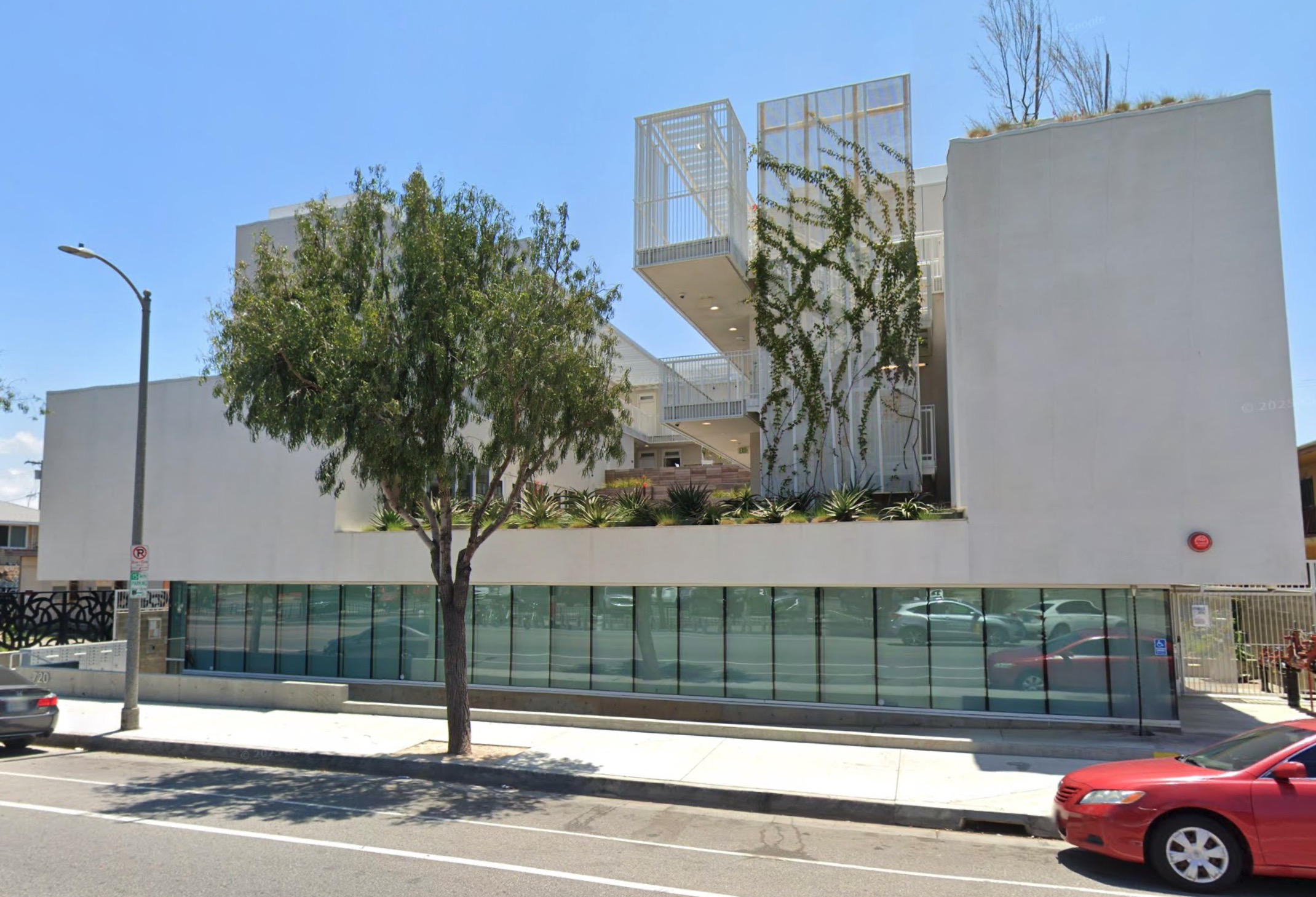
The Rose Apartments on Rose Ave. in Venice
In 2022, VCHC opened the Rose Apartments, at the site of its headquarters on Rose Avenue in Venice, opposite a Whole Foods market. Designed by award-winning architects Brooks + Scarpa, the gleaming, four story, 35 unit building looms above the surrounding neighborhood, where two-bedroom apartments typically rent for about $5000 per month. Residents at the Rose – picked from LAHSA’s Coordinated Entry System (CES) – pay between $548 and $913 a month for studio and one-bedroom apartments. The building cost $20.6 million to build, $7.2 million of it from Proposition HHH funding, a bond measure passed in 2016 paid for with a property tax assessment. A developer’s fee of $2.4 million was paid to VCHC.
Since January of this year, there have been 181 reported crimes within 500 feet of 720 Rose Avenue, according to the LAPD’s Crimemapping app. Forty-seven of these involved in assault. These included an incident on May 7th of this year in which Justin Tucker, a resident of the Rose Apartments, retrieved a sword from his apartment and attempted to slice off the arm of a man who’d asked him if he knew where he could buy some drugs.
By comparison, there have been just four crimes (including one “nonaggressive” assault at a nearby park) during the same period in the 500 feet surrounding the 98-unit Thatcher Yard, a similar supportive housing facility located less than a mile south of 720 Rose. But unlike VCHC, the operator of that facility – Thomas Safran & Associates – conducts a criminal background check going back seven years for each of the applicants (also culled from CES) for their projects and has stated that “past criminal history will be grounds for rejection”. According to TSA, they received about 10,000 applications for apartments at Thatcher Yard.
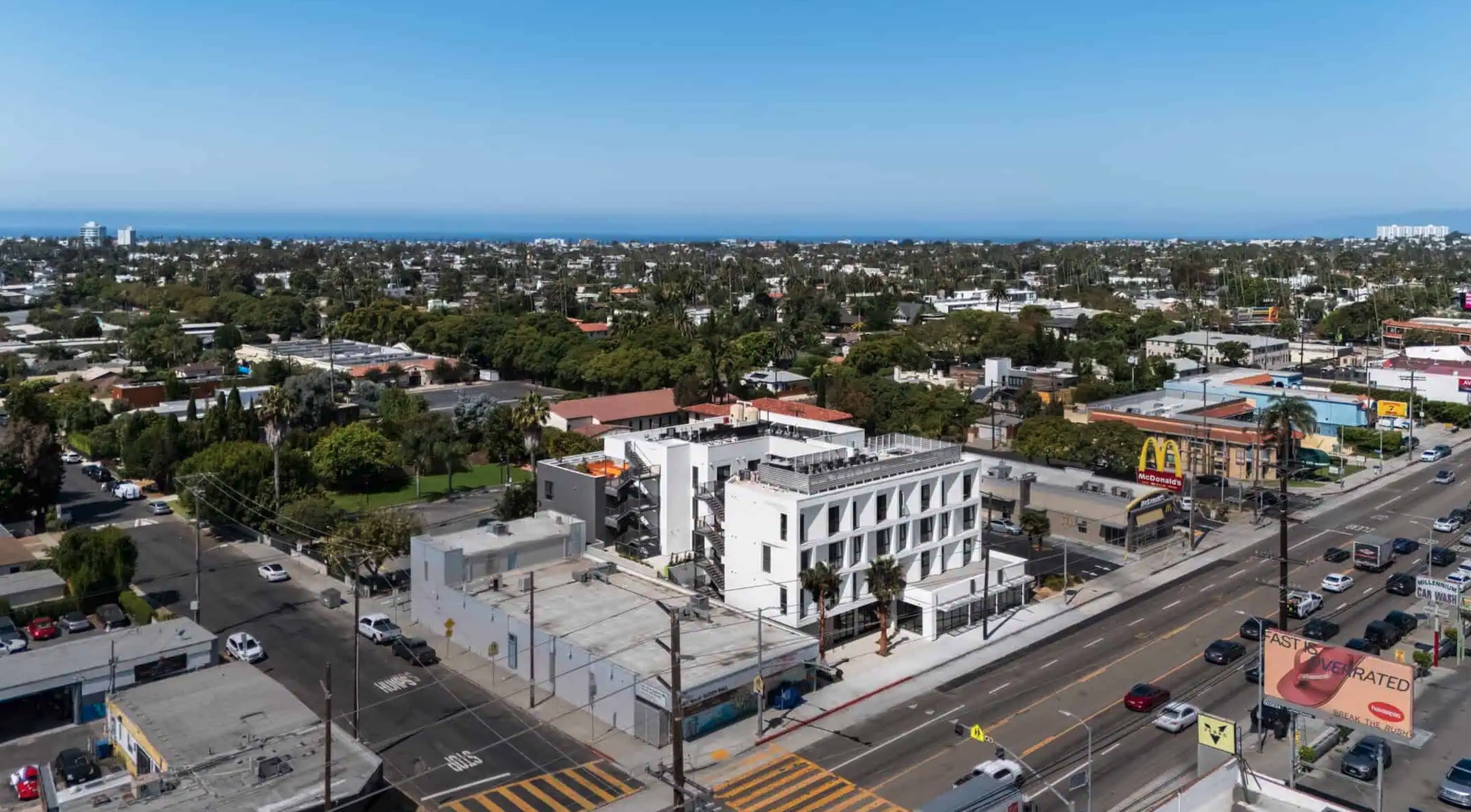
Journey apartments on Lincoln Blvd.
In 2024, VCHC, in collaboration with Safe Place For Youth (SPY) opened the 40-unit Journey Apartments on Lincoln Blvd. just north of Washington Blvd. Located adjacent to St. Mark Catholic School and within two blocks of two other elementary schools, on the site of SPY’s existing service center, the project faced stiff community opposition when it was proposed. One Venice resident, echoing many of their neighbors’ sentiments, wrote in their public comments to the city: “Literally every corner of Venice is terrorized by [VCHC}. It's not even homeless people's fault; there's no rules or consequences … PICK A DIFFERENT SERVICE PROVIDER AND NOBODY WOULD CARE!”
With Bonin’s support, the project was ultimately approved. He touted the Journey’s groundbreaking on his Facebook pages, stating that “The housing, along with accompanying supportive services, will provide stability, dignity and security, allowing residents to move off the streets and thrive.”
The worst fears of the project’s opponents appear to have been realized. On June 29, nearby residents attended a packed meeting at St. Mark School to vent about what they’d witnessed since the Journey had opened: fights, open drug use, the ever-present, nauseating stench of urine and piles of human waste, car break-ins and parents and children being harassed and threatened as they pulled up to the school. One neighbor stated he’d found dead bodies near the facility, and a YouTube video compiled by another neighbor featured a photo of the LA coroner’s van in front of a covered body on the sidewalk in front of the Journey. Traumatized speakers said their calls to VCHC, the LAPD and the CIRCLE team had been largely ignored.
But the VCHC representatives there volunteered no solutions; VCHC’s co-Executive Director Allison Riley, when asked by Fox News whether she had a response replied “I’m not going to be interviewed on camera today. It’s just not part of my plan.”
Traci Park was also on hand, pointing out that if the Journey were any other kind of business posing this kind of public health and safety risk, it would have been closed. She told the assembled crowd that on June 20th, she had submitted a motion to the City Council specifically mentioning VCHC’s failure to take the community’s health and safety into account. Noting that Justin Tucker, the sword-wielding resident of the VCHC’s Rose Apartments who had nearly amputated someone’s arm, had a “long, violent criminal history” prior to moving into the Rose, Park’s motion instructs the City Attorney to report in 60 days on the “feasibility of conditioning city funding for permanent supportive housing projects on the provision of background checks and comprehensive behavioral-health and risk assessments, in addition to screening out individuals with violent criminal histories” . The motion was referred to the Housing and Homelessness Committee, chaired by CD4 Councilmember (and Mayoral candidate) Nithya Raman, who famously told a group of stakeholders in her district that “I don’t think a kid is going to be safer if an encampment is 10 feet or 500 feet away from a school”. Even if it passes out of committee and goes in front of the entire council, it’s unclear if it would have a significant impact on projects like the Rose or the Journey, who have both already received their millions of dollars in taxpayers' money. For the much larger Venice Dell, however, the impact (if it is ever built) could be profound.
Twelve days later, in response to a request for an interview with VCHC’s staff regarding the meeting at St. Mark, my colleague Nick Antonicello received the following statement from VCHC: “Homelessness is one of the hardest, most polarizing problems our community faces, and the frustration on display Monday the 29th is something we understand. But let’s be clear: Venice Community Housing didn't create this crisis — we exist to help solve it. Our job is to get people off the street into stable housing, to provide supportive services, and to be a good neighbor while we do it. We won't pretend it's easy or that we're perfect. But we're working every day to improve conditions in Venice, alongside residents, the Council office, partner service providers, and LAPD.”
In the end, the issue is not just whether this one apartment complex will be allowed to wreak havoc in the surrounding neighborhood. Rather, will a deep-pocketed homeless housing provider with close ties to city government ever have to face a reckoning for all of the damage it has wrought?
(Angela McGregor is a Los Angeles investigative journalist and longtime Venice resident whose reporting focuses on homelessness, housing policy, public accountability, and local government.)