
High LADWP Bills: How Politicians Decry the Rate Machine They Built
CITY BLUES - Many of the employees at Canter’s Deli in the Fairfax district have worked there for 30 or 40 years. Owner Marc Canter calls them family. This fall, the iconic restaurant’s monthly LADWP bill jumped from $24,400 to $35,711. Warning that jobs could be on the line, the third-generation owners now turn off the air conditioning in one dining room from midnight to 8 a.m. to cut costs.
The story caught fire in the San Fernando Valley when Micah Reed opened a two-month LADWP bill for $3,322—more than $2,100 of it for electricity. Reed turned his shock into a viral video that captured news headlines and put a citywide spotlight on the crisis. By Tuesday, October 27, he channeled that media momentum into direct action, delivering a petition with nearly 40,000 signatures straight to the LADWP Board of Commissioners.
With the mayoral election just days away, City Hall leaped into action. Councilmember Nithya Raman, challenging Mayor Karen Bass, accused the Mayor’s LADWP appointees of driving up rates 40% "through what feels like a loophole" and demanded an audit. Bass countered by calling for an outside audit of her own. Then, on October 27, her appointed Board voted to suspend shut-offs through year-end and review electric rate rules. It’s a familiar City Hall ritual: public outcry, political grandstanding, and temporary band-aids.
Yet beneath the political theater lies a stark truth: the eye-popping bills landing in mailboxes are no surprise glitch. They are the direct mathematical result of rate structures, automatic formulas, taxes, and fee hikes that City Hall explicitly approved, and in several cases, with the votes and signatures of the very politicians now decrying them.
Who Signed Off on Your Bill
The Base Rate Illusion
Board President Allan Marks, appointed by Mayor Karen Bass last November and confirmed by the City Council in December, claims the surge is mostly about heat: hotter days, more air conditioning, and bigger bills. He points out that only 2% of accounts hit $3,000 or more. But in a system serving 1.5 million customers, 2% still translates to 30,000 households facing financial shock. More importantly, heat explains how much power people used, not why the City charges so much more for it.
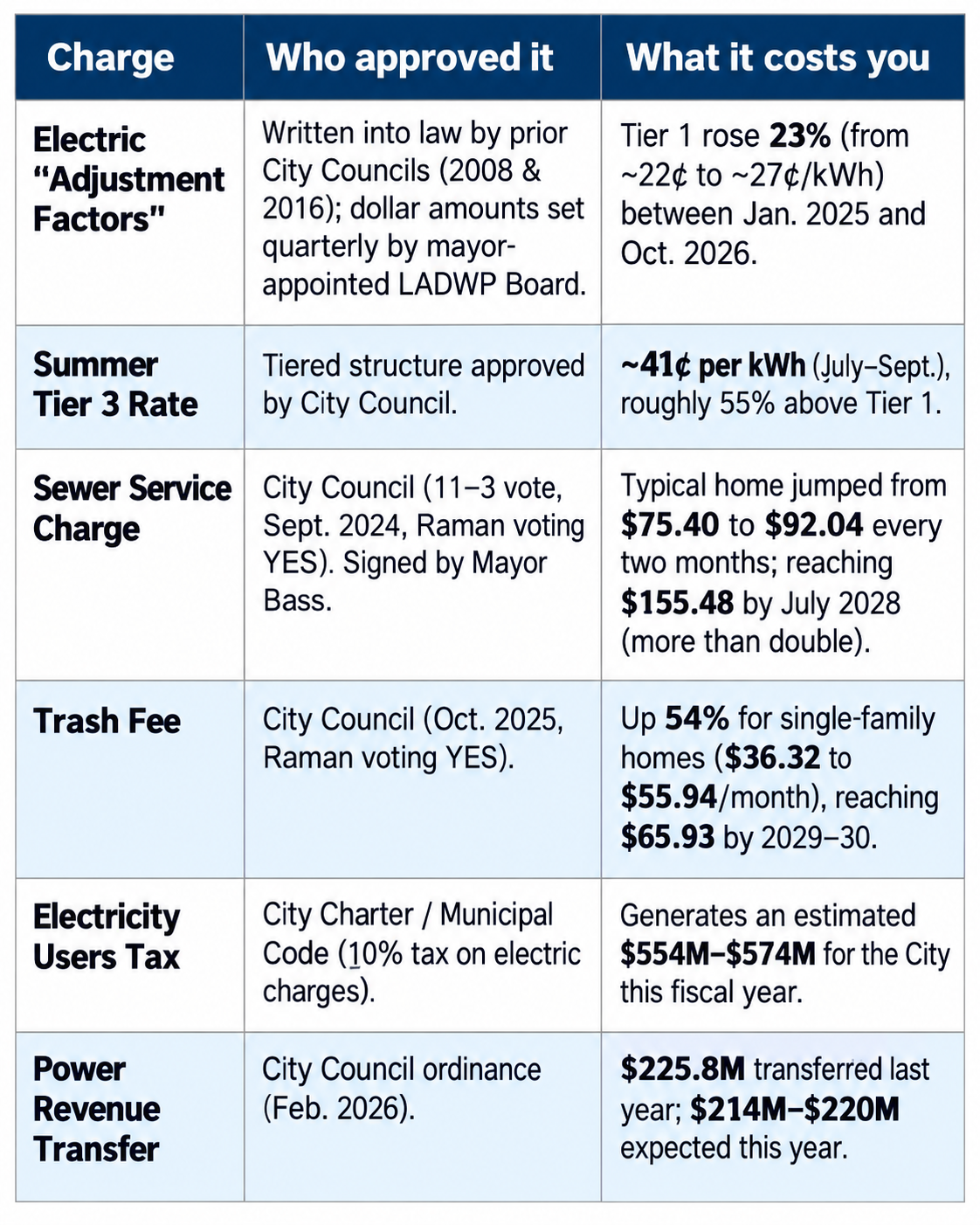
City officials can claim with a straight face that LADWP’s base electric rates haven’t changed in years. That is the political trick. The steady price increases actually arrive through quarterly pass-through “adjustment factors” for fuel, reliability, and renewable energy. Prior City Councils wrote these automatic formulas into law in 2008 and 2016, long before Bass or Raman took office. Since then, the Mayor-appointed Board has set the specific dollar amounts, driving Tier 1 rates up 23% in under two years.
Raman is right that it feels like a loophole, but the City Council is no helpless bystander. Under Section 245 of the City Charter, the Council can assert jurisdiction over almost any Board decision within five meetings. With 10 of its 15 votes, it can send a rate decision right back to the Board. The Council even set that precedent in 2010 when it challenged a Board ruling on the Energy Cost Adjustment, one of the exact pass-through charges inflating today’s bills. City Hall has always possessed the authority to push back.
For residential customers billed every two months, a summer heat wave delivers two full months of cooling costs on a single bill. Because tier limits are set on a monthly basis, high summer air conditioning usage rapidly rushes households into top-tier pricing. The peak rate, Tier 3, climbs to roughly 41¢ per kWh from July through September.
The Fees They Voted For
Electricity is only part of the story. LADWP also serves as the collection agency for City Hall, bundling sewer charges, trash fees, and city taxes onto a single utility statement.
Canter’s Deli illustrates how this bundling inflates the total bill. According to LADWP, the restaurant’s electricity usage remained flat. Yet over three months, its power charges rose 6.6% and water charges increased 21.6%, while its sewer charges surged by 45%. When LADWP suggested a leak might be responsible, the Canters dismissed the claim, pointing out that businesses and residents across Los Angeles are seeing the exact same spikes.
LADWP doesn’t set sewer rates; the City Council does. In September 2024, the Council voted 11–3 to raise sewer charges by 22% overnight, locking in scheduled increases that will more than double them by 2028. Councilmembers Monica Rodriguez, Heather Hutt, and then-Councilmember Kevin de León voted no. Councilmember Nithya Raman voted for the multi-year hike, and Mayor Karen Bass signed it into law just three days later.
Next came the trash fee. Scrambling to cover a nearly $1 billion budget hole, the City Council voted to raise trash fees for single-family homes by 54%. It was the first fee hike in 17 years. Raman voted in favor, calling it a tough choice, while Rodriguez and Nazarian cast dissenting votes.
City Hall Profits When Your Bill Rises
City Hall profits directly from your higher bill. The City slaps a 10% Electricity Users Tax on top of power charges, expected to rake in $554 million to $574 million this year. Meanwhile, a February 2026 Council ordinance skimmed $225.8 million from LADWP power revenues into the City budget, with another $214 million to $220 million queued up next. As power bills skyrocket, the City reaps the tax windfall.
Pointing Fingers, Ignoring Their Own Signatures
In the campaign’s final week, both candidates are using each other’s records as political weapons. Mayor Bass reminds voters that Councilmember Raman voted to raise trash fees on every LADWP bill. Raman counters that Bass failed for four years to hold her own appointed utility commissioners accountable. Both accusations are completely true, and both candidates conveniently leave out their own votes and appointments.
However, Micah Reed, whose $3,322 bill sparked the outcry, remains unimpressed by both sides. After listening to both campaign platforms, he says he has yet to hear a single promise that will bring genuine relief to residents.
Why Campaign "Fixes" Fall Short
Campaign fixes ignore the underlying accounting:
- Shut-off moratoriums push unpaid balances into future debt instead of cutting rates. As CityWatch contributor Jack Humphreville reported, more than 400,000 customers are already struggling with unpaid bills.
- Level Pay programs, promoted by Mayor Bass, spread high bills over a 12-month period without cutting total costs, often surprising households with a hefty settlement bill when annual usage is reconciled.
- Audit promises stall over political disagreements, as Mayor Bass calls for an external firm while Councilmember Raman points to the elected City Controller. Regardless of who inspects the books, no audit has the power to undo a fee or repeal a transfer passed by the City Council.
The heat wave has passed, but the fees remain. The sewer charge continues climbing through 2028, and the trash fee will keep rising through 2029. Until local leaders take ownership on these rate structures, their promises of relief remain nothing more than campaign spin on a political merry-go-round.
(Ziggy Kruse Blue and Bob Blue are frequent contributors to CityWatchLA. They can be reached at [email protected])