
LA's Adaptive Reuse Plan Won't Solve the Housing Crisis—And Could Cost Jobs
MIXED USE METAPHOR - Los Angeles has a habit of embracing silver-bullet solutions to complex problems. The latest arrived on the first day of February 2026, when the city's expanded Adaptive Reuse Ordinance (ARO) took effect. Touted as a cure for both vacant office buildings and the housing crisis, the ordinance allows many commercial buildings to be converted into apartments "by right," with little or no discretionary review.
It is an appealing vision. It is actually a dangerous illusion.
The expanded ARO is less a housing strategy than a regulatory shortcut. It assumes that almost any underutilized commercial building can become quality housing if government simply gets out of the way. In reality, it risks producing cramped luxury apartments, permanently shrinking Los Angeles' employment centers, and bypassing the planning process that protects neighborhoods and taxpayers.
Supporters point to Downtown Los Angeles' 1999 Adaptive Reuse Ordinance as proof that conversions work. But those projects largely involved historic buildings with shallow floor plates, generous windows, and layouts naturally suited for loft living. Today's targets are very different: post-1980 office towers, suburban office parks, and medical complexes designed around deep floor plates that leave much of each floor far from natural light. Converting these buildings into livable housing often requires extensive structural alterations, expensive plumbing retrofits, and awkward floor plans. By extending eligibility to buildings as young as 15 years old, Los Angeles is encouraging developers to force residential uses into buildings never designed for them.
Those realities shape the economics. Faced with costly conversions, developers maximize returns by building the smallest units possible. The result is more luxury micro-studios for affluent singles—not the family-sized, “missing middle” housing that represents one of the city's greatest unmet needs. Meanwhile, many projects become financially feasible only because developers avoid infrastructure obligations that would normally accompany major residential development, leaving taxpayers to absorb the costs of upgrading streets, utilities, drainage, and other public improvements.
The ordinance also threatens to cannibalize commercial districts that remain essential to Los Angeles' economy. Remote work has changed office demand, but every successful city still depends on employment centers, neighborhood retail, medical offices, and creative industries. Once those buildings become apartments, that economic capacity is lost.
The ordinance's shortcomings are no longer theoretical. They are already playing out in Sherman Oaks.
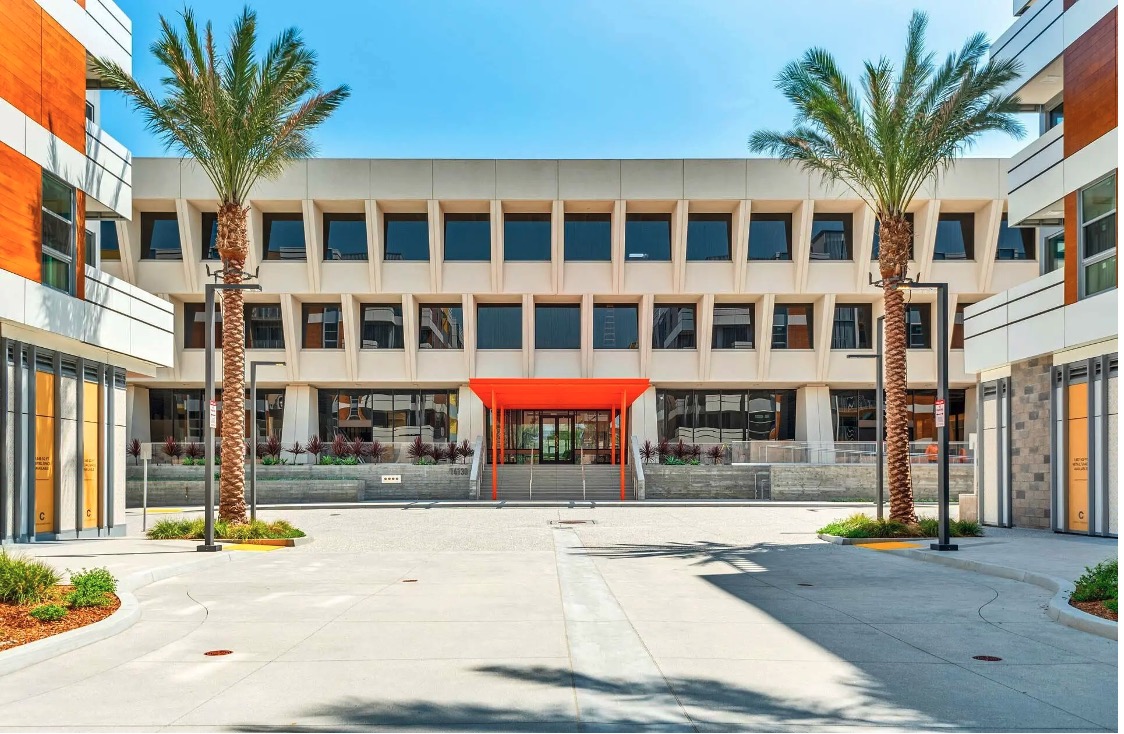
In 2020, after years of public hearings and negotiations, the Los Angeles City Council approved the Citrus Commons redevelopment of the historic Sunkist headquarters. The compromise allowed 249 apartments while preserving the landmark office building as a commercial employment anchor with more than 126,000 square feet of office space.
That balance lasted only until the expanded ARO took effect. Within weeks, IMT Residential filed plans to convert the office building into 97 additional apartments through the ordinance's administrative "by-right" process. There were no community meetings, no public hearings, and no opportunity for residents to revisit a compromise that had taken years to negotiate. A carefully crafted public agreement was effectively erased with the filing of paperwork.
The Sunkist project illustrates a deeper problem. By shifting major land-use decisions into an administrative approval process, Los Angeles has largely removed discretionary planning from the equation. Projects that fundamentally alter neighborhoods can now proceed without meaningful public review of their impacts on infrastructure, traffic, parks, schools, or long-term employment capacity. Administrative efficiency has replaced thoughtful planning.
The Sunkist case also exposes an uncomfortable irony. As City Planning increasingly shifts major land-use decisions into administrative, "by-right" approvals—not only through the expanded Adaptive Reuse Ordinance but also through other sweeping initiatives such as the proposed Missing Middle Ordinance—it is steadily diminishing its own role. A Planning Department exists to evaluate how development affects neighborhoods, infrastructure, employment, and quality of life through professional judgment and public engagement. If its primary function becomes simply verifying whether projects qualify for automatic approval, then it is no longer planning—it is processing paperwork. In its pursuit of efficiency, the city risks making one of its most important planning institutions increasingly irrelevant. Administrative efficiency has replaced the need for professional planners.
Los Angeles cannot solve its housing shortage by destroying its long-term job center capacity. Nor can it build its way out of the crisis by relying on the leftover scraps of a volatile commercial real estate market. If City Hall wants to enact true structural reform, it must confront the root causes of our housing shortage through comprehensive citywide zoning reform that allows for higher-density, multi-family housing along transit corridors while preserving commercial corridors and employment centers that remain vital to the city's economy. It should also invest directly in dedicated affordable housing. The 2026 Adaptive Reuse Ordinance is not comprehensive planning. It is a concession that prioritizes administrative speed and developer profitability over livable neighborhoods, balanced land use, and meaningful public participation. Los Angeles should stop hunting for mythical quick fixes and start building a city designed for people to truly live and work.
And if City Hall truly believes every underutilized office building should become luxury housing, perhaps it should begin with its own.
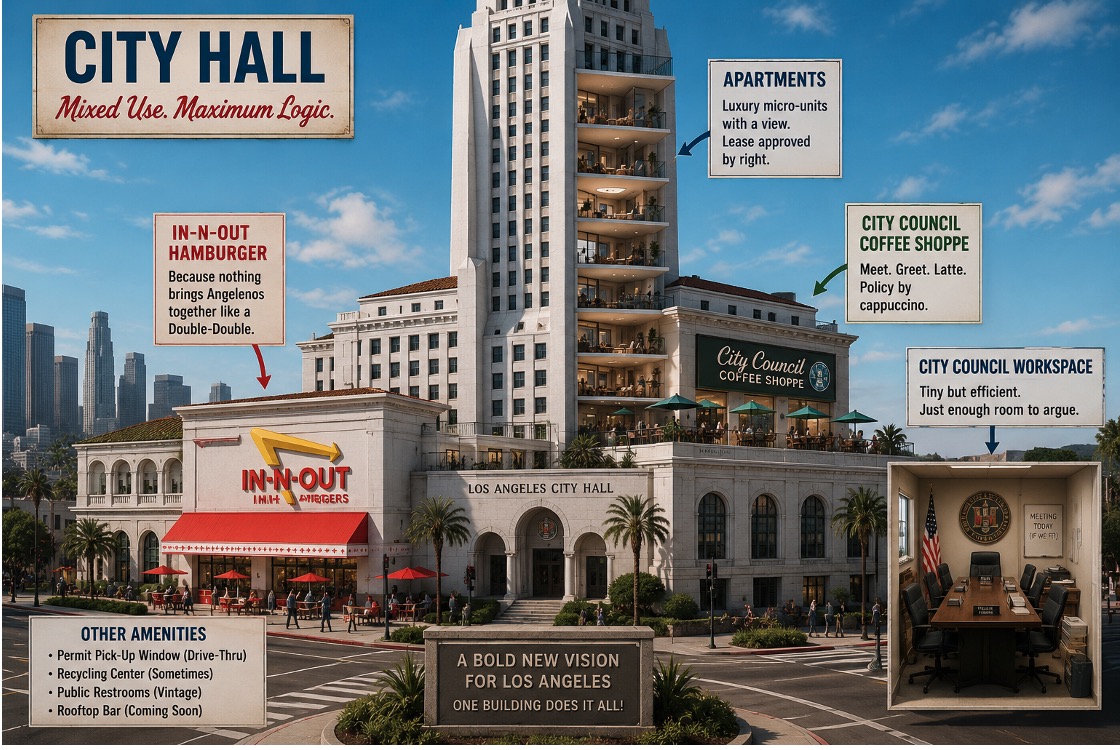
In the spirit of the new ordinance—and following the blueprint now being applied to the historic Sunkist headquarters—the next adaptive reuse opportunity is obvious: Downtown City Hall. With its cavernous and empty offices, increasingly hybrid workforce, limited Council meetings, and departments that have transformed much of their work into administrative rubber-stamping, City Hall itself seems to embody the logic behind the expanded ARO. It is an old, tired, dilapidated commercial office building; the exact type of building the ARO targets. Why stop with suburban office parks? Let us bypass the hearings, gut the council chambers, and carve the iconic civic tower into luxury micro-closets. If Los Angeles insists that cannibalizing its commercial and civic institutions is the path to solving the housing crisis, perhaps our elected leaders should be the first to live in the future they are creating.
(Tom Glick is a former Los Angeles city planner who served the City Planning Department for more than 30 years. Since 2017, he has served on the Board of Directors of the Sherman Oaks Homeowners Association, advocating for responsible planning and neighborhood preservation.)