

The Weight of Light: What Bohdan Bovt’s “The Power of Presence” Left Behind
Most paintings are finished before you arrive. Bohdan Bovt’s were not. The nine works in “The Power of Presence,” his first solo exhibition in Los Angeles, which closed on September 30, completed themselves only in front of a viewer — and in whatever light that viewer happened to be standing in.
That sounded like a wall-text flourish until you did what the work asked. Walking past one of these reliefs, you watched its ridges gather shadow; stopping, you watched the surface settle back into stillness. Nothing on the wall had moved. You had. The image lived less on the surface than in the relationship between surface, light and body. For an art form that spent five centuries training us to stand still at the correct distance, that is a quietly radical proposition.
It is not a new proposition, and Bovt would likely be the first to say so. Relief is among the oldest ways humans have made images: the palace walls of Assyria, the Parthenon frieze, the bronze doors Ghiberti cast for the Florence Baptistery. Donatello pushed it toward painting with rilievo schiacciato, a relief so shallow it behaves like drawing in light. In the twentieth century, Ben Nicholson’s white reliefs and Louise Nevelson’s monochrome walls asked the same question from the other side: what happens when shadow, not color, carries the picture?
Bovt belongs in that conversation without imitating anyone in it. His reliefs are not abstract, as Nicholson’s were, and not assembled from found wood, as Nevelson’s were. They keep one foot in landscape — ridgelines, water, stone, air — while treating landscape as a pretext. The real subject, as the exhibition text put it, is “what cannot be seen but is always felt”: emotion, memory, inner strength, the residue of lived experience.
Bovt came to painting through the chisel. From 2005 to 2009 he trained as a wood and birch-bark carver and carpenter at a vocational art school in Ivano-Frankove, in western Ukraine’s Lviv region — a craft education in which the material pushes back and the hand learns to listen. The schooling was legible everywhere on La Brea. These surfaces are built, not brushed: modeled, cut, layered, then painted. Pigment arrives last and plays a supporting role to shadow.
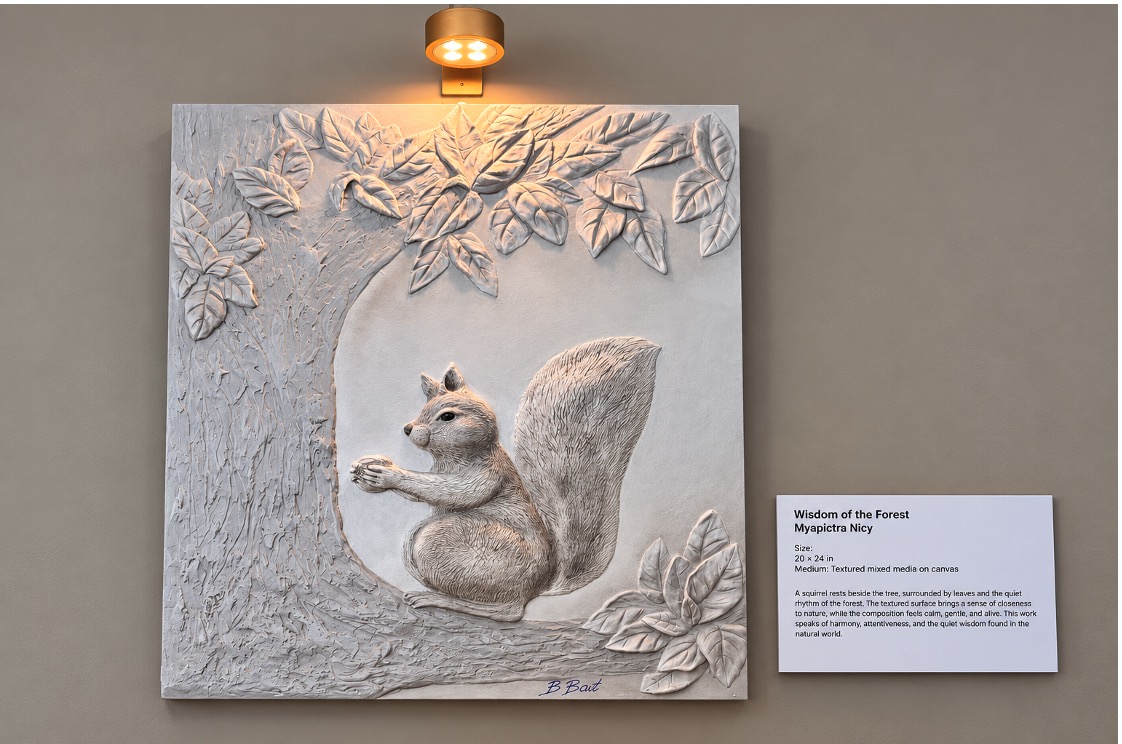
In “Wisdom of the Forest,” the layering was especially easy to read at close range. What first appeared from a distance as a restrained, almost continuous surface broke apart into shallow ridges, recessed channels and irregular edges that caught the light differently from one another. Some transitions were clean and deliberate; others retained a roughness that made the work feel worked rather than manufactured. The surface did not imitate bark or stone literally, but it carried the same sense of accumulated structure — something formed gradually, layer upon layer, rather than drawn all at once.
It would be easy to file all this under craft revival. It would also be wrong. Bovt is a researcher as well. He has published on the technology of modified gypsum mixtures in monumental and decorative art, on the migration of bas-relief from the classical façade into the contemporary interior, and on how viewers perceive volumetric wall panels under different lighting.
That last subject is the key to the exhibition. A relief lit flat from the front loses its depth; lit from a low angle, the same surface turns dramatic, every ridge throwing a long shadow. Bovt knows this as a matter of study, not instinct. In this show, lighting was not installation logistics. It was the medium.
The works were illuminated primarily with fixed directional spots angled across the surfaces rather than directly toward them. The effect was closest to raking light: raised areas caught narrow bands of brightness while grooves and cuts fell into shadow. Ambient gallery light kept the works visible as complete images, but it was the oblique illumination that activated their depth. As a viewer moved from one side of a piece to the other, the balance between highlight and shadow changed enough to alter the composition without changing anything physical in the object itself.
This was particularly effective in the quieter works, where the relief was shallow enough that frontal viewing could almost flatten the image. From a slight angle, however, the same surface became topographic. A ridge that had registered as a line became an edge; a muted plane became a recess. The eye kept revising what it thought the work was.
There is also, whether or not he intends it, a Ukrainian echo. For decades, monumental reliefs and mosaics covered the walls of public buildings across Ukraine, art made for crowds and façades. Bovt’s research traces the form’s move indoors, and his work completes the journey: relief scaled to a room, and to a single person standing in it.
“Summit of Strength” was the clearest case of what the show could do. Built around a rising mountainous form, the work reduced landscape to mass, edge and elevation. Its palette was restrained enough that color rarely competed with structure; much of what the eye read as tonal variation came instead from the shadows cast by the relief itself. From directly in front, the composition could appear compact and almost still. Move half a step to one side and the ridges separated, the central rise became more pronounced, and the work seemed to acquire a different sense of scale.
That small physical adjustment — no more than a shift of the body — changed whether the piece read as a mountain range, a geological cross-section or an almost abstract field of ascending planes. It was a demonstration, in one object, of everything the exhibition argued: that depth is not simply built into a work but completed through perception.
Hung in sequence, the nine works moved from stillness and hope toward strength, freedom and what the exhibition called inner awakening. The arc was there if you wanted it. To Bovt’s credit, he did not insist on it. Each piece held up alone.
If there was a weakness, it lay in the language around the work rather than in the work itself. Emotion, memory, inner strength — these are the most over-promised words in contemporary wall text, and the reliefs did not need them. What saves the work from sentimentality is restraint: the muted palette, the refusal to explain, the trust that a viewer will stay long enough for the shadow to do its job. The work was quieter than its captions, and better for it.
For two weeks in September, Bovt made a persuasive case that light is also a subject, and that one of the oldest image-making techniques still has something to say in a city of screens.
“Seeing the works together changed my own understanding of them,” Bovt said after the exhibition. “In the studio, each piece has its own life. In Los Angeles, I could see the conversation between them — where one work became quieter, where another opened the space, and where light connected things I had not planned to connect.”
The walls on La Brea are bare again. The argument stays.
###