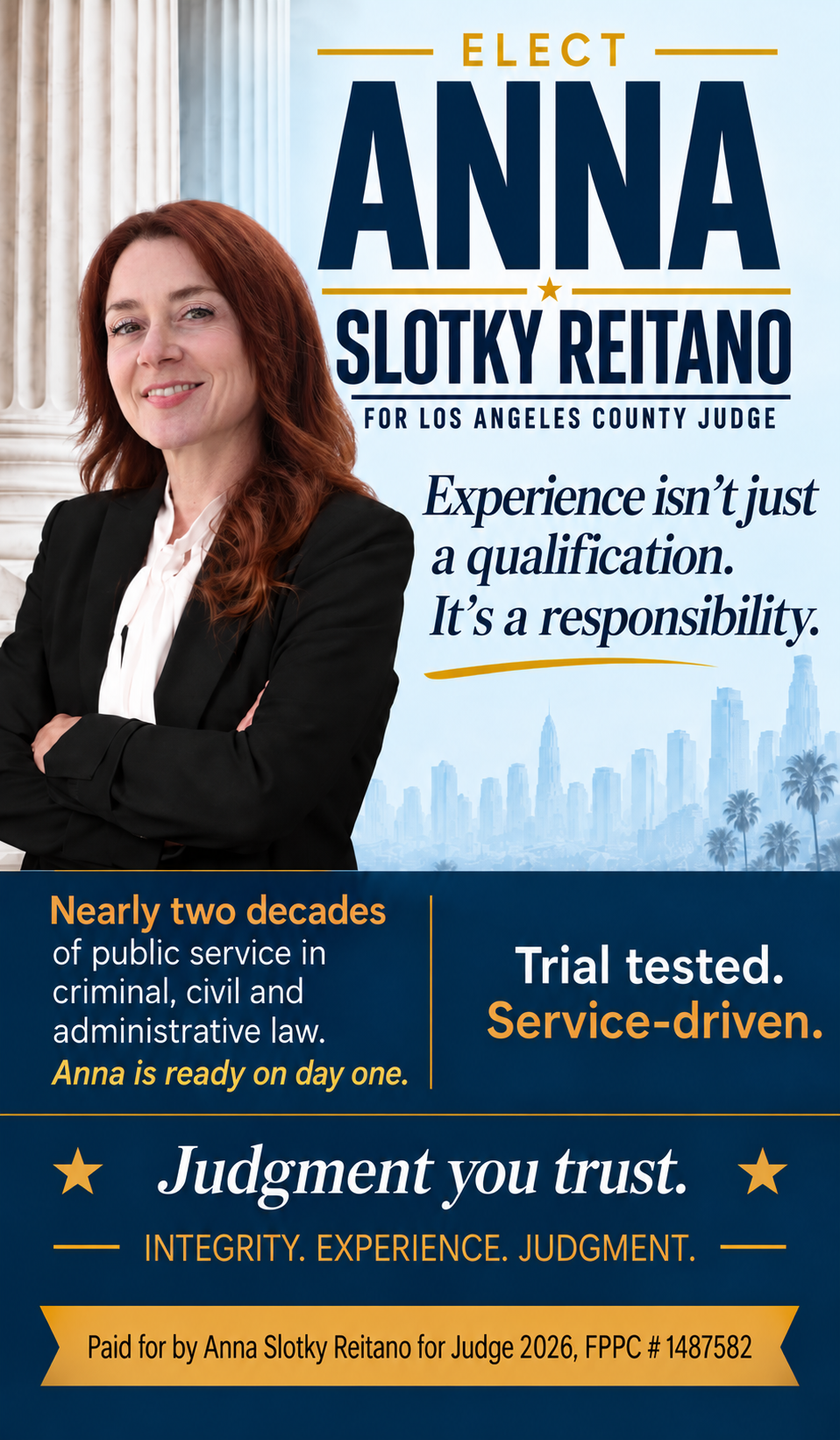
EXCLUSIVE INTERVIEW - I met judicial hopeful Anna Slotky Reitano last week at a forum hosted by the West LA Democrats with her runoff opponent, Justin Clayton. The challenger made a strong case for her candidacy as she secured their club's endorsement with an impressive 70% of the vote.
Reitano believes that experience isn't just a qualification, but a responsibility. She sees her career built on every aspect of the justice system.
A graduate of Occidental College who earned a law degree from the UC Davis School of Law, she was a child/teen actress who played Brooke in Home Alone and Home Alone 2, and had recurring roles in The Torkelsons and Sister, Sister.
A strong finisher in the June 2nd Primary, Reitano, secured the endorsements of the two candidates eliminated in Samuel Krause and Chelli Jimenez, which accounted for 33% of the overall vote. Reitano received 500,183 votes or 30% in that four-way contest.
With these critical endorsements secured, Reitano's candidacy is consolidating new support and finds herself in the right place at the right time as we head into the final weeks of the campaign. In addition, she has the support of California Treasurer Fina Ma and United States Representative Laura Friedman (D-30).
Reitano currently serves as a Deputy County Counsel in the Justice and Safety Division, supervising civil litigation and advising County departments focused on public safety, youth violence prevention, and alternatives to incarceration.
Outside the courtroom, she remains deeply committed to her community and volunteers with local schools and serves organizations helping neighbors experiencing homelessness. She is also raising three children, giving her a daily reminder that the decisions made in our courts affect real families and real lives.
Below is our extensive Q&A with the candidate:
Why do you want to be a judge, and what do you believe you would bring to the bench that distinguishes you from the other candidates in this race?
I want to be a judge because, after nearly two decades in public service, I have seen our justice system from almost every side, and I believe that breadth of experience is exactly what we need on the bench.
I spent more than a decade as a Deputy Public Defender, where I was a trial attorney fighting for the constitutional rights of people who could not afford an attorney. Earlier in my career, I clerked at the District Attorney’s Office and later represented public safety employees in labor and administrative matters. Today, as a Deputy County Counsel, I supervise civil litigation and advise Los Angeles County departments focused on justice, safety.
My competitor and I have roughly the same time behind us as Public Defenders, but unlike him, that is not all I bring to the table. The range of experience I have within the county is what truly distinguishes me in this race. I have represented individuals and county government departments, defendants and victims, and clients with very different interests. I have practiced criminal, juvenile, civil, administrative, and labor law. I have handled high-stakes trials where a person’s liberty was on the line, and I now supervise complex civil and government matters.
Working from so many different perspectives has also required me to demonstrate that I can put aside my personal views and professionally represent the client and interests before me. That is fundamental to the job of a judge.
I first ran for judge in 2022 because I believed we needed to broaden the traditional path to the bench and encourage experienced attorneys from different legal backgrounds to run. I am proud that the conversation has changed. Now I am ready to finish what I started.
People who come into a courtroom deserve a judge who is prepared, experienced, patient, and fair. They deserve to be heard and treated with dignity, regardless of who they are or which side of a case they are on. I believe my career has prepared me exceptionally well to be that judge.
Judges have enormous discretion in how they interpret and apply the law. What is your judicial philosophy, and how would you describe the proper balance between following precedent and exercising independent judgment?
My judicial philosophy is straightforward: follow the law, respect precedent, carefully evaluate the facts, and approach every case with an open mind. A judge’s role is not to reach the result the judge personally prefers, but to apply the law fairly and impartially to the case before them.
Precedent is fundamental to a fair and predictable legal system. Trial judges are bound by controlling authority, and I would follow it even when I might personally have reached a different conclusion. At the same time, judging is not mechanical. The law often requires judges to evaluate credibility, weigh competing arguments, interpret how precedent applies to different facts, and exercise discretion within boundaries established by the Legislature and appellate courts.
That is where experience and independent judgment matter. My career has required me to advocate from very different perspectives- advocating for the government, the indigent, children, and even law enforcement. I have zealously represented all of them and have learned to separate my personal views from my professional responsibilities and to analyze an issue based upon the facts and law, not emotion.
Ultimately, judicial independence does not mean freedom to disregard precedent. It means having the judgment and integrity to make difficult decisions without regard to politics, popularity, or personal preference, while remaining faithful to the law and ensuring that every person before the court is heard and treated fairly.
How would you ensure that every person appearing before you—regardless of their race, income, political affiliation, profession, or social status—receives the same treatment and consideration in your courtroom?
Equal treatment begins with recognizing that everyone who enters a courtroom deserves the same fundamental things: to be heard, to be treated with dignity and respect, and to have the law applied fairly to the facts of their case.
My career has prepared me particularly well for that responsibility because I have represented people from virtually every side of our justice system. As a Deputy Public Defender, I represented people who were indigent, unhoused, struggling with mental illness, or otherwise among the most vulnerable members of our community. I have also represented public safety employees, clerked at the District Attorney’s Office, supervised civil litigation defending the County, and advised County departments. I have represented defendants and worked on matters involving victims. Those experiences taught me not to make assumptions about people based on a label, profession, background, or the side of the courtroom on which they happen to stand.
Fairness also requires self-awareness. Judges, like everyone else, must be conscious of implicit bias and willing to continually examine whether it is affecting their decision-making.
Finally, equal justice includes how a courtroom is run. I would be prepared, punctual, patient, and respectful of everyone’s time. For someone paid by the hour, arranging childcare, or missing work to appear in court, unnecessary delays can impose a very real burden. I am very aware of how judges who are late affect everyone in front of the court- witness, litigants, colleagues, defendants, families and the one promise I will make is to be early and start on time out of respect for others. A person’s income or status should never determine how seriously their case is taken, and I have demonstrated through my practice that I believe that.
What do you believe is the biggest problem facing the Los Angeles County court system today, and what, within the authority of a trial judge, can realistically be done to address it?
One of the biggest challenges facing our court system is trust. Courts depend on public confidence that decisions are being made fairly, impartially, and based on the law rather than politics, personal preferences, or who the parties are. When people lose that confidence, it undermines the justice system as a whole.
A trial judge cannot solve every systemic problem facing Los Angeles County, but judges have tremendous control over what happens in their own courtrooms. I would work to strengthen trust through the way I do the job every day: being prepared, punctual, transparent in my reasoning, consistent in applying the law, and respectful to everyone who appears before me.
My years as a trial attorney taught me how much courtroom culture matters. People notice whether a judge has read the motions, listens to the arguments, explains rulings, treats attorneys and litigants respectfully, and values their time. For many people, one court appearance may be their only direct interaction with the judicial system.
I also believe my breadth of experience would help me build that trust. I have represented people and institutions on many different sides of the legal system, and I understand that no group has a monopoly on being right or wrong.
A judge earns public confidence one case at a time. My goal would be for people to leave my courtroom- even when they disagree with my ruling- believing they were heard, the process was fair, and the decision was based on the facts and the law.
Judicial independence is especially important when elected judges have political supporters and campaign contributors. How would you respond if someone who supported your campaign later appeared before you as a litigant or attorney?
Campaign support would never entitle anyone to special treatment in my courtroom. A judge’s obligation is to the law and to the fair administration of justice, not to supporters, contributors, political organizations, or anyone else who helped them get elected.
Judicial campaigns necessarily involve endorsements and contributions, particularly in a countywide race as large as Los Angeles County. But once elected, the campaign ends and the responsibility of judging begins. If a supporter or contributor appeared before me, I would follow California’s judicial ethics rules governing disclosure and disqualification and evaluate whether the circumstances required me to disclose the relationship or recuse myself. Part of being a good leader is to know when it is time to step down. As a judge, I plan to always follow the judicial ethics rules and avoid any appearance of impropriety by stepping back if the situation demands it.
Judicial independence means being willing to make the legally correct decision even when it disappoints a friend, supporter, political ally, or contributor. No endorsement or campaign contribution would buy access, influence, or a particular result in my courtroom- and to be honest, like most judicial campaigns, I am down-ballot and not receiving the money that more visible candidates would. I am getting donations of $100 on a good day. Regardless, the same facts, the same law, and the same standards would apply to everyone.
What is one aspect of your professional record or experience that you believe voters should examine most closely when deciding whether you are ready to serve as a judge?
I would ask voters to look most closely at the breadth of my experience and my nearly two decades of public service.
Judges encounter an extraordinary variety of cases. No attorney arrives on the bench having practiced every area of law, so a good judge must not only bring substantial experience but also have demonstrated an ability to learn new areas of law quickly, understand different perspectives, and make sound decisions in unfamiliar situations.
My career demonstrates that ability. Each transition within the County required me to master new laws, procedures, and subject areas. I have represented individuals and government entities, handled matters involving defendants and victims, and worked in criminal, civil, juvenile, administrative, and labor law.
That breadth matters to me because being a judge is not simply about knowing the law you practiced before taking the bench. It is about knowing how to analyze the law, listen to competing arguments, learn quickly and adapt to new assignments and unfamiliar areas of law, and fairly apply legal principles to the facts in front of you. My record shows that I have been doing exactly that throughout my career.
Tell us your most significant endorsements to date. What will be your emphasis as we come to the campaign's final weeks?
The endorsements I am most proud of are from Sam Krause and Chellei Jimenez, the two candidates who competed against me and Justin Clayton in the primary.
Those endorsements are particularly meaningful because Sam and Chellei had a unique opportunity to evaluate me. We spent months campaigning alongside one another, appearing at the same forums and endorsement meetings, answering the same questions, and watching each other interact with voters and organizations. After that experience, both independently decided that I was the candidate they wanted to support in the runoff. I think that says something important about my qualifications, temperament, and the campaign I have run.
I am also incredibly proud of the diversity of my coalition.
My supporters include judges and attorneys from different areas of law/backgrounds/beliefs, women’s organizations, labor, Democratic clubs, civic and community organizations, educators, violence-prevention advocates, and elected officials.
In the final weeks, my emphasis will be on reaching as many voters as possible with a simple message: experience matters. We want a judge for everyone, not just people with certain viewpoints. Judicial races often receive very little attention, so I want voters to understand what distinguishes my background and why breadth of experience matters in a judge. I will continue showing up throughout Los Angeles County, talking directly with voters, and building the broad coalition that has gotten us this far.
Any final thoughts for voters?
I want voters to know how hard I am working to earn their trust and their vote.
This is a countywide race, and I have made a deliberate effort to get outside my comfort zone and show up in communities throughout Los Angeles County. I have driven from Santa Clarita, Glendale, Lancaster, Palisades, Monrovia, Beverly Hills, Pomona, Carson, the City of Bell, Norwalk, Pasadena, Sylmar, Palos Verdes, to many places in between.
I am doing that because I believe running for judge should involve more than putting your name on the ballot, posting pictures, and asking people to trust you. I want to meet voters where they are, listen to what they expect from their courts, and give them an opportunity to evaluate me for themselves.
Campaigning across a county this large takes time, energy, and commitment, but so does being a good judge. I hope the effort I am putting into this campaign demonstrates the work ethic, preparation, willingness to listen, and commitment to public service that I would bring to the bench every day.
(Nick Antonicello is a thirty-three-year resident of the Westside and is covering several of the city, county and legislative races on the ballot with an emphasis on the judicial contests. A regular contributor to City Watch LA, he can be reached via email at [email protected])