The Granny Flat War … From Someone Who’s Been In It
UP CLOSE AND PERSONAL--On August 31, 2016, the LA City Council could make a huge mistake that will have lasting impacts on our community. 

Once upon a time, the city of Los Angeles created regulations that protected the characteristics of single family home zones. 

In essence, some of these regulations prevented homeowners from building big second homes on a single family home property. Makes sense, right? Because that’s what “single family home zone” means. 

So, in LA, a wide variety of different neighborhoods are zoned R-01. And these R-01 neighborhoods are really a great place to live, partly because our city’s zoning regulations have helped to keep them that way. 

These regulations did allow homeowners in those zones to build another detached home on the property. But that structure had to be small, low profile, and it couldn’t have a separate address. According to LA’s regulations, homeowners were free to build “granny flats” for their relatives to live in. And remember, they are always free to add an addition to their home. That was never in question. 

This worked, for the most part, to protect the character of the neighborhood. It guarded against overdevelopment. 

But one day, in 2010, the Planning Department made a mistake, based on incorrect legal advice, instructing officials to ignore the City’s standards, and instead, to follow the state standards, which are much more lenient. For the next six years, the City issued about 75 permits each year for second units in these single family home neighborhoods. Almost all of the permits were for structures that exceeded the City’s adopted standards. 

Earlier this year, a judge determined that the Planning Department’s “ZA Memo 120” was not legal. Since then, permitting for these structures (even the small ones that would have met the city’s regulations) has been halted. 

But instead of amending the City’s regulations, City Council is now considering throwing out the regulations entirely and defaulting to the considerably more lenient state’s standards. In essence, this would mean returning to ZA Memo 120, which a Judge has already revoked. 

Why does LA have different zoning standards than the state of California? Because LA has specific needs. Just like every other major metropolitan city in this country, our city has adopted regulations to protect against overdevelopment and against negative impacts on the environment, infrastructure, and the character of neighborhoods. 

All of this may seem silly to Angelenos who live on larger parcels of land or in apartment buildings. They might say, what’s the point? If it is your land, you should be allowed to use it any way you want. Right? 

I can see why some may think that. But imagine if you lived in my neighborhood: 

Welcome to the quintessential San Fernando Valley single family neighborhood. Our houses are very close together. In my cute, quiet little neighborhood known as “Kester Ridge” in Van Nuys, our mostly small houses sit on mostly small lots. Our fences (which cannot exceed eight feet in our backyard) create the barriers which afford us some visual, if not acoustic, privacy. 

Our backyards aren’t huge, but they offer a great place to relax; most of them are big enough to accommodate a small pool or a nice little garden. Most of the lots are approximately 50 feet wide and average about 6,000 square feet. Almost every house in the neighborhood is only one story high. 

So imagine you've just bought your dream home, right here in this cute little neighborhood. It took every penny you had. But you've worked hard, you turned it into a beautiful home, and you’ve promised yourself that you are finally going to relax and lay out by the pool in your lovely backyard. 

A few months later, the property right behind you goes up for sale. And the guy who buys it is a developer. He tells you that he doesn’t have any intention of actually moving to your little neighborhood. His car, an Aston Martin, gives you an idea of where he calls home. 

He’s going use the property to generate rental income. His plan is to rent out the main property, and, thanks to ZA Memo 120, he's also going to rent out a second house which he plans to build in the backyard! It’s going to be two stories high with just as much square footage as the main house. 

The backyard isn’t very big, so he’s going to have to build as close to your back fence as the law allows. He tells you that he's got properties like this all over LA. 

This developer has started an LLC for the property, and between the two homes on a single lot, he will be generating $6,000 a month in rental income. He doesn’t care one bit about the fact that your ability to enjoy your yard (to say nothing of your property value) just went down as a result of his actions. 

He says: “This isn’t my first rodeo.” 

So, you take a moment. You try to process this: A large, two-story tall, very visible structure in the small backyard -- even though the very concept of a single family neighborhood means that this sort of thing isn't supposed to happen. 

But he gets the permit. And no one in the City even notifies you that this was happening. You live right next to the property, well within the 500-foot range. How is this possible? If there had been a particular time to voice your opinion on the matter, no one in the government told you when it was. 

You try to talk to your political representative in City Council. They keep calling it a “granny flat.” But it’s not a granny flat. It's huge. It’s a fully functioning second home, with its own house number, mailbox, and soon, a whole bunch of tenants. 

You do some research online. Even California’s Legislative Analyst has determined that this type of “urban infill” in single family home zones is not going to solve the affordable housing crisis. In fact, this type of new structure isn’t even going to make a dent in the affordable housing crisis, because there is no requirement to price it affordably. They’ll be renting at market rates. But the politicians keep throwing around the term “affordable housing” when they discuss this issue. Strange, isn't it? 

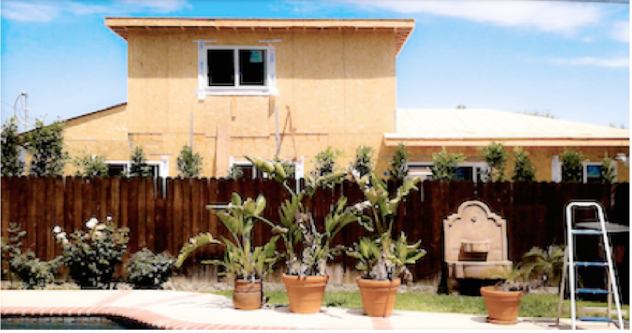
So this developer builds -- full steam ahead. The framing goes up. It’s big. And tall. And man, it’s close! You think, well, maybe we’ll get used to it. And then one day you come home to see the framing for the second story window: it looks right down onto your pool, your yard and into your bedroom! 

The building is so close to its own property line that the people living in it won’t be able to see their own yard from the window. But yours? Well, they’ll be thrilled that you've given them such a lovely view. Too bad that you can’t say the same about your new view. (See photo above.) 

This is how it happens. And because this unfair and previously illegal thing has happened to you, you decide to sell your dream home. And the winning bidder? Well, wouldn’t you know it -- a developer. If this process continues ad infinitum, say goodbye to the very notion of a single-family neighborhood. 

Wealthy developers will have a huge opportunity to make a lot of money for themselves if the SDU ordinance is repealed. They will be able to outbid the average homebuyer and will overdevelop every property they can get their hands on. 

I have read a few misinformed articles that frame this issue differently. The politicians who are in favor of the repeal of the SDU Ordinance are likely in the pockets of wealthy developers whose projects have been put on hold. These smart politicians are smart to hold actual, legitimate granny flats hostage: they know all too well that if you create a crisis that arouses public sympathy, you can exploit it. 

This is all about greed. It opens the door to rampant overdevelopment…not granny. 

Here’s what I’m hoping my City Councilmembers will do: 

Investigate the environmental impacts of any possible changes to zoning laws before they make those changes. For instance, more “urban infill” means more concrete, therefore less groundwater is absorbed, making both the drought and the flooding, due to the lack of storm drains in my neighborhood, even worse.

Discuss this issue with the public, and do it in a way that is intellectually honest. Don’t tie this repeal to the creation of affordable housing. And that includes you, Mr. Mayor! California’s Legislative Analyst's Office has determined that urban infill will not solve the affordable housing shortage in Los Angeles. In fact, the LAO has determined that this repeal won't even offer a small supply of "affordable" housing for another twenty-five years. Our politicians need to stop spinning this issue. It's unethical to confuse constituents into submission. We deserve better. 

Remember, this isn't about granny flats. While I strongly oppose the repeal, I support the public’s right to build granny flats that are appropriate for the size of one’s immediate community. We just need our politicians to create the right laws -- or common-sense amendments to existing regs -- to make that happen. 

Our politicians have a number of potential solutions that don’t involve repealing the Second Dwelling Unit Ordinance, leaving us vulnerable to overdevelopment. They should do their due diligence and behave with integrity. If revisions to the Second Dwelling Unit ordinance are necessary, at the very least they must be considered with adequate public outreach. It is not in LA's best interest to discard our protective local standards.  

I repeat: the politicians have several options at their disposal. Those options should not include throwing the baby out with the bathwater.

Please contact your LA City Councilmember before Wednesday, August 31 about this important issue. We need a lot more support because the developers have been lobbying the City Council hard for the past six months.


(Dannielle Langlois is film and television actress who lives in Van Nuys, next door to the above “second unit dwelling.”) Edited for CityWatch by Linda Abrams.

Should Pets of LA’s Homeless Have Their Own Attorneys?

ANIMAL WATCH-Los Angeles Animal Services has issued a media release announcing, "Non-profit Law Firm Partners with Local Dog Rescue and LA Animal Services." It explained that the Inner City Law Center (ICLC), Downtown Dog Rescue (DDR) and Los Angeles Animal Services (LAAS) are launching an "easily accessible" Pet Resource Center on Skid Row. (No physical address was provided.) 

Here are some of the highlights of the program, which has very noble -- albeit idealistic -- goals: 

"Pets and homelessness are linked in many ways," we are told. “People living on the streets often rely on their pets for emotional support and companionship. Low-income families struggling to pay rent often also struggle to care for their beloved family pets." Thus, resources and services will be provided "to enable more people and their pets to stay housed. Fewer pets will enter the Los Angeles shelter system and fewer unwanted litters will be produced. 

“ICLC, DDR and LAAS want to make it known that no matter what a person's housing or financial situation there are ways [to] keep pets with their people.” 

This statement is a little unsettling because, although it does not directly say so, it implies this is always advisable. 

It is unclear what legal services Inner City Law Center will be providing to homeless pet owners -- but it is hoped there will be an emphasis on legal responsibilities of pet ownership, including public health and safety and humane care. The only description is that, “ICLC will provide space at its office on Skid Row.” (The Inner City Law Center website lists only one office at 1307 East Seventh Street.) 

The Pet Resource Center will be open one day per week and will be run by volunteers for Downtown Dog Rescue, a highly respected organization headed by Lori Weise, who has dedicated over 20 years to providing assistance -- with an emphasis on spay/neuter -- to the pets on Skid Row, in all downtown LA areas, and also in Compton. 

Here is the list of services offered by the Pet Resource Center: 

  • Free spay/neuter vouchers
  • Assistance with animal registration
  • Vaccinations
  • Microchips
  • ID tags
  • Collars
  • Leashes
  • Crates
  • Access to emergency boarding and short-term foster care.
  • Medical care at approved partner veterinarian clinics.
  • Assistance with transportation to animal hospitals.
  • Short-term motel stays for persons who do not have a permanent residence when their pet is      undergoing a non-outpatient medical procedure.
  • Trained, volunteer counselors to provide the necessary services and offer support. 

This program will only reach a few of the thousands of homeless persons in LA with pets, but it promises tremendous benefits. 

It also poses important questions to residents and taxpayers of Los Angeles. 

Do you think homeless people should have dogs/pets? 

This question was posted recently on the Weddingbee.com site by a woman in NYC, who explained: 

“I don’t think homeless people should have dogs. I live in NYC, and there are a lot of homeless people, and a number of them have dogs. While most of their dogs are very well behaved, my dog and I got attacked by an unleashed pit bull owned by a homeless person. I sustained a bite. The homeless person didn’t have any vaccination records for the dog. Of course the dog didn’t have any rabies shot tag. He didn’t have a cell phone that we could reach him on. I asked the police to help us, but they said they couldn’t do anything. We called center for disease control and reported the incidence. I couldn’t give them any information about the dog, except for its name and the owner’s name, no known address. I had no health insurance at the time (working a contract job and not married), so I couldn’t afford the $10,000 rabies shot. The CDC told me that the dog had to be observed 10 days after the bite to make sure it didn’t know any symptoms of rabies, and if it didn’t, I would be fine. . . .What happened is probably an anomaly, but that’s the main reason why I don’t like seeing homeless people with dogs. What do you bees think about this?” 

Most responders felt that the value to the homeless person of having a pet far outweighed any occasional transgression that affected a human or another animal. 

However, most also had the opinion that the homeless owner is “saved” by the pet, that the pet has a great life of attention, is often “fed before its owner eats,” and/or that having a pet causes a homeless person to be more responsible because of he or she has someone to love. 

Is a dog/pet’s life with a homeless person humane? 

In his photo series, Skid Row Stories,” a vignette by John Huang describes a homeless woman whose life included tragic physical and emotional abuse since childhood. He wrote,“‘I thank God for everything,’” she told me as she shared her dog food with other Skid Row residents who couldn’t afford to feed their pets today. She leaned forward from her wheelchair and bent down to kiss her dog. 'I love animals,' she said. 'They're always there for you.'" 

He later added: Update: I visited Cheryl to give her some supplies. Sadly I found out her dog was stolen. Part of the reality of being homeless.” 

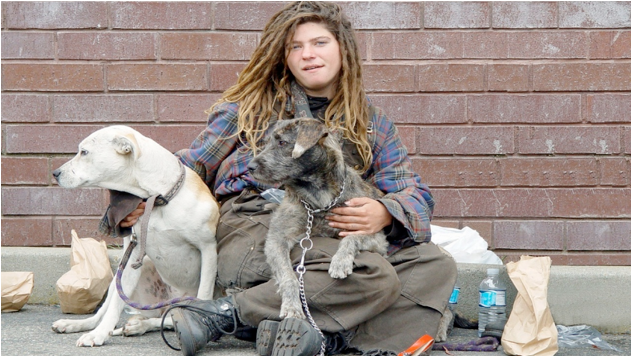
Cheryl’s dog (a mid-size terrier) may have been stolen. Or, it may it have been left unleashed and unattended and wandered or run away. The presumption that it was stolen relieves her of any responsibility or guilt for the loss. Homeless people often have a series of dogs. 

One of the issues that MUST be addressed in any program involving the City issuing microchips and “registrations” for the homeless is that the dog is often someone’s lost pet which was found and not reported or taken to the shelter, as required by law, to be redeemed by a grieving owner. 

Will any pet discovered to have a prior microchip or license be impounded for the legal notification period (to allow transfer of title) before LAAS issues a new “registration” to the homeless person? 

Does anyone want to think of their lost pet tied in -- or to -- a shopping cart being pushed down a trash-filled street by someone who may be unable to care for him/herself? 

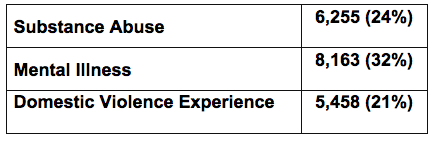
Los Angeles Almanac reports that in 2015 the homeless demographic in the City of Los Angeles showed the following characteristics:


(Source: Los Angeles Homeless Services Authority]


Will the Inner City Law Center's attorneys assure that animals whose legal ownership is being given to a homeless person through their program receives the same standard of treatment required of other pet owners?

If the homeless pet owner neglects the animal, abuses it or beats it during a fit of rage, will ICLC take action to have the helpless creature removed and the owner prosecuted or banned from having another animal? Or, will their duty be to the person who was 'temporarily out of control' and should be allowed to keep his/her pet? 

An LA Times article, “Hounding a Homeless Man into Giving up his Dogs,” portrayed the 2014 struggle by compassionate and concerned animal rescuers to have a Pit Bull and her ten puppies removed from a homeless man, Gerrick Williams, who was keeping them in a cardboard box on the sidewalk.

Even though City officials were inundated with emails alleging that Miller was operating a puppy mill for profit, General Manager Brenda Barnette said LAAS could not seize the dog and her 10 puppies because they were not “illegal.” 

A few days after agreeing to allow the shelter to temporarily hold the dogs for him, Miller was arrested on a drug possession charge and sentenced to a year in a rehabilitation program. He told the Times reporter by phone, "This is a lot better than the streets." 

A shelter employee described the mother Pit Bull as “shy and her belly and teats sagging from having litters.” 

"If people are struggling, homeless and have addictions, another responsibility is not appropriate," Whitney Hope Smith, a rescuer who videotaped Miller's camp, told the Times. "It's very easy to give a sob story for homeless, but the endgame for the animals isn't pretty." 

What Do You Think? 

There is no question it is good to have spay/neuter, vaccinations, micro-chipping and licensing easily available for pets of the homeless. But how will these voiceless animals be protected, if necessary, from the actions or inactions of those who are mentally unstable, irresponsible or cruel after they are granted legal possession by the City and their whereabouts is unknown? 

Another serious concern is who would be held liable if dogs the City assists in placing and "registering" with the homeless attack, injure or kill other animals or a human?

Important basic questions that have not been debated by the public are whether the homeless should be held to the same or lesser standards of care and responsibility for pets, and who will speak for these animals’ legal rights to safety and humane treatment?


(Animal activist Phyllis M. Daugherty writes for CityWatch and is a contributing writer to opposingviews.com.  She lives in Los Angeles.) Edited for CityWatch by Linda Abrams.
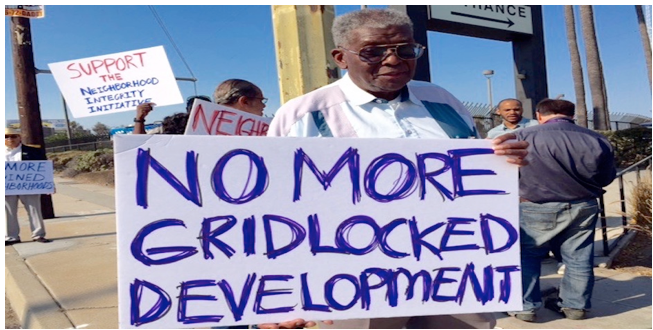
Neighborhood Integrity Initiative Heads to March 2017 Ballot, Delivers 104,000 Signatures to City Hall

VOX POP--The Coalition to Preserve LA announced Wednesday that the Neighborhood Integrity Initiative is heading for the March 2017 ballot, marking an unprecedented push by residents to take control from for-profit developers who are wielding far too much power over what Los Angeles becomes.

Backers of the citizen initiative today delivered just shy of 104,000 signatures to Los Angeles City Hall, nearly double the number required, and predicted that their measure will easily qualify for the ballot.

At a press conference in South Los Angeles at the site of the illegally approved mega-development known as the Cumulus Skyscraper, residents of Baldwin Hills, West Adams and nearby areas condemned City Hall’s rigged development system.

Dove Pinkney, a member of the Crenshaw Subway Coalition and the longstanding New Frontier Democratic Club, said of Cumulus, “The community should not be overwhelmed by people who are just in it for the money.” Veteran Los Angeles Sentinel columnist Larry Aubry warned, “There’s a corporate takeover of Los Angeles,” underway by developers. Aubry said that City Hall’s rigged system is hurting residents not just in South L.A., but citywide.

Damien Goodmon, a key supporter of the Neighborhood Integrity Initiative and executive director of the Crenshaw Subway Coalition, said, “Development should be for us. Development should not displace us. Folk are getting pushed out because the City Council is busy building luxury housing.”

The March 2017 measure directly targets the City Council’s failure to plan for the city’s infrastructure, parks, and housing needs, and its severe bending of the rules to approve mega-developments that overwhelm local streets and destroy neighborhood character.

The Council’s failure to create and follow a modern “General Plan” common in well-run cities, and the City Council’s back-room dealmaking with wealthy luxury housing developers, have led to widespread destruction of affordable housing — while creating a massive luxury housing glut in Los Angeles.

According to the city Housing Department’s own data, L.A. has a staggering 15% to 20% vacancy rate in the thousands of luxury units built in the past 10 years. Yet overall rental vacancy rates are just 2.7%, and even people with good jobs can’t afford a place to live.

The City Council and city planners have allowed the demolition or conversion to condos of 22,000 affordable housing units since 2000, the city’s data show, much of it standing in the way of luxury housing developments. The real estate industry has showered the City Council and mayor with money — including $6 million in campaign contributions since 2000.

Each of the lost 22,000 affordable units would cost $300,000 to $450,000 to replace, leaving L.A. unable to catch up.

Opal Young, a member of the Baldwin Hills-Crenshaw Homeowners Coalition, said of the planned Cumulus skyscraper, which does not include any affordable housing, “The building that is proposed to be built totally overwhelms the community.” It would soar 320 feet in a neighborhood of single-story homes and two- to four-story businesses and apartments. The skyscraper would be surrounded by a fortress-like complex of 10-story luxury office towers.

Nearby resident Nadine Angele said that allowing developers to radically alter a community’s character is no way to create a livable city. Angele said the Los Angeles City Council and mayor hold “a trusted position. They should be ashamed for approving a 320-foot tower. It’s going to push local diversity out.”

Darren Starks, president of the Baldwin Neighborhood Homeowners Association, and Clint Simmons, a member of Expo Communities United, both touched on the massive gridlock the skyscraper will bring to already overwhelmed streets including La Cienega, Venice, Jefferson and Washington boulevards.

Yet, Starks said, “When this project was initiated, we residents were never contacted.” Simmons, an engineer, slammed the project as “a community wrecker” filled with luxury housing — some place the future rents at $4,000 per unit — not intended for people in the community.

Residents from other parts of Los Angeles spoke in solidarity with local residents, including Luis Saldivar, a member of the Hollywood United Neighborhood Council.

Saldivar said, “We’re displacing people in Los Angeles [ranging] from South Central to the San Fernando Valley. You need to plan before you build. You can’t build, build, build.”

The Neighborhood Integrity Initiative has attracted donations from more than 200 small givers citywide averaging about $25 each, as well as $20,000 from former Mayor Richard Riordan, who calls the current City Hall planning system “a train wreck.” The organized opposition to the Neighborhood Integrity Initiative, led by the Chamber of Commerce, has attracted a handful of donors — two of them billionaire developers.

About 30 of the measure’s supporters last week met with Mayor Eric Garcetti to provide him an opportunity to announce his own long-promised reforms of the broken system at City Hall.

Jill Stewart, campaign director for the Coalition to Preserve LA, said Wednesday, “We appreciated the meeting with the mayor, but since April, Mayor Garcetti has not announced any notable reforms that would alter the Wild West system that’s destroying neighborhood character, displacing thousands of people, and wiping out precious older affordable housing.”

The March ballot measure requires the City Council to immediately begin writing a “General Plan,” and to include the communities in creating 35 Community Plans that address and create a plan for the city’s aging infrastructure, overtaxed safety services, sewers, water supplies, parks and housing needs. It would ban developers from choosing the consultants who write the Environmental Impact Reports for their own proposed projects, an obvious conflict of interest. The measure would place a two-year timeout on City Council back-room deals that let a small cadre of developers get around the rules.

(Patrick Range McDonald writes for the Coalition to Preserve LA)

-cw


Join our citywide, grassroots movement by clicking here right now to donate any amount you wish, and follow and cheer our efforts on FacebookTwitter and Instagram. You can also send us an email at [email protected] for more information.


‘Mutual Bribery’ or Why We Have Unanimous Voting in City Council

CORRUPTION WATCH-Los Angeles has significantly more people leave each year than move here. We now know who is leaving the City – the Millennials starting families. Los Angeles has become a city to avoid as we are #60 on places where the professional and business service class want to live. That attitude holds true for all the middle class. Some older middle class citizens are stuck in LA since they bought their homes decades ago and their children are finished school. However, the Millennials who are deciding to start a family are moving away in droves. 

When tens of thousands more people leave the City than chose to come here, the supply of vacant housing increases. For several years, Los Angeles has seen its vacancy rate climb, except for one segment – rent controlled housing. Mayor Eric Garcetti has been tearing down poor people’s homes with a vengeance, swelling the ranks of the homeless. 

How does Garcetti get away with both the massive destruction of poor people’s homes and the construction of luxury units which show an ever increasing vacancy rate? Building more luxury units in Los Angeles is like stocking a kosher butcher shop with pigs’ feet. You know something isn’t right. 

Why would the kosher shop load up on pork products, when no one is buying them? And why is Los Angeles constructing more luxury condos and single family homes which are eight inches apart? Yes, I said eight inches! 

The answer to both questions is the same – the butcher shop no longer cares about being kosher and is catering to a different clientele; so too with the City of Los Angeles. Its housing policies have nothing to do with the housing desires or needs of Angelenos. 

Corruption Destroys 

While power tends to corrupt and absolute power corrupts absolute, “corruptionism” destroys. With the blessings of the courts and law enforcement, the Los Angeles City Council has become a bona fide criminal enterprise. I do not mean this metaphorically; I mean it literally. The Los Angeles City Council is a criminal enterprise. 

I do not suggest that it caters to criminals, nor do I merely imply that councilmembers are crooks. I mean that the City Council itself is The Criminal Enterprise. In the olden days of Al Capone and Elliot Ness, Chicago had corrupt judges and a plethora of city officials on the take. In Los Angeles, however, the City Council itself operates according to Mutual Bribery. 

The term Mutual Bribery is used because the State of California amended Penal Code § 86 in 2006 to forbid any councilmember to trade his or her vote in return for a vote by another councilmember. Penal Code § 86 is one of the California’s anti-bribery statutes. In the Los Angeles City Council, Mutual Bribery operates very efficiently. Each councilmember agrees to never vote No on a construction project in another council district. The reciprocal nature of their agreement is why it is called Mutual Bribery. 

The Los Angeles City Council unanimously approves each construction project in the City 99.9% of the time. The courts see nothing wrong with this practice. The likelihood that this unanimous voting occurs “by chance” is less than one in one thousand billion, billion, billion. I think the number is written 1/1,000 followed by 18 zeros. Yes, ten years of unanimous voting is merely a statistical coincidence! 

But what is wrong with the system? After all, it is very efficient. All a developer needs to do to have his project unanimously approved is to have a kindly councilmember place it on the City Council agenda. It will be unanimously approved. And here’s the great part of the Los Angeles City Council: even if not a single councilmember actually votes for the project, it gets unanimous approval. 

Gee whiz, what could go wrong with a system in which a developer is guaranteed his project, no matter how many laws it violates and will get unanimous approval -- even if not a single councilmember leans forward to press his Yes button? The City Council has rigged its vote tabulator so the machine automatically votes “Yes” – a quirky reflection of the corruption at City Council. So let’s look at the impact of corruptionism. 

Ramifications of City Council’s Mutual Bribery 

When a city retains a construction company to build something, it is supposed to use competitive bidding. When the developer is chosen in secret with zero public oversight, there is great potential for pay offs, bribes, shoddy construction, skimming, etc. The unanimous vote trading at City Council allows a single councilmember to meet in private with a developer to construct whatever he wants, and then the City is compelled to pay for a substantial portion of the project. 

For example, look at Grand Ave Project across from Eli Broad’s Museum in DTLA. The City Council unanimously voted to give the developer $198 million. Where was the competitive bidding to see if this developer was the best one for the job? There was none. There never is any. 

Look at 5929 Sunset where the City gave the developer over $17 million. Was there any competitive bid to see if this developer was the best one for the project? Nope. 

Unanimous voting in City Council is habitually used to circumvent the requirement that all City- sponsored projects are subject to competitive bidding. Instead, one councilmember and one developer make a secret deal, and then, after that, the City Council unanimously approves millions of dollars for that project. CIM Midtown in Council President Herb Wesson’s CD 10 reportedly got $42 million plus all the sale taxes earned by retailers at the project site. 

Across LA, we see the City as “co-sponsor” of project after project based upon secret deals between one councilmember and one developer. Never is there any competitive bidding. That’s because the developer is selected before the city money is donated. 

As a result, billions of tax dollars are funneled to developers who are destroying LA neighborhoods and looting the public treasury with zero oversight. The courts see nothing wrong with this system. 

But wait, it gets worse! 

The construction mania continues and City Hall is in a panic over the Neighborhood Integrity Initiative [NII]. Why is that? As everyone knows, the middle class is deserting Los Angeles. There is an increasing glut of these luxury condos and yet the City wants to construct more and more of them. Yes, that brings us back to: why would a kosher butcher shop stock pigs’ feet? 

There Are a Couple Scams 

(1) The City will borrow the money and give it to the developers, who then will bankrupt their LLCs and LLPs, leaving the City’s taxpayers to repay Wall Street. The tax dollars that flow to Wall Street will then not be available to pay for our infrastructure improvements. The decaying infrastructure will then cause more businesses and more of the middle class to flee the City. None of that matters as long as the developers can siphon off hundreds of millions of tax dollars. 

(2) The newest angle is money laundering. Since Putin has made moving money out of the Russia illegal, the desire of Russians to move money to other countries has naturally increased. (Putin does not understand that his own massive corruptionism is the major reason so many Russians are devising schemes to get their cash out of their country. 

In order to cut down on not only Russians but also Chinese who are looking to stash their money overseas, the United States has a new rule requiring the reporting of real estate investments by foreigners. More specifically, in Manhattan and Miami-Dade real estate transactions of more than $3 million in NY and more than $1 million in Miami have to be reported. The purpose is to stop money laundering not only by Russian oligarchs but also by drug traffickers, Blood Diamond traders, weapons dealers and a host of other international criminals. 

So far, Los Angeles is not on the list of locales where reporting is required. Thus, some thug who made his money by the child labor and mutilations in Central Africa can still secretly buy up Los Angeles condos and small lot subdivisions (the new single family homes separated by 8 inches.) LA developers do not care who buys their units.  

Looking ahead, one can anticipate the Feds placing the same reporting requirements on LLCs and LLPs in Los Angeles real estate market and this is why condos and small lot subdivisions are so important. If a Russian oligarch buys a 12-unit apartment house for $10 million, his identity cannot be kept secret. But if he buys 12 condos or 12 small lot subdivisions, each one will be less than the reporting requirement. Secrecy is very important, especially if you’re hiding your money from Vladimir Putin. 

Why the Los Angeles Power Structure Circles the Wagons to Protect the Mutual Bribery at City Council 

We see why the entire Los Angeles power structure does not want anything to interfere with the Mutual Bribery running City Council. It is an extremely efficient system to get in on the international money laundering craze. In a year or two, it will probably be some other criminal venture that will become all the rage. 

With Mutual Bribery, there is never any disclosure of who is paying whom and how much is being paid. Each councilmember is the petty dictator in his or her district. All we Angelenos know is that our infrastructure has decayed, our taxes are increasing and our quality of life is deteriorating.


(Richard Lee Abrams is a Los Angeles attorney. He can be reached at: [email protected]. Abrams views are his own and do not necessarily reflect the views of CityWatch.) Edited for CityWatch by Linda Abrams.
 

Tags: 

LA’s Political Voices Come Together in Continued Modernization of LAX

GETTING THERE FROM HERE--What happens when the citizenry of all political stripes organize and the politicians actually listen to and work with them?  Progress.  Even in the City of Los Angeles.

(Plane lands on north runway at LAX-photo above) 

Actually, especially in the City of LA, considering how there's a persistent pro-grassroots movement that consistently fights against political oppression (like the Coalition to Preserve LA). 

Republican Richard Riordan came up with the concept of Neighborhood Councils, and Democratic LA City Councilmember Bill Rosendahl championed both citizen outreach and empowerment, in ways that were both scorned and which are now increasingly in vogue in the City of the Angels. 

And because of this adherence to grassroots empowerment, and because of both of civic heroes like Riordan, Rosendahl, Friends4Expo Transit, and the Coalition to Preserve LA, the goal was and is for civilized discussion, debate, compromise...and, most of all, for reasonable and realistic SOLUTIONS. 

Enter Councilmember Mike Bonin and Mayor Eric Garcetti, who both learned from and continued the efforts of their respective predecessors Bill Rosendahl and Antonio Villaraigosa to modernize LAX. 

And they've just made major progress!  After years of ferocious attacks and belittling by the LA Times and even the majority of the LA City Council, LAX will be modernized for a much cheaper cost, and with a much less invasive footprint, then the plan which LA World Airports tried to ram down our throats … and yet that which a NASA study concluded was not necessary. 

And after years of grief and lawsuits that Westchester was pushed into, those who stood up for Westchester (and, by extension, the rest of the Westside and even the City) are now vindicated

I still have concerns about how Mayor Garcetti's approach to Planning is entirely unsustainable, both economically and environmentally, but I will give the Mayor his props here:   

Mayor Garcetti kept his word and avoided and unnecessary push of LAX into Westchester that would have both cut off the vital north-south arteries of Lincoln and Sepulveda Blvds and that would have also threatened the viability of rail line from LAX to the Westside and the San Fernando Valley. 

In other words, in addition to avoiding the coziness of Wendy Greuel with the DWP, Eric Garcetti's election guaranteed a defense against a costly and devastating LAX expansion into the Westside.  I well remember how Mr. Garcetti put his foot down during the last mayoral campaign, and he's earned as much cred in stopping LAX expansion as he's done in promoting better balance at Metro. 

And shame on you, to those in the Times and the City Council for ignoring the "Group-Think" at LA World Airports about the northern airport expansion, and for pushing around and demonizing the Alliance for a Regional Solution to Airport Congestion (ARSAC) as selfish NIMBY's. 

So LA World Airports (LAWA), which runs LAX, will NOT be sued, but WILL be able to modernize, and WILL save a lot of money and disruption in its short- and long-term operations. 

As with the Crenshaw/LAX Light Rail Line effort, where Westchester saved the county a lot of grief by allowing that line's maintenance yard to be built within its borders when other regions were truly playing the NIMBY card, Westchester will remain a devoted partner to LAX, and will seek to encourage light rail and local modernization when it makes environmental and economic sense. 

ARSAC had a lot of similarities with Friends4Expo Transit, in that grassroots/volunteer members of all political stripes came together and pushed for modernization that made sense...and saved money!  Civic leaders like Denny Schneider, Sheila Mickelson, Robert Acherman, and Marta Evry come from all over the political spectrum, and they all banded together and made a stand. 

It was truly David vs. Goliath...but I remember when Friends4Expo Transit was in the role of David, and yet persevered.  And to the memory of the late Nan Schneider...your hopes and efforts in defending Westchester against an overreaching political tidal wave were not and will not ever be forgotten or lost. 

When Democrats, Republicans, Progressives, and Tea Partiers all come together to make a stand, there must be a good cause behind that stand. 

Perhaps the biggest hero of all is someone who just doesn't get enough credit: City Councilmember Mike Bonin, whose transportation/planning efforts have focused on both credibility and compromise, on both idealism and pragmatism.  LAX modernization is something that Mr. Bonin has played a role in for decades ... decades! 

And I'm sure that Mr. Bonin's predecessor, Bill Rosendahl, is smiling from Heaven knowing that--as with runaway overdevelopment in Los Angeles, we don't always have to put up with that. 

Two other big Thank You's are in order: one goes to Argonaut writer Gary Walker.  Westsiders who read the Argonaut have known for many years that when the Times is off writing and opining about what the Times thinks will get its next Pulitzer Prize, they can always rely on Mr. Walker to factually and fairly write on issues that are most relevant to them. 

And then there's newly-appointed Director of LA World Airports Deborah Flint, and a host of amazing planners and LAWA officials who worked with the City of LA and Metro to change its obstructionist working paradigms to becoming a true partner, and a good neighbor, and of focusing on goals rather than fighting the wrong battles at LAX (which LAWA used to deem was its own personal property). 

Pinch me, somebody!  LAX modernization will actually occur without thrashing the Westside! 

Pinch me, somebody!  Metro Rail will be connecting to LAX! 

Pinch me, somebody!  The Expo Line IS a success, and LA is moving towards becoming an efficient and economically-viable city with respect to transportation alternatives. 

Now if we can only fix that overdevelopment/neighborhood transformation problem over at the L.A. City Planning Politburo, my cup would runneth over. 

But for all you heroes in Westchester, at LAWA, in the LADOT and Metro, and especially Mayor Eric Garcetti and Councilmember Mike Bonin...take a bow. 

Lord knows you've earned it!


(Ken Alpern is a Westside Village Zone Director and Board member of the Mar Vista Community Council (MVCC), previously co-chaired its Planning and Outreach Committees, and currently is Co-Chair of its MVCC Transportation/Infrastructure Committee. He is co-chair of the CD11Transportation Advisory Committee and chairs the nonprofit Transit Coalition, and can be reached at  [email protected]. He also co-chairs the grassroots Friends of the Green Line at www.fogl.us. The views expressed in this article are solely those of Mr. Alpern.)

-cw


Gladstone’s Last Oyster

THIS IS WHAT I KNOW--The iconic beachfront Gladstone’s may be serving its last oysters by October 2017. County officials aim to entice a new restaurateur or developer by expanding the maximum concession terms, which would give the new developer time to recoup investments. 

A vote by the County Board of Supervisors has doubled the long-term lease for the Pacific Palisades property to forty years from its current twenty-year term and would require a redevelopment plan for the facility in hope that a new establishment would be constructed from the ground up. 

Supervisor Sheila Kuehl wrote in a motion to the board, “Because the existing facility is seriously deteriorated and outdated, the Department desires the successful bidder to construct an entirely new facility.” 

Angelenos and tourists have been ordering chowder, crab cakes and the like at Gladstone’s since 1972. The eatery pays about $1.7 million in rent each year to occupy the state-owned property, which is operated by the county. The county discounted the rent to $875 K this year to accommodate the restaurant’s financial setbacks, according to the LA Daily News. 

How would the lease expansion bring in a bidding war? Kuehl’s motion would give new facility owners or developers forty years to recoup the cost of renovations or redevelopment instead of the existing twenty. The current owners of Gladstone’s would be eligible to rebid on the property. 

Carol Baker, spokesperson for the LA County Beach and Harbors said, “This isn’t some, ‘Let’s do this to Gladstone’s.’ This lease was coming to an end. We need to think about what’s the best way to move forward on this iconic property. It’s a harsh environment, right on the ocean. That property experiences a lot of wear and tear. An operator will need to address that – while you’re at it, what is your concept?” 

Former Mayor and current majority stakes holder of Gladstone’s Richard Riordan has some ideas, including a possible museum with a restaurant. He’s not officially tied with any redevelopment plans but favors the idea. “I think it’s a good idea if they can put the pieces together,” he said. 

The benefits of the proposed amendment include minimizing loss of revenue for the county when Gladstone’s closes, as well as making maintenance and security costs more affordable for a new operator. According to The Daily News, the restaurant has been running at a deficit of $100,000 per month. 

Currently, Gladstone’s website assures guests that there is no set closure date for the beachside restaurant. 

ATTENTION GUESTS:

Despite what you may have heard throughout the media, at this present time, there is no set closure date for Gladstone’s Malibu. We are happy to continue taking your reservations and event inquiries over the phone or via email/website submission. Thank you for your continued support and patronage to an iconic beach landmark!-Management.


(Beth Cone Kramer is a Los Angeles writer and a columnist for CityWatch.)

-cw

Getting It Wrong: An Open Letter to LA City Councilman Mitchell Englander (and His PLUM Committee Buddies)

BILLBOARD WATCH--Dear Councilman Englander … At the August 23 meeting of the City Council’s PLUM committee, you publicly accused me of putting out false information in the articles I write about billboard and signage issues. Specifically, in asking a city official for clarification of a point under discussion, you said, “Because I want to make sure that when Mr. Hathaway writes about this, since he gets it wrong most of the time, that he hears it clearly.”

I consider this an attack on my personal integrity, because I always strive to be factually accurate and avoid taking things out of context or otherwise trafficking in misinformation. For example, before writing about PLUM committee meetings I almost always listen to the meeting audio, to make sure that I heard things correctly and that I accurately quote committee members and other speakers. I have a definite point of view about the signage issues the PLUM committee deals with, but that doesn’t mean I believe in using less than ethical and honest means to promote that view.

But your accusation was more than just an attack on me, it was an attack on the very idea that LA residents are entitled to be fully informed on the issues that affect them, in this case issues of billboard and signage regulation. That’s because the large majority of those residents can’t come to PLUM committee meetings to hear the discussion firsthand. Unlike lobbyists, billboard company representatives, and others who are paid to attend these meetings, most community people can’t take time off work, arrange child care, and make the necessary adjustments needed to attend a weekday meeting at City Hall. So, without someone reporting on the details of those meetings, they are denied the knowledge they need and deserve to form opinions and make decisions about the issues at hand.

I’m not paid, either, but I’m fortunate enough to be at a stage of my life that I can devote a significant amount of time to a cause I consider very important to the mental and physical health of communities throughout LA And an important part of that effort is to inform those citizens who want to know what their elected representatives are doing about billboards and signage but don’t have time to attend the many meetings held on the topic or read the many lengthy reports issued at various points in the deliberative process.

Unfortunately, your public statement at the Aug. 24 PLUM committee meeting tells those citizens, in essence, that the information they read online at the BanBillboardBlight [[banbillboardblight.org ]] website or in CityWatch or hear in public service programs on local radio stations is “wrong most of the time.” Doubly unfortunate is the fact that you didn’t specify a single instance of what you considered wrong, so it’s just an accusation put out there, deliberately or otherwise, to create doubt in some people’s minds that what they’re reading and hearing is factually accurate.

I have been writing articles about PLUM committee actions and deliberations, as well as those of the City Planning Commission and other government agencies, for almost nine years. In that time, not a single billboard company lobbyist or billboard company executive or employee has approached me and said that something I wrote was false. Not a single member of the PLUM committee, present or past, has contacted me to make that complaint. Not a single City Councilmember, not a single city planner or member of the city attorney’s staff or any other city official involved with billboard and signage issues has told me that something I wrote was inaccurate.

You surely understand that people come to meetings and otherwise involve themselves in community affairs, not because they are paid to, but because they believe in a vision of a better community and a better city. Those people deserve the respect and even the encouragement of their elected representatives, regardless of where they happen to stand on a particular project or issue. Those people deserve access to as much information as possible, so that they can make the kind of informed decisions that are in important part of the bedrock of a democratic system.

I hope you will take that into consideration before making unsupported accusations against someone who has volunteered his time and energy to disseminate that information as widely as possible and help make the system work the way it was intended.

(Dennis Hathaway is the president of the Ban Billboard Blight Coalition and a CityWatch contributor. He can be reached at: [email protected].)

-cw

Get The News In Your Email Inbox Mondays & Thursdays