 BROWN ACT-Los Angeles County leaders are once again on the wrong side of government transparency in their opposition to a bill that would prevent them from banning criticism of elected and appointed officials during public comment time at meetings.
The Ralph M. Brown Act, California's open meetings law, protects the right of people to have meaningful input into their local governments' decision-making, in public, at the time and the place where their elected officials meet. That right necessarily includes the ability to critique the performance of politicians and bureaucrats.
Such criticism surely is no fun for the targeted officials to hear, especially in front of peers and other critics. But anyone in public service ought to be prepared to hear complaints and distinguish between those that are legitimate and those that are frivolous. Smart public officials learn from the former and ignore the latter. AB 194 by Assemblywoman Nora Campos (D-San Jose) should not be necessary, but it apparently is, and lawmakers should pass it and send it to the governor's desk.
The Los Angeles County Board of Supervisors originally stood up against Campos' bill because members opposed a clause that could have resulted in the nullification of some government actions — if they were the result of votes taken after hearings in which speakers' public comment rights were violated. The proposal that got the supervisors so worked up actually was intriguing, and may be worth another look if there is no better way to keep public bodies from continually violating speakers' rights.
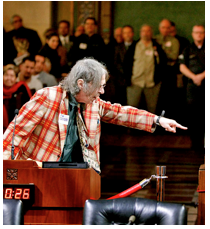
Speaking at a public meeting -- even to criticize a politician -- is not a disruption. It's a right.-
For good or bad, though, that provision was removed from the bill, and Los Angeles County should have dropped its opposition at that time. But it persists. As the county's chief executive officer explained to the board, the bill would "create undue disruptions at public meetings."
{module [862]}
{module [662]}
Such "disruptions" include basic elements of civic participation. Some city councils, school boards and boards of supervisors, for example, won't let a member of the public address them when a controversial topic comes up if the would-be speaker failed to file a request at the beginning of the meeting.
A member of the public should no more be prevented from speaking because of his or her failure to arrive early than should a public official. Speaking at a public meeting — even if it is to criticize a politician's performance — is not a disruption. It's a right.
(Find other Los Angeles Times Editorial Board perspectives here.)
-cw
CityWatch
Vol 12 Issue 70
Pub: Aug 29, 2014